
AI didn’t invent hiring fraud. It made it harder to see.
- Josephine Tan
- Topics: Features, Home Page - Features, HR Technology, Recruitment
AI has not created a new category of hiring fraud. What has been done is make an old one considerably more convincing – and considerably harder to catch at the stage where most organisations still look for it.
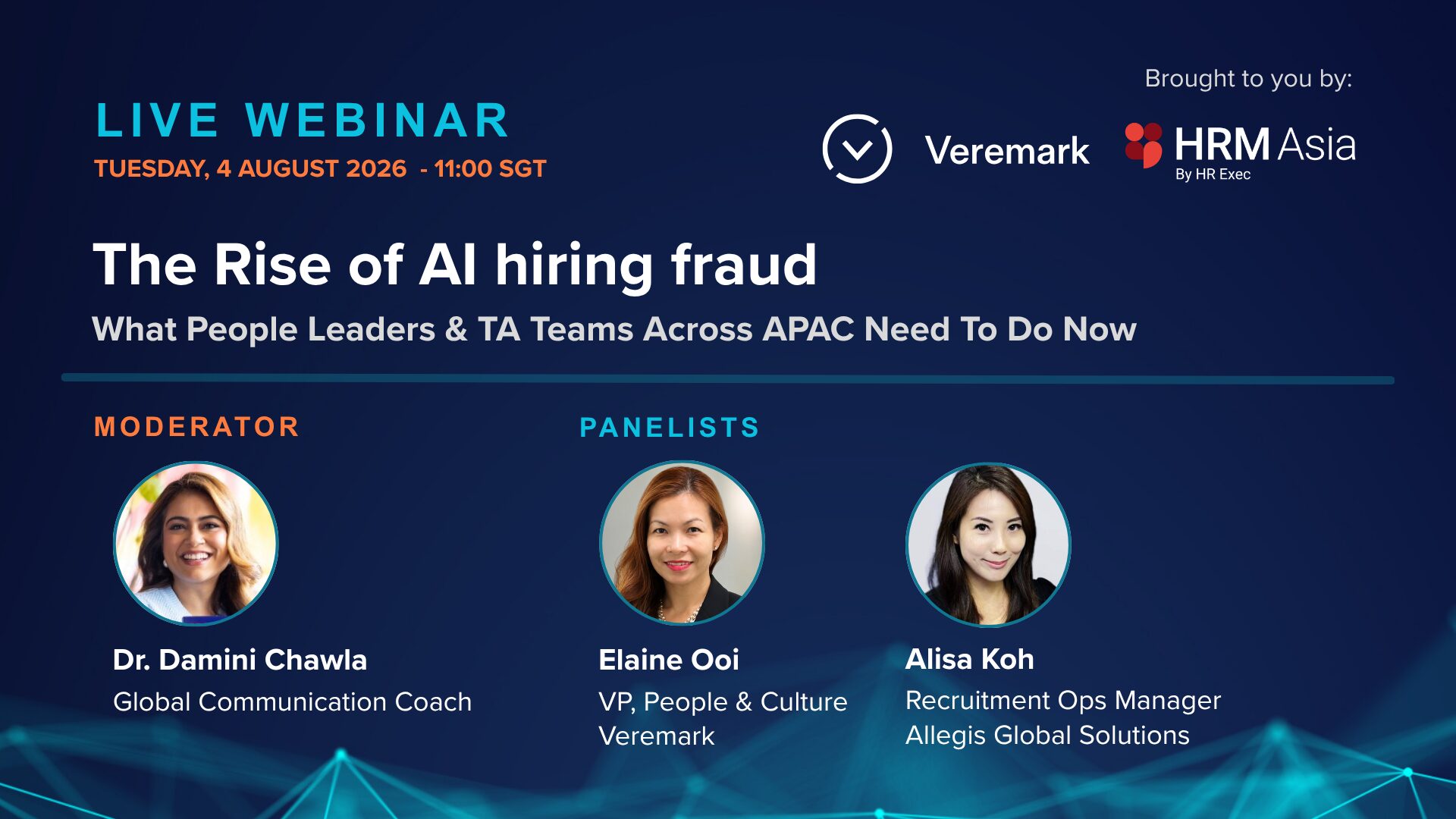
That was the framing running through The Rise of AI Hiring Fraud: What People Leaders and Talent Acquisition Teams Across Asia-Pacific Need to Do Now, a webinar hosted by HRM Asia in partnership with background screening provider Veremark. Moderated by Dr Damini Chawla, the session brought together Elanie Ooi, Vice-President of People and Culture at Veremark, and Alisa Koh, Recruitment Operations Manager at Allegis Global Solutions.
An opening poll suggested the audience was still early in its AI journey. Attendees from Singapore, Hong Kong, Malaysia, the Philippines, and Thailand overwhelmingly described their organisations as cautiously exploring AI in recruitment or not using it in any meaningful way – with few reporting established or experimental programmes.
An old problem, better disguised
Ooi opened with a case that made headlines last year, in which a cybersecurity firm unknowingly hired someone using a stolen identity and AI-enhanced imagery. The candidate cleared multiple video interviews because everything looked authentic; once onboarded, the individual attempted to install malware.
“AI did not create a new type of fraud,” Ooi said. “It made an old one much more convincing.”
Veremark’s screening benchmark data points in a similar direction. Drawing on a database of around half a million cases, Ooi said that CV gap analysis produced the highest discrepancy rate of any check, surfacing issues in 51.7% of cases where it was applied. She was careful to note that most of those discrepancies are not deliberate deception – some reflect genuine error or poor record-keeping. The key point is narrower: what appears on a CV does not always tell the full story.
For Koh, the line between preparation and misrepresentation is not new, but it has become harder to draw. Responsible use, in her view, is AI helping a candidate communicate real experience more clearly—structuring a CV, organising examples, and preparing for a conversation. It crosses over when the tool is used to inflate experience or imply ownership and accountability the candidate never had.
She pointed to CV matching as a live concern at Allegis Global Solutions. Candidates are using AI to rewrite resumes so they mirror the job description almost exactly, and because many screening processes still rely on keyword matching, a thin profile can read as strong. The question for recruiters, Koh argued, is shifting from whether the experience behind it is genuinely there.
The checks that find the least
One of the sharper findings concerned where organisations put their screening budgets. Ooi said database checks—fast, automated, and often mandated by policy—uncover discrepancies in less than 1% of cases. Employment verification flagged issues in more than 15%, and education verification in more than 21%.
Asked where a CHRO with a limited budget should invest first, Ooi nominated employment verification, on the basis that employment history underpins most hiring decisions. She also suggested that HR leaders ask their screening providers a single question: which of our checks actually uncover discrepancies? An answer grounded in data enables an informed decision; one grounded in tradition or compliance alone signals an opportunity to rethink the programme.
Koh added a timing dimension. Verification concentrated at the end of the process means identity or credential issues surface only after an offer has been accepted, by which point sourcing and interviewing costs are already sunk. Organisations handling this well, she said, apply a risk-based approach—deeper checks for fully remote or technical roles with access to sensitive systems—and move identity or credential verification forward, often between final interview and offer, or run employment and education checks in parallel.
Candidate experience need not suffer as a result. What frustrates candidates, Koh noted, is rarely verification itself but repeated requests for the same information and silence about what happens next.
Interviewing for evidence
Both panellists returned to the interview as the point where human judgement still does distinctive work. Koh described the moment that makes her pause: a candidate’s account sounds polished, but the evidence behind it is missing. Her follow-ups probe for the difficult decision, the stakeholder who pushed back, and what a project sponsor would identify as their contribution – questions that are harder to rehearse.
Equally, she cautioned against treating non-traditional profiles as warning signs. Career breaks, non-linear paths and AI-assisted preparation are not, in themselves, cause for concern.
Ooi also flagged a gap after day one. Veremark’s report found only around 15% of organisations conduct post-hire screening, leaving the remainder relying on information that may have aged since the initial check – as licences lapse, conflicts of interest emerge, and employees move into roles with greater data access.
Her closing challenge reframed the whole exercise: instead of asking whether hiring is compliant, ask whether it is confident. “Compliance sets the minimum standard,” she said. “Confidence is what helps you to make better hiring decisions.”
Watch the full webinar: https://www.youtube.com/watch?v=A14WuFm_KP4.