
Most leaders agree sustainability matters. Far fewer know what to do with it.
- Josephine Tan
- Topics: ESG, Features, Home Page - Features, Hong Kong, Leadership
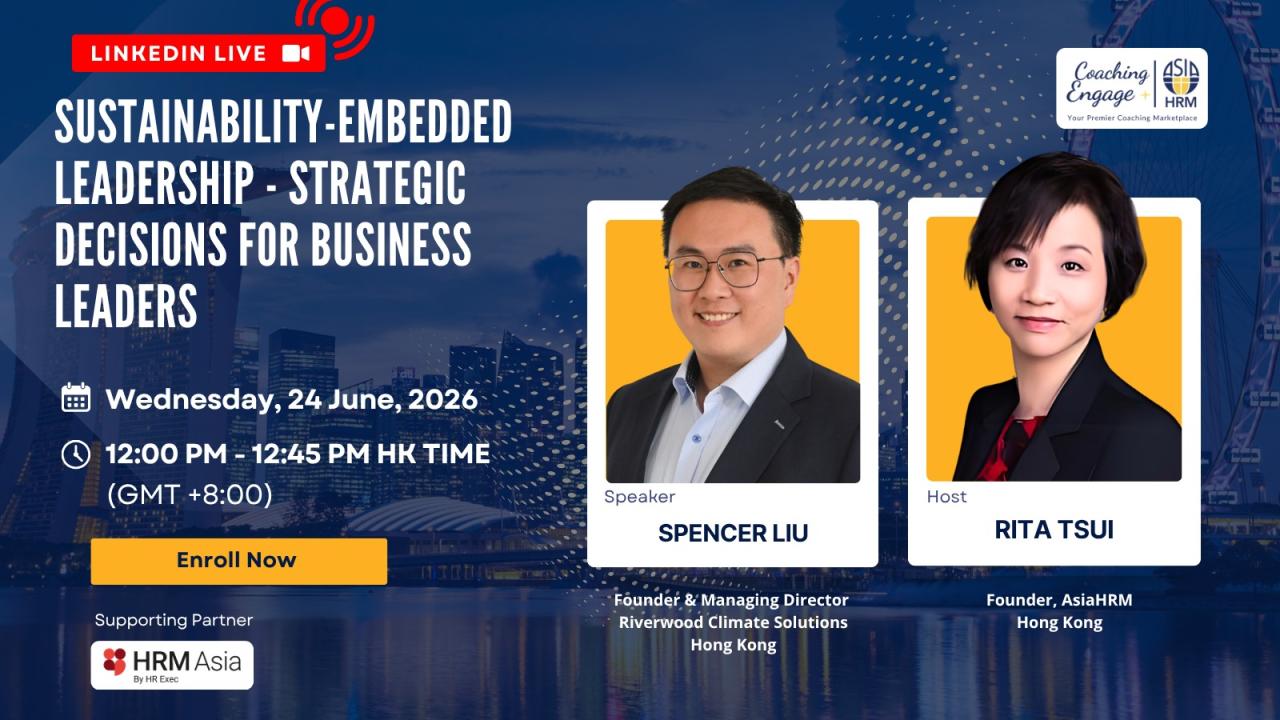
Sustainability has outgrown the ESG report. That was the framing Rita Tsui, Founder of AsiaHRM, set out at the top of a recent LinkedIn Live session in the organisation’s Sustainability for Business Series, supported by HRM Asia. Most leaders now accept that sustainability matters, she noted; far fewer know how to translate that conviction into the decisions they make every day.
Closing that gap was the task taken up by the session’s speaker, Spencer Liu, Founder and Managing Director of Riverwood Climate Solutions and Executive Director of The Climate Governance Initiative Hong Kong Chapter. A former associate partner at McKinsey, where he co-led sustainability and green business building in China, Liu structured his case around three questions: why sustainability has become a leadership issue, what embedded sustainability decisions look like across a business, and what people and HR functions can do to support them.
A decade or so ago, Liu said, sustainability sat within corporate social responsibility and was often treated as optional – a belief to be debated rather than a fact to be managed. That has changed. Countries and organisations have committed to climate targets, and organisations are increasingly looking past disclosure to the question of how sustainability reshapes their business model. He frames it as a strategic driver rather than a reporting obligation: a potential source of competitive advantage and an organisation-wide effort that spans every function.
His supply chain example was tech manufacturing, where large technology buyers now ask suppliers to produce at lower carbon intensity. The ability to source renewable energy or greener inputs, Liu argued, can become a structural way to compete on more than price. He pointed to a widening set of stakeholders shaping corporate behaviour – customers, investors, suppliers, regulators and employees – citing the gradual mandating of the International Sustainability Standards Board (ISSB)-aligned disclosures for listed organisations in Hong Kong, and evidence that younger employees weigh an employer’s environmental record more heavily, having more of their working lives ahead of them under a warming climate.
Liu also positioned the transition as an opportunity rather than only a cost. Drawing on McKinsey research, he said climate transition could open a revenue pool of more than US$10 trillion globally by 2030, spread across areas such as the built environment, energy systems, transportation, and food and agriculture – each, in his description, a potential trillion-dollar opportunity in its own right.
Asked by Tsui to name the single biggest shift leaders must make, Liu pointed to moving from risk avoidance to value creation – a change he said is harder than it sounds, because the compliance reflex is deeply embedded in how large organisations operate. When sustainability enters as a support function, the mental model is defensive: what must we do to avoid penalties, litigation or reputational damage. He contrasted this with a recent board training he delivered at a commercial bank in Hong Kong, where the questions centred instead on what opportunities the transition opened up. The practical test, he suggested, is where sustainability sits in planning – written on top of business strategy after the fact, or applied as a lens while that strategy is still being formed.
READ MORE: AI is a sustainability tool. It is also a sustainability cost.
In the session’s second part, Liu set out a decision framework spanning five areas: strategy, finance, people, operations and governance. He deliberately left out sustainability as a standalone department, on the view that the work belongs across the organisation even where a dedicated team exists. Strategy, in his account, is about identifying long-term risks and opportunities and selecting the right sectors to pursue. Finance covers capital allocation tied to that strategy, internal carbon pricing and multi-year transition budgeting. Operations span decarbonising operations and supply chains, circular product design and biodiversity. On the people side, he tied talent strategy to an employer proposition that resonates with candidates who increasingly treat ESG as a prerequisite, and linked leadership capability to change management, noting the consulting-sector estimate that around 70% of corporate transformations fail, most often at implementation, when people are not aligned by the right incentives.
That led to the question of which domain most often becomes the bottleneck. Liu’s answer was governance and incentivisation. Where sustainability costs and benefits are invisible or treated as externalities, he said, departments have little reason to take on extra responsibility, and leadership teams with genuine conviction can be outmanoeuvred by processes that were never redesigned to accommodate a sustainability lens. Governance, in his view, is the first thing to address – and the area that has been most under-addressed over the years.
Liu finally turned to the people and HR functions that made up much of the audience, casting them as central to embedding sustainability rather than peripheral to it. The levers he set out were board and leadership development – building sustainability into board induction, leadership frameworks, executive development, and competency models. It tied back to the bottleneck he had named: if sustainability most often stalls on governance and the incentives that sit beneath it, then how leaders are inducted, equipped and assessed becomes part of how that bottleneck is worked through. For the HR practitioners in the room, it placed their function not at the edge of the sustainability agenda but close to where the hardest decisions are made.