The traditional architecture of the global workforce is undergoing a profound and permanent restructuring. As AI moves from the periphery of corporate experimentation to the core operational execution, the long-standing divide between “technical jobs” and “people jobs” is rapidly dissolving. According to the 2025 Skills Economy Report from Cornerstone, this phenomenon, termed the “Great Skills Merge,” represents a future in which technical proficiency and human empathy are no longer distinct career paths but prerequisites for every modern role.
The data, derived from 28TB of live labour market intelligence across more than 200 countries, underscores a seismic shift in global demand. For the first time in over a decade, communication has been displaced as the most demanded skill globally. In its place, AI implementation skills have surged by 245% year-on-year. However, the report reveals a critical paradox: as automation scales, the value of the “human element” does not diminish; it intensifies. Emotional intelligence in advanced technical roles has seen a 95% increase in demand, while data literacy in customer-facing functions has grown by 22%.
This shift is not merely a trend but a survival mandate. The World Economic Forum’s Future of Jobs Report 2025 projects that by 2030, approximately 39% of existing workforce skills will become obsolete. Himanshu Palsule, CEO at Cornerstone, warns that while AI is rewriting the rules of work, the future will not wait for organisations that fail to meet the moment. The challenge for contemporary leadership is no longer whether to adopt AI, but how to ensure that its deployment remains human-centric and strategically aligned with long-term talent development.
A primary obstacle to this transition remains the fragile nature of corporate trust. Research from Sapient Insights Group indicates that more than a quarter of organisations cite data quality and governance as the primary barrier to AI adoption. To bridge this gap, the industry is moving toward standardised accountability. The achievement of the ISO/IEC 42001 certification—the international standard for AI management systems—marks a turning point for HR technology. This framework ensures that AI-driven decisions are transparent, ethical, and designed to scale responsibly, providing a foundation for leaders to move from reactive experimentation to proactive workforce planning.
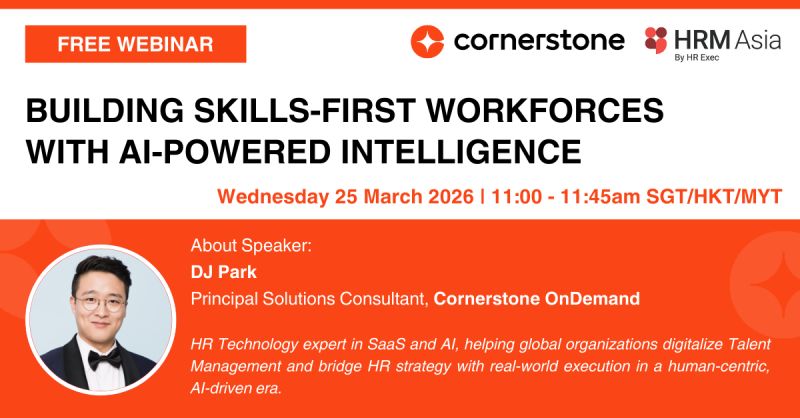
To address these complexities and provide a roadmap for regional transformation, Cornerstone will host an exclusive webinar on 25 March 2026. Titled Building Skills-First Workforces with AI-Powered Intelligence, the session will feature DJ Park, a Principal Solutions Consultant at Cornerstone with nearly a decade of experience digitalising talent management for global entities such as Samsung Electronics. The discussion will move beyond theoretical benefits to focus on practical execution, including the use of “People Graph” to build a unified, real-time view of internal capabilities.
The webinar is designed specifically for HR leaders who recognise that the era of static job titles has ended. By connecting external market demand with internal talent mobility, organisations can begin to build a “skills-first” workforce that is resilient to disruption. As the 2030 deadline for skill obsolescence approaches, the ability to gain high-fidelity workforce intelligence is the only viable path to maintaining a competitive edge in an automated yet human-led economy.
Registration for this webinar is now open to those ready to lead in this transition. To find out more, click here.