

Workday rolls our Sana AI platform globally to streamline HR and finance workflows
- Josephine Tan
- Topics: Home Page - News, HR Technology, News
Workday has announced the global availability of Sana, a “superintelligence” platform designed to move AI from a siloed experimental tool into the core of HR and finance operations. The launch marks a significant pivot for the enterprise giant as it seeks to solve a common C-suite frustration: AI tools that look impressive in demos but fail to deliver ROI because they lack access to the secure, real-time data found in core business systems.
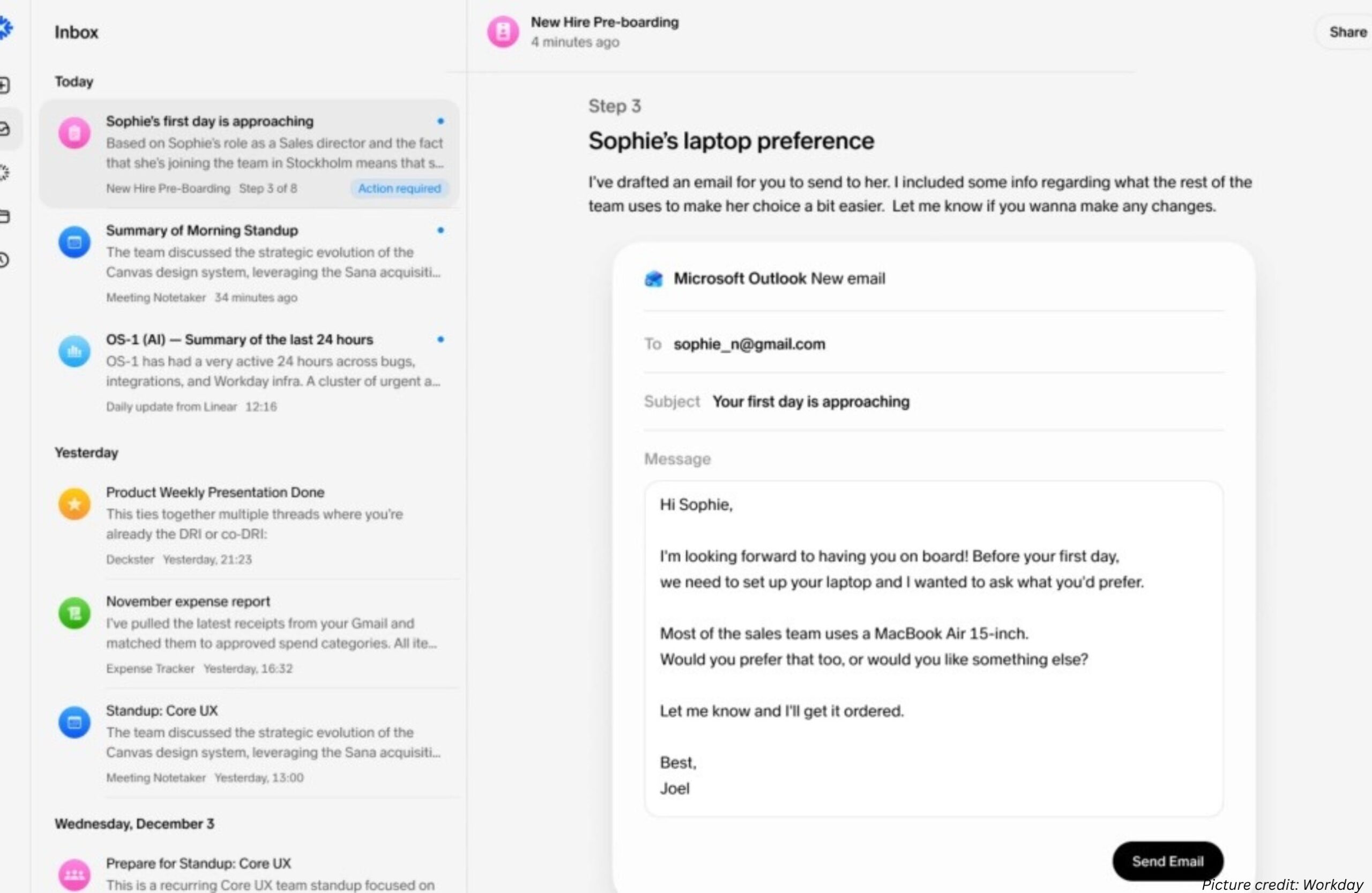
Unlike standard chatbots or co-pilots that primarily offer suggestions, Sana is built to take action through a three-tiered architecture. Sana for Workday serves as a new unified, AI-first interface that replaces traditional menu navigation with a conversational experience. Meanwhile, the Sana Self-Service Agent acts as an automated assistant equipped with over 300 skills—ranging from payroll and time-off requests to contract value updates—designed to reduce the burden of manual HR support tickets. Finally, Sana Enterprise serves as a high-level orchestrator, extending Sana’s reach beyond Workday into third-party applications such as Salesforce, Microsoft Outlook, and ServiceNow.
For CHROs, the primary barrier to AI adoption has long been data privacy and compliance. Workday’s strategy focuses on “grounding” Sana within the organisation’s existing security and audit frameworks. Because Sana operates within Workday’s native permissions, it inherits the same controls used for sensitive employee and financial data. This ensures that when an employee asks a question about their benefits or a manager requests a recruitment dashboard, the AI accesses only the information the user is legally permitted to see. According to Aneel Bhusri, Co-Founder and CEO of Workday, this hybrid architecture is essential because AI only works in the enterprise when it is connected to trusted, deterministic systems.
READ MORE: From AI speed to human impact: Why CHROs must redefine performance in 2026
Early testimonials suggest the platform is already impacting operational costs and employee habits. Joona Honka, Head of AI and Analytics at Berner, reported that Sana became their default interface within 40 days, reaching 90% adoption and allowing the organisation to retire 400 standalone ChatGPT licenses. Similarly, Anton Nytorp, CTO for Cheffelo, described Sana as the “AI backbone” where work now starts and agentic workflows run autonomously in the background.
In a move to lower the barrier to entry, Workday is making Sana for Workday and the Self-Service Agent available via Workday Flex Credits. This model allows existing customers to begin using the technology as part of their current subscription without requiring additional licensing or separate paywalls. Josh Bersin, Global Industry Analyst and CEO of The Josh Bersin Company, noted that the integration of Sana will likely transform Workday’s business and the entire customer and employee experience, positioning the organisation as a leader in the race to provide agentic AI solutions.