

For decades, organisations have pursued productivity by perfecting systems, deploying advanced tools, and accelerating timelines. When performance dips, attention quickly shifts to closer supervision and increased pressure on the workforce. Yet, even with mature performance frameworks and technological advancements, organisations still grapple with disengagement, burnout, and the growing phenomenon of quiet quitting.
The problem is not that organisations are doing too little, but that they are working on the wrong layer. The real productivity crisis is not operational. It is a lack of cognitive and emotional understanding.
Employee engagement is not an event
Employee engagement has often been misunderstood as an HR initiative limited to fun Fridays, team outings, Secret Santa events, and social gatherings. Unfortunately, this has diluted and weakened the strategic value of employee engagement.
In reality, employee engagement spans every phase of the employee lifecycle, from onboarding to exit, and every interaction between HR and management. Each interaction is an opportunity to strengthen engagement and belief in the organisation.
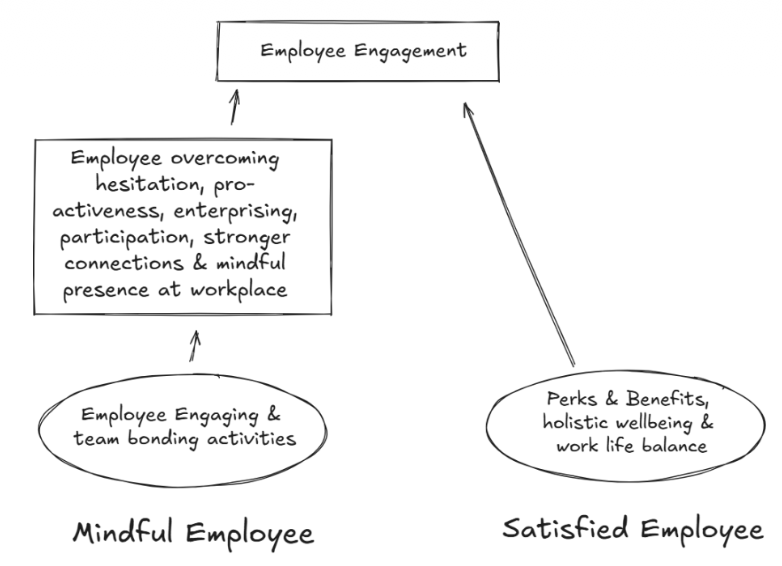
The main idea behind employee engagement is to unleash employees’ true potential and foster their mental investment and mindfulness in their work within the organisation, ultimately translating these efforts into organisational development. Making employees comfortable and happy is only a small part of the broader concept of employee engagement.
To further describe,
Employee Engagement (EE) = Satisfied Employee (SE) + Mindful Employee (ME)
While satisfaction keeps employees comfortable, mindfulness makes them invested. Engagement exists only when both coexist.
 Furthermore, Gallup’s State of the Global Workplace report estimates that if the world’s workforce were fully engaged, US$9.6 trillion in additional productivity could be added to the global economy, equivalent to 9% of global GDP. This number alone makes it clear that engagement is not an HR metric but an economic variable.
When employees are effectively engaged and involved in the organisation’s business, they not only develop their professional identities but also contribute to the organisation’s growth. A mindful employee applies judgment, not just instructions. They observe, analyse, and question. They feel a sense of responsibility beyond their job description. They find their own development in their organisation’s growth.
This mindfulness ownership is the invisible force behind building long-term fortunes of organisations.
It is time we acknowledge that while a resume may be the second most valuable input in hiring, the first most critical asset is the employee’s mind, which has the intellect to observe, analyse, and enterprise.
How employee engagement manifests at work
A sincere employee thrives on open, supportive dialogue with their manager, where they can share perspectives, highlight workflow gaps, discuss ideas or concerns, and even address personal impediments. Such interactions foster ownership, mindfulness, and deeper integration with the organisation, enabling focused and productive effort and making employees more mindful.
A component of employee engagement also involves group activities such as team dinners, outings and developmental events. The idea is that putting people on a team is one thing, and making them work together is another. People who eat, play, and have fun together stay connected and collaborate more naturally and cohesively, further breaking the monotony of work and bringing fresh air into the office atmosphere.
We believe that most people are good human beings with their own sides of stories, compulsions, and baggage that drive them to do or be who they are. They may seem indifferent and awkward from a distance, but when communication is established and people come closer, understanding between them increases.
The central role of the manager
The success of employee engagement initiatives depends on manager involvement and their willingness to foster an engaging workforce. A manager not knowing what employees are up to is an inefficiency on the manager’s part, not the employees’.
While policies set direction, managers create reality. Employee engagement lives or dies at the manager level. Gallup’s research shows that 70% of the variance in employee engagement is attributable to the manager. A well-designed policy cannot survive a biased or indifferent manager. Managers who act only as task distributors create disengagement. Managers who act as coaches create mindfulness. Google’s Project Oxygen found that the highest-performing managers coach, empower, and foster psychological safety.
The most dangerous employee is the one who stays but disconnects
Attrition is visible, but disengagement is silent.
Gallup reports that only 23% of employees globally are engaged, while 59% are “quiet quitters.” They are not lazy; they have simply stopped investing their minds in the organisation.
From a business perspective, this is more damaging than attrition because the organisation continues to pay salaries while losing thinking capacity, creativity, and ownership. An employee can attend meetings, meet deadlines, and still remain disengaged in spirit.
Employees cannot be mindful if they are fearful. The ability to speak up without fear of embarrassment or retaliation is not a soft concept. It is a performance requirement.
When employees feel unsafe, they stop sharing insights and questioning flawed decisions. This creates organisations that look stable on the surface but rot internally.
How to kill mindfulness at the workplace?
- Constant urgency, unrealistic timelines and 24×7 digital communication
- Unclear priorities and shifting expectations
- Weak communication with the managers
- Poor grievance management and unfair performance management
These are a few common modern workplace practices which actively destroy the very mental state required for high performance. With time, employees shift into survival mode. In addition, burnout is another practice that erodes remaining hope. The World Health Organisation recognises burnout as an occupational phenomenon, caused by chronic workplace stress that is not successfully managed. Burnout is not an individual weakness. It is a systemic failure.
Employees do not disengage because they lack motivation. They disengage because organisations fail to create conditions in which thinking, ownership, and effort are valued.
Employee engagement as risk management
Forward-looking organisations are beginning to recognise that disengagement is not merely a people issue; it is a business risk. Gallup reports that organisations with high employee engagement experience:
- 23% higher profitability
- 78% lower absenteeism
These gains occur not because employees are happier, but because they are mentally present and invested.
Australia’s 2024 Right to Disconnect law is another signal that people are coming to terms with understanding the significance of employees’ mental health, allowing employees to ignore work communications after official hours. This is not a cultural luxury, but a recognition that mental recovery is essential for productivity.
HR’s role
When employees disengage mentally, organisations compensate by adding layers of monitoring, reporting, and control, which ironically increase costs while further eroding trust. Therefore, HR cannot remain a passive custodian of policies.
HR must look beyond the data to identify recurring themes, observe patterns, start communicating at different levels, and identify issues before it is too late. The HR’s effectiveness lies in identifying disengagement while employees are still inside the system.
HR must have the mandate to surface and address issues without fear or favour. When engagement exists without corrective action, it breeds cynicism; employees see feedback collected but not acted upon. Likewise, opaque or unfair performance systems erode trust and accelerate disengagement.
This is why HR must shift decisively from being an event organiser to a culture architect, which is not shaped by town halls or engagement calendars, but by what is tolerated, rewarded, and corrected on a daily basis.
The World Economic Forum reports that investing in employee wellbeing can enhance productivity, reduce healthcare costs, and foster a resilient and engaged workforce, potentially yielding up to US$11.7 trillion in global economic value. Mindfulness at the workplace, therefore, is not a wellness trend; it is a competitive advantage.
Organisations that learn to tap into the mental depth of their employees will consistently outperform those driven by pressure and control. The future of work will not be shaped by how hard people are pushed, but by how deeply their minds are engaged.
About the Author: Lalita Sanwal is an HR professional with over a decade of experience in shaping HR operations and building people-centred workplace cultures. She currently serves as the HR Head at an investment firm based in Noida, India. Bharat Prasad is a Chemical Engineer by education and currently works with the Government of India. Together, Sanwal and Prasad have authored a book, Making of a Mindful Employee.