
Why ‘planet’ is the new priority in business leadership
- Josephine Tan
- Topics: ESG, Features, Home Page - Features, Leadership
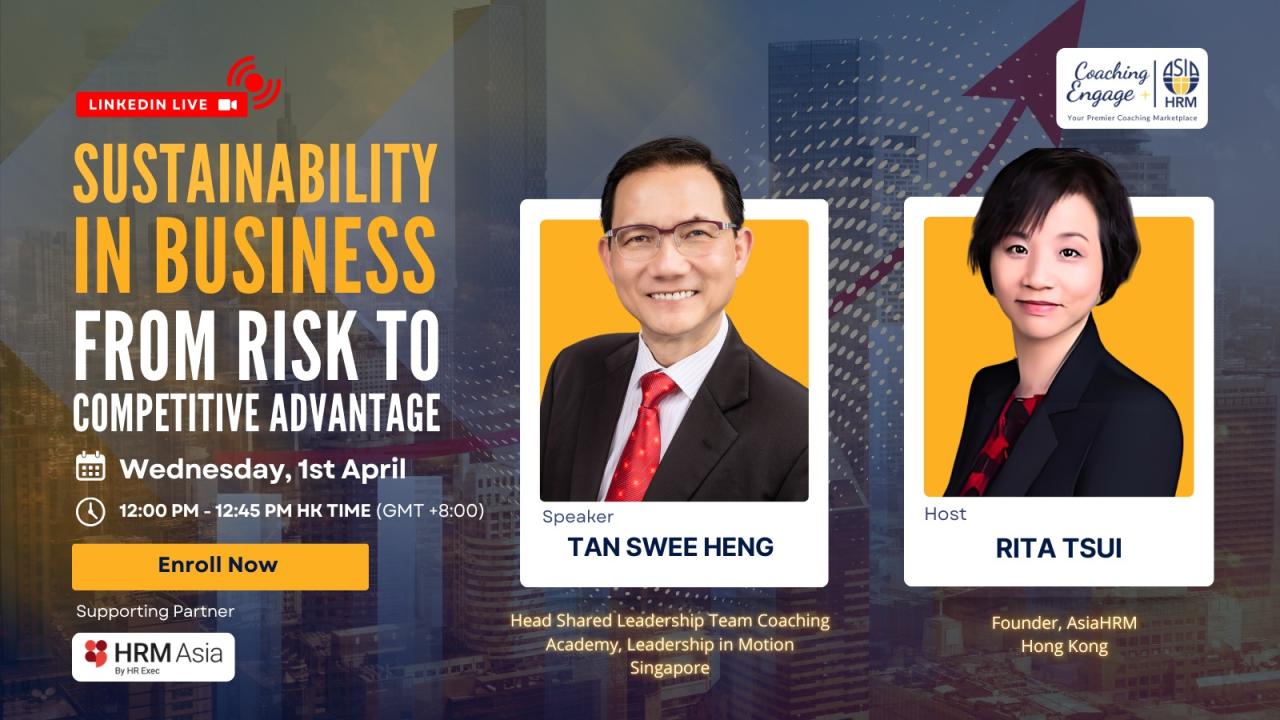
The conversation around sustainability is no longer confined to environmental circles or corporate reporting frameworks—it is steadily reshaping how organisations define growth, resilience, and long-term value. This shift was at the heart of the opening session of the Sustainability in Business Series, organised by AsiaHRM and supported by HRM Asia, which set out to unpack how organisations can move from viewing sustainability as a risk to leveraging it as a competitive advantage.
Framing the discussion, Rita Tsui, Founder of AsiaHRM, emphasised the intent behind the series: to move beyond awareness and towards practical understanding. “Sustainability is about environment, social and governance,” she said. “Hopefully, towards the end of the series, you’re able to have a good idea of that and apply what you have learned in your workplace and even in your personal life.”
The session, led by Tan Swee Heng, Head of Shared Leadership Team Coaching Academy at Leadership in Motion, took a wide-angle view of how current economic models have contributed to today’s sustainability challenges—and what that matters for organisations today.
A key turning point in the discussion came with a stark data point. “In 2024, the global temperature increase reached 1.55 degrees,” Tan noted. “In less than 10 years, we have already gone from 1.1 degrees to 1.55 degrees.” The significance of this lies in the fact that the 1.5-degree threshold, widely regarded as a critical limit under the Paris Agreement, has effectively been breached, highlighting the speed at which climate risks are intensifying.
Rather than treating climate change as a distant or abstract issue, Tan traced its roots to patterns that are deeply embedded in business and economic systems. Industrialisation, population growth, and rising consumption have collectively driven GDP expansion, but often at the expense of natural ecosystems. “The assumption was that natural systems are infinite,” he said. “So all you care about as a business is to grow.”
This mindset, he reflected, has shaped decades of decision-making. Drawing from his own experience, Tan acknowledged how business priorities have traditionally been defined. “When I was in my leadership role… it was all about revenue, profit, performance, and people,” he said. “But today, I think that’s probably a bit too short-sighted.”
The consequences of that short-term focus are now becoming increasingly visible. Climate change is not only an environmental issue; it is a business issue with tangible operational and financial implications. From rising material and supply chain costs to increased insurance premiums and carbon taxes, organisations are facing mounting pressures on multiple fronts.
“If you are not sustainable, you lose market competitiveness,” Tan explained, pointing to procurement processes where sustainability credentials are becoming a deciding factor. Over time, this can translate into declining revenue and reputational risks that affect relationships with clients, investors, and employees.
At the same time, the discussion made clear that sustainability is not simply about mitigating downside risks. It also presents a pathway to new forms of value creation. As Tan put it, “Sustainability helps you to become more efficient.” Whether through energy optimisation, waste reduction, or product and service innovation, organisations that embed sustainability into their operations can unlock cost savings while strengthening their market position.
This dual nature of sustainability—as both risk and opportunity—was further explored through a four-stage framework that maps how organisations typically evolve their approach.
At the most basic level, sustainability is often seen as a constraint—something that slows down business or adds cost. The next stage is compliance, where organisations respond to regulatory requirements but treat sustainability as a side project. It is only in the later stages that a more strategic shift occurs, with sustainability driving competitive advantage and eventually becoming integral to the organisation’s core purpose and culture.
“At that stage, sustainability and business cannot be separated,” Tan said. “They are integrated.”
READ MORE: Defining a new era of leadership for HR as AI trust guardians
This shift is already being reinforced by market dynamics. During the session, a participant highlighted research showing that organisations with strong sustainability performance have outperformed their peers over time. Another noted that competitive pressure—not regulation—is often the primary driver behind sustainability efforts. Tan agreed with this perspective: “If your closest competitors are doing it and you are not, you are out of the game.”
Yet, beyond strategy and competition, the conversation also touched on a more personal dimension—how to inspire genuine commitment to sustainability. “Until we touch the heart, change can happen,” Tan said. “Bringing sustainability closer to home, making it relevant to oneself, is probably something that everyone can think about.”
This emphasis on mindset is critical. While policies and frameworks provide structure, lasting change often depends on how individuals and organisations internalise the importance of sustainability. It is not just about meeting targets, but about rethinking priorities and behaviours.
Importantly, the session avoided framing the outlook as entirely bleak. While acknowledging the scale of the challenge, Tan pointed to historical examples that demonstrate the power of collective action. The Montreal Protocol, which successfully addressed ozone depletion, was cited as a reminder that coordinated global efforts can lead to meaningful progress.
“There’s hope,” he said. “If we can work together at the country level, at the business level, at the individual level, we can solve difficult problems.”
As the session drew to a close, the conversation returned to the evolving business priorities. “It is no longer about just performance and people,” Tan reflected. “The next ‘P’ is even more important—planet. Without a liveable planet, the first two don’t matter.”