
Capability is harder to recognise when it arrives in an unfamiliar shape
- Josephine Tan
- Topics: Features, Home Page - Features, Leadership, Talent Management
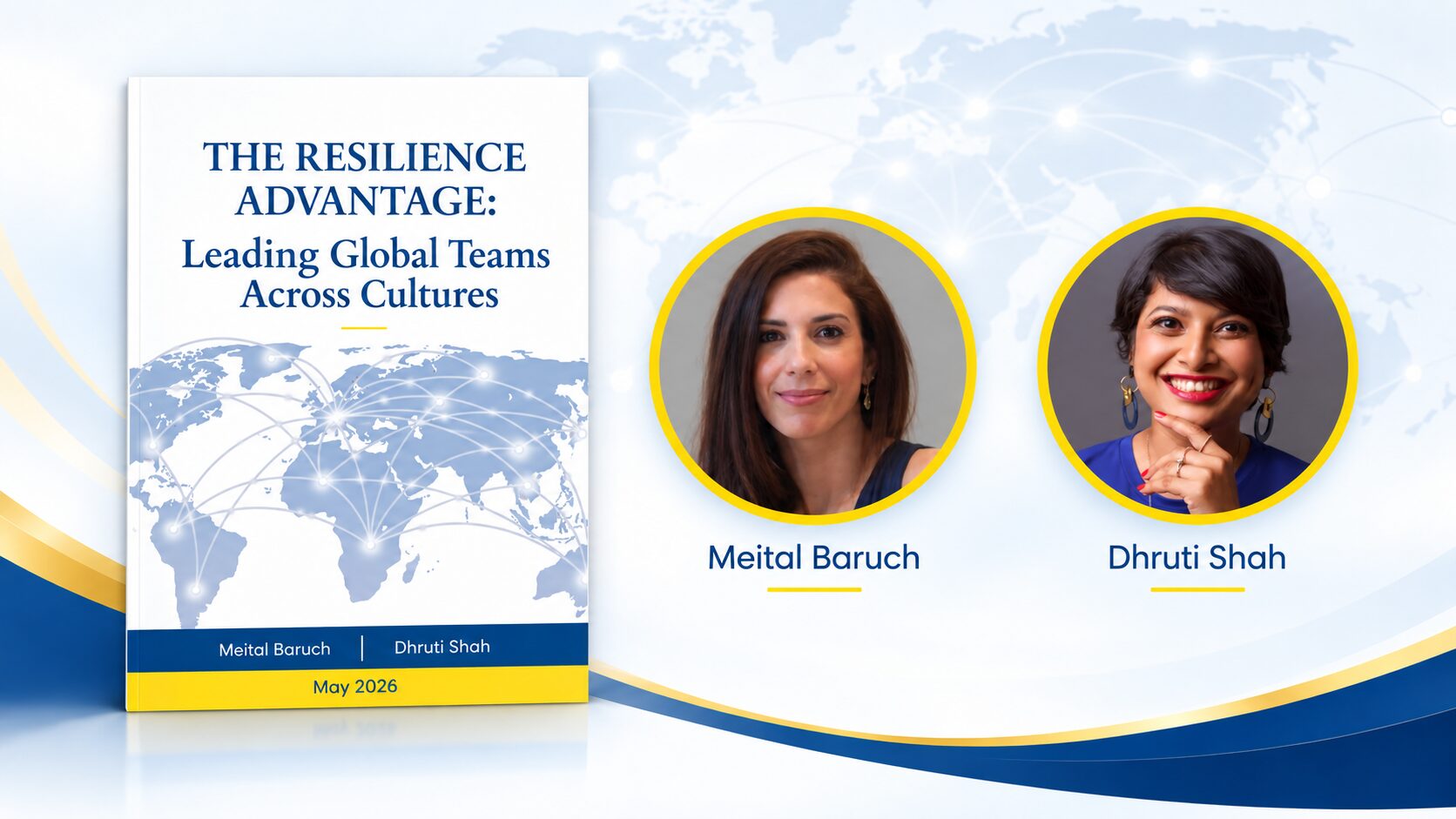
Resilience is usually treated as an individual trait: some people recover from setbacks better than others, and the organisation’s job is to find them, develop them, and promote them. The Resilience Advantage: Leading Global Teams Across Cultures, a white paper by Meital Baruch, Founder of Global Mindsets, and Dhruti Shah, Director at C2C Organisational Development (C2C-OD), argues that this misses something. Once teams work across borders, resilience also shows up as a culturally shaped capability, visible in how people respond to uncertainty, seek support, communicate struggle, and what they have been taught strength looks like.
The risk they identify is straightforward. When resilience is separated from its cultural context, it becomes easy to assume that resilient people speak up, take initiative and confront obstacles head-on. In practice, it can appear as patience, emotional restraint, or a determination to hold a team together. Organisations that recognise only the first version end up rewarding what feels familiar and misreading people who are coping perfectly well in an unfamiliar register. “The risk is that behaviours that do not align with management’s familiar image of resilience or global leadership may be seen as a lack of capability,” Baruch and Shah tell HRM Asia.
Across more than 20 in-depth interviews with senior leaders, 19 of whom lead teams in Asia-Pacific, communication under pressure shows up most clearly. In some cultures, concerns are voiced directly; in others, they are signalled through implication and handled in relationships and informal settings so both sides can save face. One leader interviewed for the paper summarised the problem for anyone reading a room in Asia: the quiet person does not necessarily agree, and the vocal person does not necessarily disagree. Israeli and Dutch teams were described as at the opposite end, where blunt feedback and open challenge build tolerance for discomfort. Coping mechanisms vary just as widely – Australian humour, American optimism that recasts a problem as an opportunity, and Japanese silence rooted in trust in the process. The authors carefully present all of this as tendencies drawn from their interviewees’ experience rather than fixed national traits.
Read wrongly, none of it is harmless. Some leaders take silence as composure; others read it as indifference. Either way, ideas go unheard, and decisions proceed with support that was never truly there.
Chakshu Singh’s experience shows how far that can go. When a major crisis hit his organisation in India, other teams visibly rushed and expressed urgency. His team set up its own war room, worked methodically and stayed in the office for three nights running. His manager said they looked like they had run away. Years later, working in Singapore, Singh – now Director of Product at a global telecom company – received almost the opposite feedback and was advised to calm down under pressure: same instincts, two verdicts. “If visibility, vocal urgency or speaking up signal resilience, someone working quietly and effectively may receive less recognition,” the authors note.
That is where the argument stops being about individual misunderstandings and starts being about process. In high-potential identification, self-promotion and networking are easily mistaken for leadership potential. During restructuring, visible confidence and proactive pitching get read as resilience. And the effect compounds: “If HR systems recognise only certain behaviours, capable people may be overlooked, particularly in succession planning, where organisations may continue to select leaders who resemble those promoted before them.”
The authors offered one further example, unattributed. A leader whose manager expected a highly structured, process-focused style instead worked through human connection and relationships. While waiting for a promotion, she eventually challenged the assumption that effective leadership had to follow a single model, and the promotion arrived the next day. Baruch and Shah do not claim the delay was caused by her style but suggest that “capability may be harder to recognise when someone’s leadership style does not match the cultural model.”
When silence gets misread
At team level, the same failure appears as a lack of escalation, and the paper is blunt about how little that absence proves. “A team with no problems and a team that doesn’t feel safe to escalate can look very similar on the surface,” the authors say.
Hierarchy is part of the reason. In more hierarchical cultures, raising a problem early can carry social risk and be read as poor judgement, so employees are inclined to solve it themselves before it moves up the management chain. Harmony, face and respect for authority all push in the same direction. The paper warns about timing: as the pace of change accelerates, the window to respond to an emerging risk narrows, and a problem that surfaces late has usually grown more complicated and more expensive.
Several signals suggest the silence is not benign. Concerns are raised only after a decision has been taken, or once a problem can no longer be hidden. Issues are discussed among colleagues but never with the person able to act. People hesitate to admit mistakes or ask for help. And disagreement is consistently absent, which is unlikely in a genuinely diverse team. If challenge and bad news never surface in any setting, that is information in itself.
There is a distinction to hold onto, though, and the authors draw it firmly. Leaders “need to be careful not to confuse cultural preferences with a lack of psychological safety” – in some places, people prefer to raise issues privately. They point to a leader who presented a new initiative to Indian colleagues, invited questions, and got none. Rather than treating that as agreement, he asked: “What could go wrong if we proceed with this?” The constraints came out at once. The team had not been holding back; the question had been wrong.
READ MORE: Is your leadership style failing your multicultural team? How to adapt and succeed
What that implies is less a technical matter than a habit of building several routes for information to travel – group discussion, one-to-one conversation, written updates, and check-ins, where flagging an obstacle early is framed as part of the job rather than an admission of failure. It also means being explicit about which problems belong inside the team and which should move up, since escalation reads as sound risk management in some places and as an admission of incompetence in others.
Then comes the moment that sets the pattern. “The response to the first escalation is critical because that is when the team discovers whether speaking up is safe or not,” the authors say. Getting it wrong can look like defensiveness, asking why the employee did not handle it themselves, or going straight to the person responsible. The problem may still be fixed. The team learns that bad news carries personal risk.
The alternative is mostly about restraint: stay calm, respond with curiosity, acknowledge that the issue was raised, focus on the situation rather than the person, establish the urgency and what has already been tried, and offer support where it is needed.
None of it asks a leader to lower their standards. It asks them to notice how much of what they currently read as strength is simply what strength has always looked like to them.
Meital Baruch is an organisational consultant and professional speaker specialising in Culture Intelligence and Global Leadership. As the Founder of Global Mindsets, she works with leaders and teams globally to navigate cultural differences and build more inclusive, connected, and high-performing workplaces.
Dhruti Shah is a leadership coach, facilitator and director at C2C-OD, specialising in resilience, leadership development and navigating change. She is the author of The Resilient Entrepreneur and brings a global perspective shaped by living and working across India, the US and Singapore.
In part two, Baruch and Shah turn to what organisations can build instead: why strong systems both absorb shocks and quietly limit the chances people get to develop resilience of their own, why HR should look twice at leaders whose every success has come from inside an existing process, and what has to change about which behaviours get noticed and rewarded.