


Before the COVID-19 pandemic, HR was largely viewed as a transactional function—which the health crisis turned on its head. For a few years after the worst of the pandemic, however, the strategic nature of the function started fading again, said Valerie Capers Workman, CHRO at Empower Pharmacy, who was vice-president of HR at Tesla at the start of the pandemic.
Now, however, the emergence of AI has thrust HR “back into the centre” again—but the expectations have grown exponentially, Capers Workman said during a keynote at the HR Strategy Summit as part of HR Tech in Las Vegas.
“HR needs to own their new role as a leader,” Capers Workman said. “AI is our moment.”
Five areas HR needs to own in AI transformation
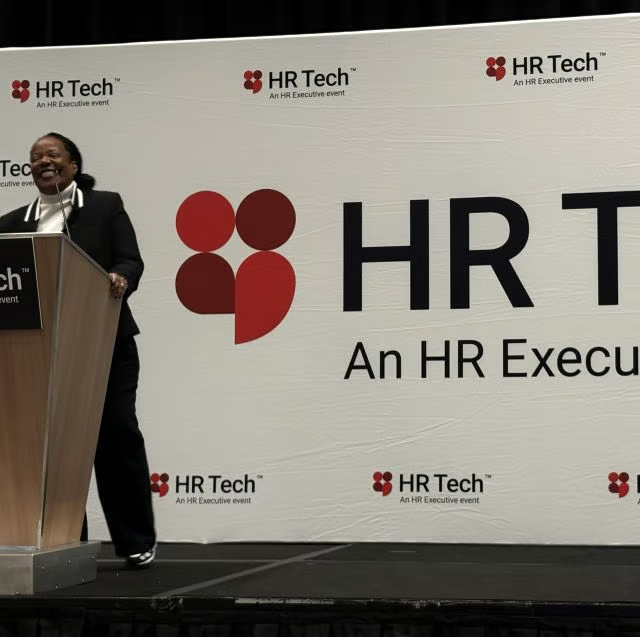 While HR needs to work collaboratively with leaders across the enterprise for AI transformation, there are a number of areas in which HR has a distinct role to play in developing. For instance, Capers Workman points to:
AI fluency: If AI training is voluntary or reserved for certain segments of the workforce, it can create an equity issue. Particularly as organisations move to performance management models that take AI utilisation into account, they need to ensure all employees have robust opportunities to become fluent in AI—and HR needs to lead such efforts.
Performance: Today’s performance management is not yesterday’s performance management, Capers Workman said. “Whatever you spent the last two years building in teams on a performance management platform, you now have to redo,” she said, “because you have to bake in how people are using AI.”
Ethics: HR needs to be the voice in the room calling attention to the ethical dimensions of AI integration—particularly around how humans are involved in AI-driven decision-making—to reduce risk.
“The question”: Employees today are considering what will happen to their jobs once they become AI-fluent—some are hesitant to deepen their AI skills for fear that the tech will take over their jobs, while concerned that not knowing their way around AI will reflect poorly on their performance. “Employees are desperately trying to understand if they should take the time to learn AI, and the answer is yes,” Capers Workman said. “HR needs to be telling them they have to learn it here or someplace else: ‘Dig in because your career depends on it.’”
Tech stack: HR should co-own tools and vendor relationships alongside the CIO and CTO, Capers Workman said, meaning HR professionals need to particularly understand how to evaluate vendor capabilities.
Think broader than ‘human in the loop’
As HR steps into its leadership role in AI transformation, Capers Workman advised, a cornerstone needs to be advocacy for retaining the “human in the loop”; however, she said, many organisations are approaching that topic incompletely.
Humans need to be the designers of AI. “The people who use the tool need to help build the tool,” she said. That means at least one person on the HR team—who could be anyone with an appetite for AI expertise—must be willing to become extremely well-versed in AI to step into that designer role.
“You have to have someone from the beginning on those tech calls,” she said.
READ MORE: CHRO Singapore 2026: Time saved, skills at risk, trust on the line
HR must also ensure humans are closing the loop as the decision-maker. “Someone has to hold final decision authority because that’s where most litigation comes from,” Capers Workman said.
“HR has to be at the table from the beginning, in the process, in the middle and to make sure there is an assigned decision-maker at the end of every process,” she said.
Courage: HR’s most important capability
It is not an HR job description, but courage is becoming an increasingly critical capability for HR leaders to meet the AI moment.
HR needs to advocate for training, for humans in the loop across the AI journey, for calculating the real costs of AI investment.
“It’s incumbent upon us to speak up,” Capers Workman said. “We have to learn the tech, we have to learn the CTO speak, we have to learn the CFO speak. It takes courage—it’s always better to speak up before [AI] gets deployed because after that, you’re just doing damage control.”
About the Author:
 Jen Colletta is Managing Editor at HR Executive, where this article was first published.