The new hire at KnowBe4 cleared the organisation’s screening process. Only after the laptop was switched on and began reaching out to a server in North Korea did the security team work out who had been hired. For an organisation built entirely around catching fraud, the catch came from the security stack rather than the hiring funnel.
The incident has become a reference point for a wider shift in how hiring fraud is being manufactured. Fabricated employment histories, forged qualifications, AI-written reference letters and invented payslips can now be produced in seconds and are frequently polished enough to pass standard screening. Gartner predicts that by 2028, one in four candidate profiles globally will be fake.
The gap is largely structural. Most hiring processes still lean on document reviews and reference calls – methods that were never designed to detect AI-generated fraud, and that assess the polish of an artefact rather than its provenance.
What the session
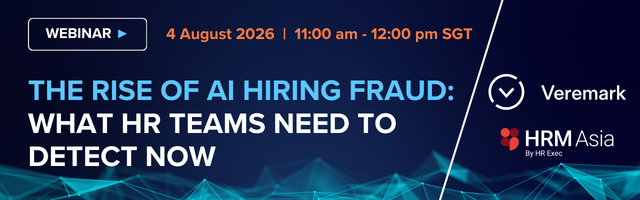
The Rise of AI Hiring Fraud: What HR Teams Need to Detect Now breaks down what is actually turning up across Asia-Pacific verifications: the documents candidates fake most often, the warning signs teams are missing, and the verification methods that continue to work.
Taking place on August 4 at 11:00 AM (SGT), the session is moderated by Dr Damini Chawla, Global Communications Coach, and features Elaine Ooi, Vice-President, People and Culture at Veremark, alongside Alisa Koh, Recruitment Operations Manager at Allegis Global Solutions. Koh brings a view from volume hiring, walking through how one of the world’s largest recruitment organisations is adapting its process to detect AI-generated candidates without slowing recruitment down.
The agenda runs across four areas: why AI hiring fraud is escalating and what employers in Asia-Pacific are up against; real cases from the field, including where screening failed and why; how identity fabrication, AI photo manipulation and interview coaching work in practice; and the practical changes employers are making to their verification processes, and where to start.
Attendees will come away with a clearer view of how candidates are using AI to fake employment records, qualifications and references; which red flags to spot before an offer is made; which verification layers detect inconsistencies across Asia-Pacific markets; and what leading employers are changing in their screening for 2026.
For hiring processes still built around document reviews and informal checks, the session is a map for where the blind spots sit.
Register for the webinar here.