
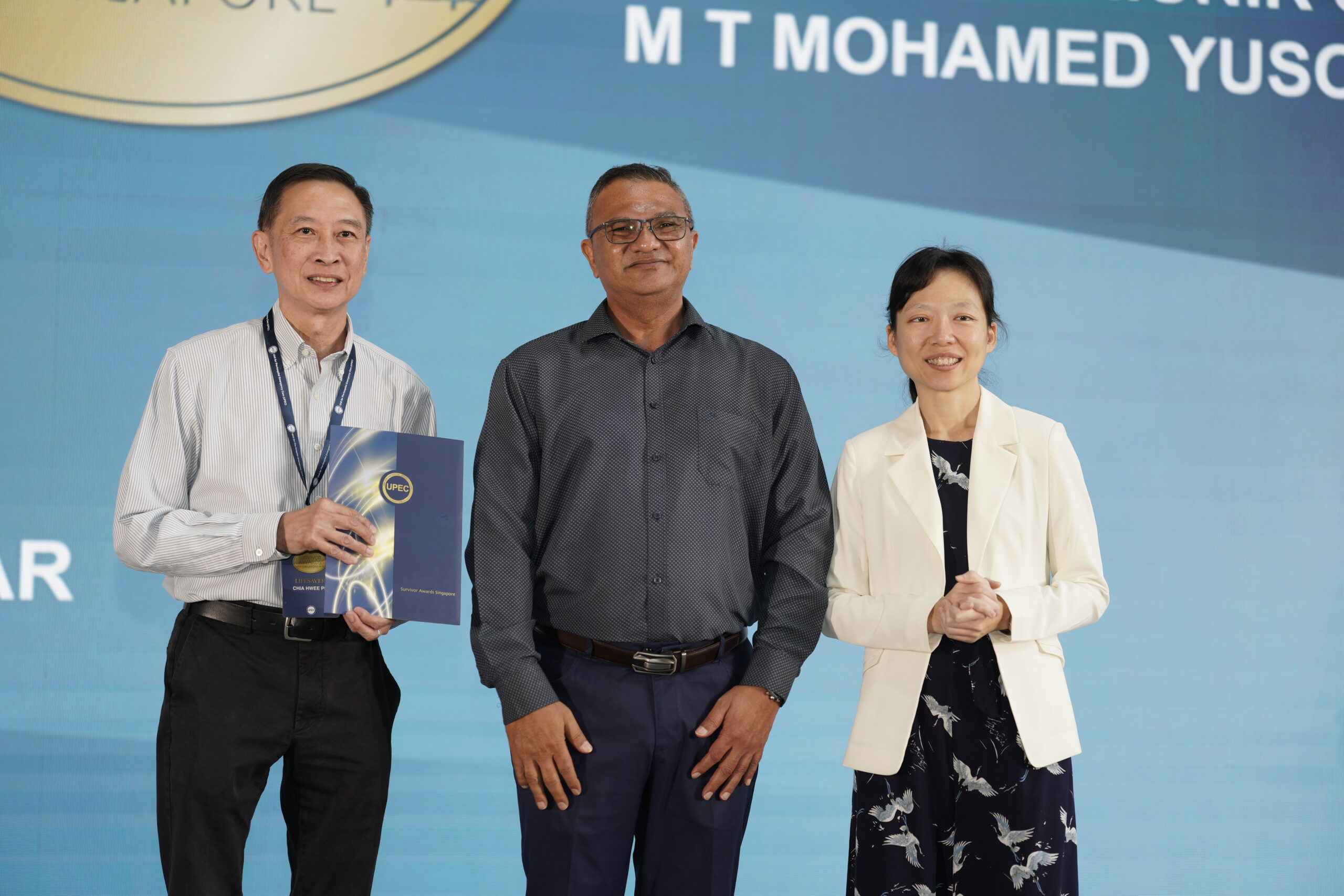
Cardiac arrest survivor Mohammed Munir from ExxonMobil Asia Pacific posing a photo with his rescuer Dr Nicholas Chia and Guest of Honour Jasmin Lau, Acting Minister for Manpower and Senior Minister of State, Ministry of Digital Development and Information, at Project Heart 2026 event. (Photo credit: Singapore Heart Foundation)
It was an ordinary workday on 28 September 2022 when Mohammed Munir passed out at his workstation.
He remembers very little of what followed. “The next thing I remember was waking up in the hospital and my colleagues who visited me later recounted what happened,” Munir, a senior operations technician at ExxonMobil Asia Pacific Pte. Ltd., tells HRM Asia.
He had suffered a sudden cardiac arrest. A colleague in the office saw that something was wrong and called for help, while others nearby started CPR and used an automated external defibrillator (AED) to resuscitate him before the paramedics arrived.
“Hearing that was both shocking and incredibly humbling. Their prompt actions and response gave me a second chance at life,” he says.
Not every workplace can count on that kind of response. A 2026 survey by the Singapore Heart Foundation (SHF), a social service agency that has worked against heart disease since 1970, found that only 51% of respondents would perform CPR if they witnessed a cardiac arrest. Fewer still, 46%, said they would step forward to use an AED.
Singapore recorded 4,058 out-of-hospital cardiac arrest cases in 2022, according to a report published in July by the Unit for Pre-hospital Emergency Care. One in five occurred outside residential settings, a category that could include workplaces.
SHF launched the Heart Safe Mark in October as Singapore’s first cardiac emergency response certification for workplaces. Close to 20 organisations hold it so far, including ExxonMobil Asia Pacific Pte. Ltd., among them, alongside Amazon Web Services Singapore and the People’s Association. SHF aims to certify 200 organisations within five years.
For Clin A/Prof Ching Chi Keong, who chairs SHF’s Heart Safe Committee and is a senior consultant cardiologist at the National Heart Centre Singapore, the starting point is that an AED on its own does not make a workplace ready.
“Having an AED on the premises of a workplace only provides the equipment to save a life. What matters more is the ability to save a life using CPR and the AED available as a team in a coordinated fashion, when a cardiac emergency strikes,” he says.
The certification is built around that team response. At least five employees, or 10% of the workforce if that number is larger, must be trained in CPR and AED use. These employees must also have gone through SHF’s Cardiac Life Emergency Action Response (CLEAR) programme, or similar emergency planning and drills, “so that they will know how to respond swiftly and confidently to the emergency as a team,” says Prof Ching. An AED must be available too, either in the office or elsewhere in the same building. Each certification is valid for two years.
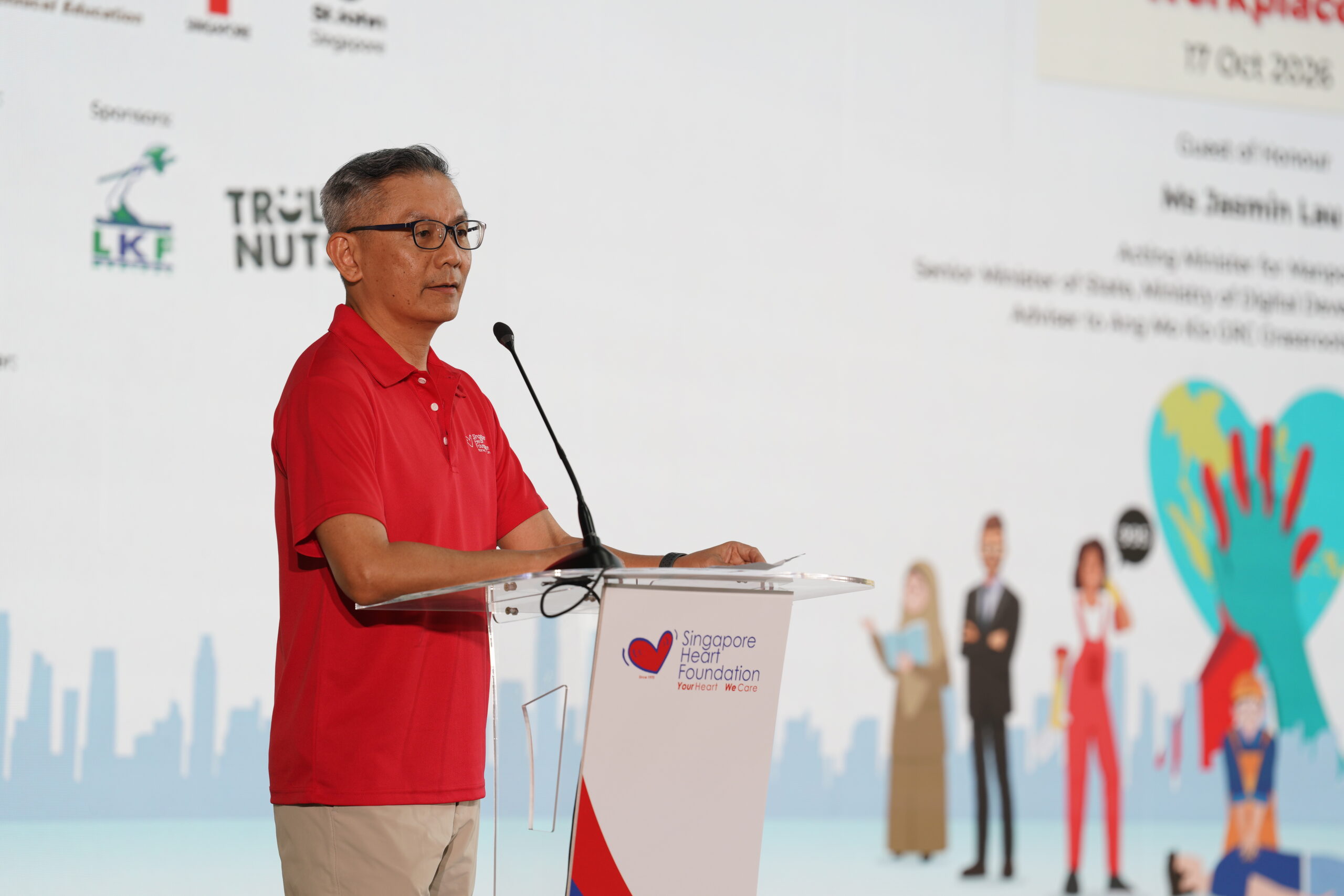
Who owns that readiness inside an organisation is a separate question. Emergency preparedness has often been handed to facilities or safety teams, but Prof Ching says it should be: ingrained in every organisation’s corporate DNA”, with the ability and willingness to save a colleague’s life treated as a shared responsibility.
That does not push other wellbeing priorities down the list, he adds. “That is not to say that we de-prioritise other important wellbeing priorities and duties of care on the HR agenda, like mental wellness and flexibility. Instead, we are saying that cardiac emergency preparedness should be as important as those priorities.”
He sees HR as integral to making this happen. The first step is recognising cardiac emergency preparedness as a corporate priority and making it part of the organisation’s culture. From there, HR can act as “an invisible hand” that encourages employees to learn CPR and AED skills and take part in response drills.
“After all, if an organisation think that it is important to have fire drills and first aid drills to prepare for emergencies, it will make a lot of sense to prepare for cardiac emergencies too.”
The same principle applies beyond Singapore, where employers across Asia-Pacific differ widely in size, resources and regulation. Prof Ching’s advice is to begin with the basics: make sure some employees have CPR and AED skills, and have an AED on the premises where possible. These, he says, “would establish the foundation for a more structured approach to respond to cardiac emergencies, should they decide to move towards that direction in the time to come.”
For Munir, knowing that his colleagues were ready “means everything”. He is a husband and a father of four.
“In a situation like a sudden cardiac arrest, where the heart stops beating, every minute matters. Knowing that my colleagues were trained, stayed calm and knew exactly what to do is the reason I am still here today, and fit enough to return to work.”
READ MORE: Mental health at work: When well-meaning caution narrows a career
That return took time. He was recovering physically and mentally and had to rebuild his confidence and settle back into his routine.
After he was discharged from the hospital, ExxonMobil’s Medicine and Occupational Health team reviewed his health status and enrolled him in the organisation’s Return-to-Work programme. His work was modified while he recovered, which meant no field work in the plant, and he was advised to attend all his follow-up appointments with his specialists. He resumed his full duties as a senior operations technician only after the specialist cleared him at his final follow-up.
The people around him mattered as much as the programme. “They were understanding, checked in on me regularly, and gave me the space and encouragement I needed to recover,” he says.
“I will always be grateful that they had the confidence and skills to step in and respond when it mattered most.”