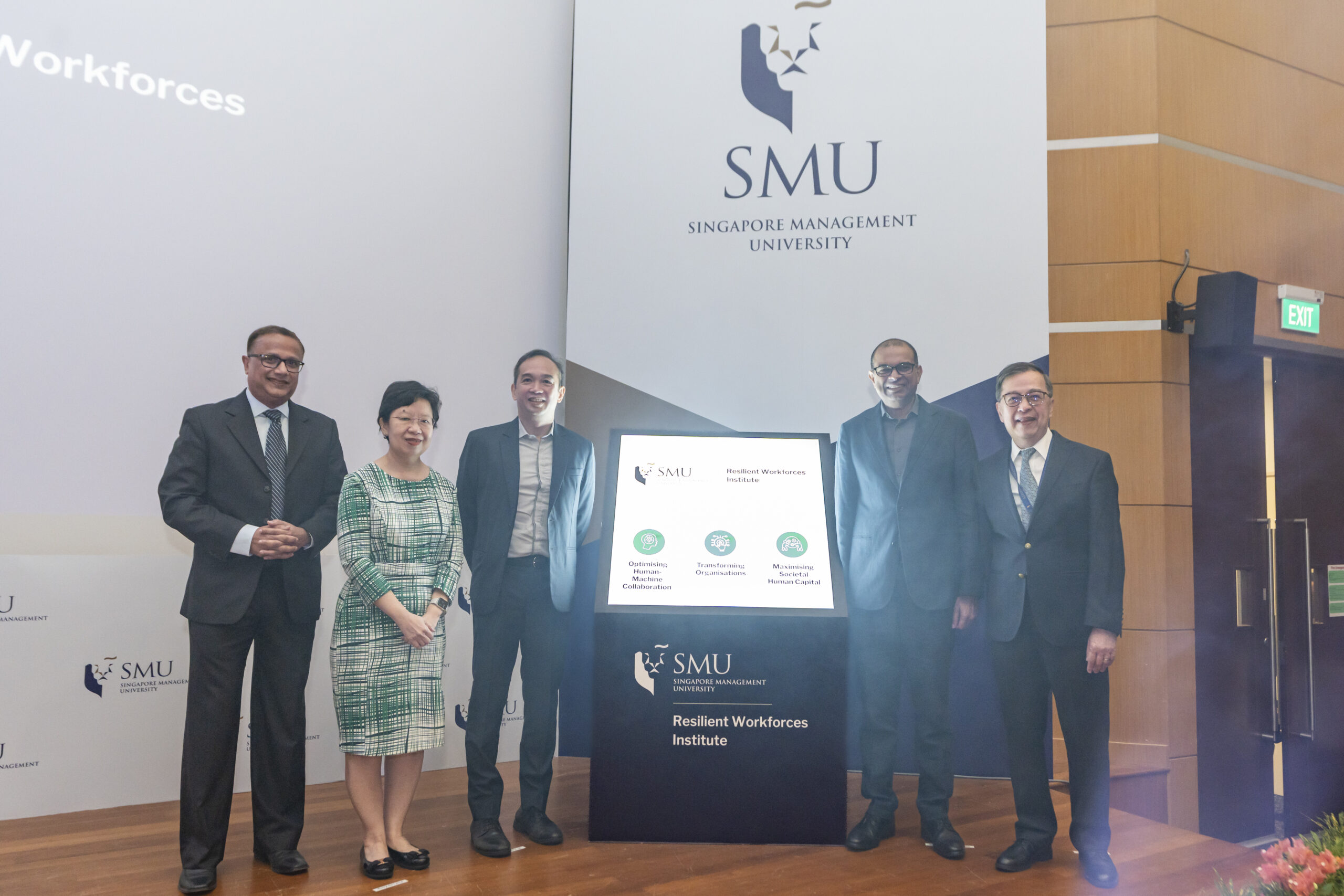
Launch of SMU Resilient Workforces Institute [right to left: Professor Alan Chan, SMU Provost, Guest-of-Honour Dr Janil Puthucheary, Senior Minister of State, Ministry of Education & Ministry of Sustainability and the Environment, Mr Tan Kok Yam, Chief Executive, SkillsFuture Singapore, Professor Lily Kong, SMU President, and Professor Archan Misra, Vice Provost (Research); Interim Director of SMU Resilient Workforces Institute]
As AI redraws the boundaries of work and learning, Singapore Management University (SMU) has launched a new research institute aimed at helping organisations and employees adapt with confidence rather than fear.
The university this week unveiled the Resilient Workforces Institute (ResWORK), a university-level research centre dedicated to advancing workforce resilience and lifelong learning amid rapid technological change. Among the first in Singapore and the region to jointly examine adult learning and the future of work through an integrated lens, ResWORK brings together expertise across economics, management, behavioural science and technology.
Guest-of-Honour Dr Janil Puthucheary, Senior Minister of State for Education and for Sustainability and the Environment, underscored the importance of industry partnerships in navigating workforce disruption driven by AI and digital technologies. He highlighted how research-enabled collaboration will be critical to helping organisations and employees manage transitions as jobs evolve.
SMU President Professor Lily Kong described the institute as part of the university’s commitment to “research that matters”. “By bringing together insights across disciplines, ResWORK will help Singapore and the region navigate the profound changes reshaping work and learning in the age of AI,” she said, adding that the institute’s work will inform public policy, organisational practice and workforce resilience.
At the heart of ResWORK’s agenda are three research pillars. The first focuses on optimising human-machine collaboration, examining how employees can learn and perform effectively alongside AI, machines and robotics. The second pillar looks at transforming organisations, from redesigning business processes and workflows to rethinking leadership and culture in AI-enabled workplaces. The third pillar addresses maximising societal human capital, analysing labour-market transitions and shaping policies that promote inclusive, gainful employment.
Professor Archan Misra, Vice Provost (Research) and Interim Director of ResWORK, said the institute is grounded in the belief that AI-led change will “reshape opportunity rather than displace it”. In his address, he noted that careers and skills now have far shorter “half-lives”, requiring individuals to relearn and reskill multiple times over their working lives. “Technology will reshape how we work, and all of us will need to repeatedly relearn skills,” he said.
READ MORE: SMU Academy forges new learning pathways with polytechnics and ITE to fast-track workforce upskilling
Beyond diagnosing disruption, ResWORK aims to generate practical solutions. Its research spans adult learning science, human-robot interaction, organisational redesign and labour-market policy. Ongoing projects include using AI to personalise adult course design, studying how humans and robots collaborate in the workplace, and developing AI-based career planning tools that account for individual preferences and personality traits.
To anchor its work in national priorities, SMU also signed a two-year Memorandum of Understanding with SkillsFuture Singapore (SSG). The partnership will examine how AI, digital technologies, and shifting work preferences are transforming job tasks, skill demands, and career pathways, translating insights into policies that sustain employability and inclusive growth.
Tan Kok Yam, Chief Executive of SSG, said the collaboration is aimed at futureproofing Singapore’s adult learning system. “Adult learning must adapt to emerging technologies and changing workforce dynamics, so that training best equips learners for these changes,” he concluded.