
Beyond the buzzword: What inclusive leadership actually looks like in practice
- Josephine Tan
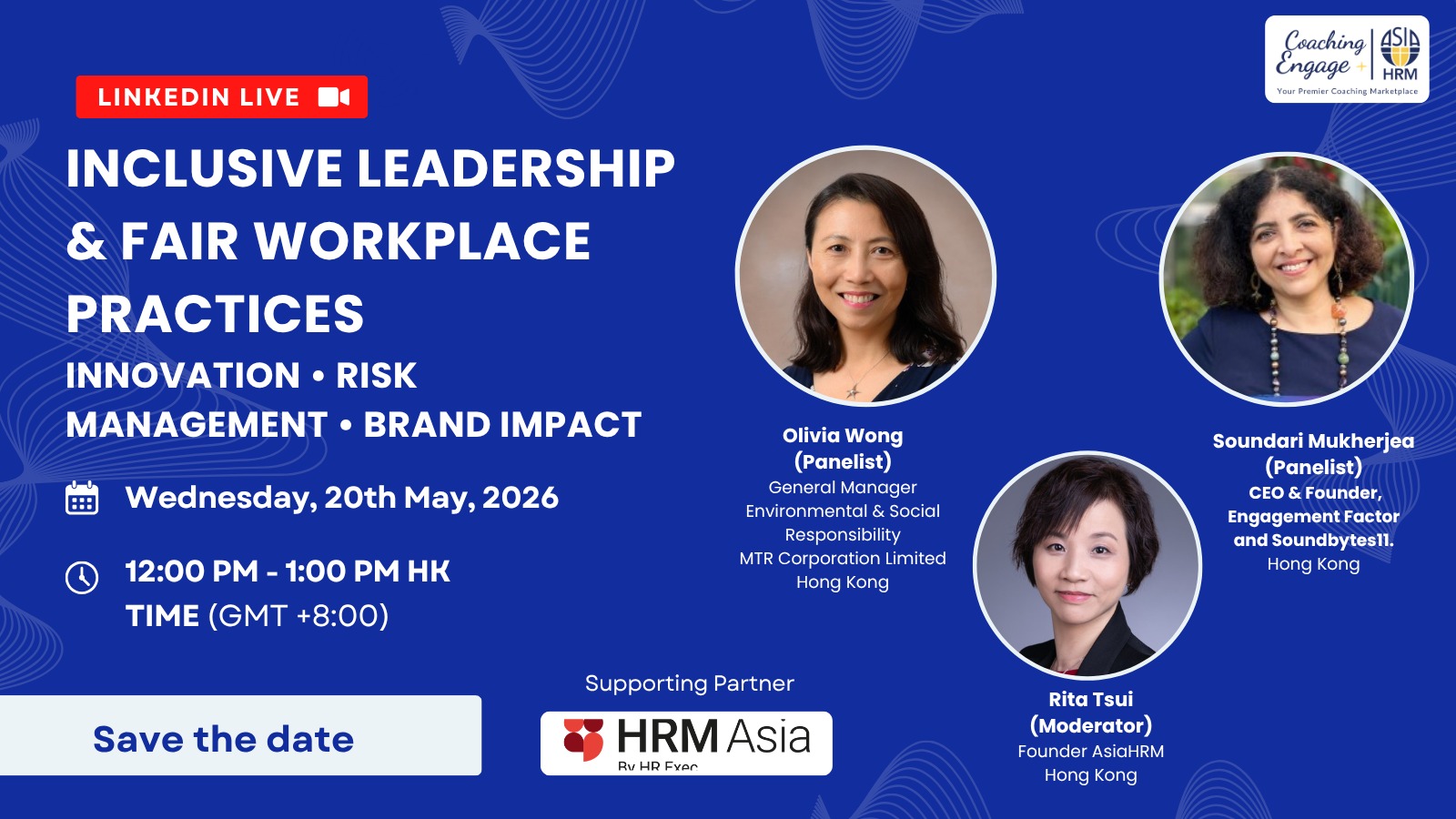
Inclusion has long been treated as a corporate virtue – something organisations aspire to do, display in annual reports, and workshop into existence once a year. But according to leaders who gathered for AsiaHRM’s LinkedIn Live on Inclusive Leadership and Fair Workplace Practices, that framing fundamentally misses the point.
“Inclusion is no longer nice to have,” said Rita Tsui, Founder of AsiaHRM. “It is a leadership capability, a risk management strategy, and a brand differentiator.”
Joining Tsui were two experienced practitioners: Olivia Wong, General Manager for Environmental and Social Responsibility at MTR Corporation; and Soundari Mukherjea, CEO of Engagement Factor and Soundbytes11. Together, they moved the conversation from theory to the concrete, everyday realities of building workplaces where people genuinely feel they belong.
Inclusion means the right to disagree
When asked what inclusive leadership means to them, both speakers converged on an idea that rarely appears in diversity training materials: psychological safety to dissent.
“It’s okay for all of us to respectfully agree to disagree,” said Wong. “When you’re working in a corporate environment, you’re bringing in people from different backgrounds and different thinking. We’re all going to bring something of our own experience.” For her, true inclusion goes beyond welcoming diverse voices – it means ensuring people feel safe enough to share why they see things differently.
Mukherjea added a human rights dimension to the definition, describing inclusive leadership as acknowledging everyone’s inherent worth without judgment, and remaining conscious of how interconnected those contributions are. “It’s about recognising that value – and then creating the conditions where it can actually surface,” she said.
Diversity drives innovation – when the culture allows it
The business case for diversity is well-worn, but the panel grounded it in vivid examples. Mukherjea cited findings from Deloitte research showing diversity of thinking leads to significantly better decisions and greater innovation revenue. She also shared a compelling case from the Open Sustainability Technology Lab at Michigan Technological University, where a multigenerational team – drawing on the technical know-how of Gen X researchers, the software fluency of Millennials, and the resourcefulness of older colleagues – developed the first low-cost, open-source metal 3D printer.
“By combining these perspectives, they built something better and cheaper,” said Mukherjea. “That’s the synergy that diversity of age, thinking, and experience produces.”
Wong was quick to note, however, that diversity alone is insufficient. If team members do not feel comfortable speaking up, the potential goes unrealised. “You might as well have groupthink,” she said. “At least they’d be willing to talk to each other.”
Inclusive design is for everyone – not just special groups
One of the session’s most useful threads concerned how workplace policies and physical design are framed. Wong challenged the common assumption that flexible working, accessible offices, or quiet rooms are concessions made for specific groups.
“Do this because everybody needs it,” she said plainly. She noted that men also want to share caregiving responsibilities, that anyone can sustain an injury that makes a staircase suddenly challenging, and that a nursing room renamed a “quiet room” – with priority still given to nursing mothers – becomes a space that serves sensory needs, mental rest, and decompression for the entire workforce.
Mukherjea echoed this with the example of signage at Austin Airport, where changing facilities were clearly marked for both fathers and mothers travelling with children. “These are small things,” she acknowledged, “but they make a big difference when you walk into an office and see them. They signal that this place was designed with you in mind.”
The principle extends to product design too. She pointed to the automotive industry, where engineers once relied entirely on male bodies for safety testing – until an “empathy belly” was created to help engineers understand the experience of a pregnant driver. The lesson for HR practitioners: inclusive design requires actively asking whose perspective is missing.
Measurement matters – but break it down by demographic
On the question of how to track progress, both speakers urged organisations to look beyond aggregate scores. Wong described running both a dedicated diversity and inclusion survey and a broader engagement survey, then cross-referencing results by demographic group.
“Maybe your overall engagement score looks strong, but men feel their voices are heard more often than women,” she said. “That breakdown tells you exactly where to focus.”
READ MORE: AI sees patterns, humans see people: Restoring judgment to HR decision-making
Mukherjea outlined a three-tier measurement framework spanning diversity metrics (workforce demographics, hiring funnels, leadership representation), equity metrics (pay equity, promotion rates, development access), and inclusion metrics (belonging index, psychological safety scores, exit interview themes). She recommended embedding relevant measures into leadership KPIs. “What you measure will get done. If it’s a nice-to-have, it won’t get enforced,” she said.
On the anti-DEI wave: Localise, don’t abandon
The session also addressed a timely and uncomfortable question: how have US anti-DEI policies affected organisations operating in Asia?
Both speakers acknowledged the impact – budget cuts, withdrawn initiatives, a “chilling effect” on some multinationals – but pointed to organisations that have responded by localising rather than retreating. Wong suggested that if the label “DEI” creates friction, drop it and return to the underlying values instead.
“In Asia, we talk about respect. We talk about harmony. That’s really what this is,” she said. “If you genuinely believe in building a competitive, talent-attracting workplace, you can keep delivering on those values, whatever you call them.”
The overlooked skills: Grace
The session closed with what may be its most memorable insight. Asked about the advantages and challenges of inclusive leadership, Wong did not reach for a framework. She offered something more human.
“Have grace,” she said. “Grace for yourself, because you will have good days and bad days. You will have your biases. Don’t beat yourself up. And have grace for others. Not everyone who falls short is intentionally exclusive. They’re human too.”
Mukherjea offered a practical self-check: Do people feel they have permission to be candid with you? Do your meetings make people feel smarter or quieter? And are you listening not just to the ideas being shared, but to the ideas that were never shared at all?
Inclusive leadership, the session made clear, is less a destination than a discipline – one that requires intent, attention, and the willingness to keep showing up, even when you get it wrong.
The conversation continues next Wednesday, 27 May 2026, as AsiaHRM’s Sustainability in Business Series turns its focus to talent strategy in sustainable enterprise. Ng Chow Yong, AGM of Learning and Talent Development at M1, will share insights from leading workforce transformation across industries, exploring how organisations can build the green and digital capabilities their people – and their businesses – will need to stay competitive. If you are responsible for talent strategy, leadership development, or organisational growth, this is a session worth making time for.