Ten years of poor health, and the workplace in the middle of it
- Josephine Tan
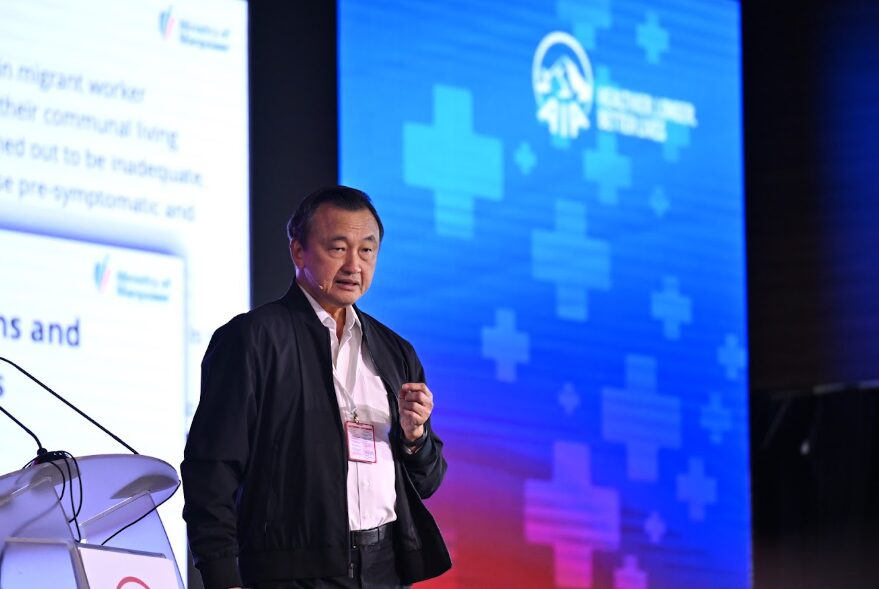
Professor Chia Kee Seng told the AIA Healthcare Summit that value systems around health are formed during working life, giving employers a role most have yet to take up.
Singaporeans expect to live to an average of 80.2 years but expect their health to begin declining at 70.2 – a decade spent in poor health, according to the AIA Longevity Study. More than half (51%) now view longevity as a concern instead of an opportunity.
That gap framed the inaugural AIA Healthcare Summit 2026, held on 12 August at The Ritz-Carlton, Millenia Singapore, which brought together more than 700 policymakers, clinicians, technology innovators and corporate leaders under the theme Purposeful Longevity: Advancing Holistic Health through Public-Private Partnerships. A recurring theme was that the problem is no longer a shortage of wellbeing investment, but how disconnectedly employees encounter it.
Where health habits are actually formed
Delivering the keynote on workforce health and longevity, Professor Chia Kee Seng, Professor and Founding Dean of the National University of Singapore (NUS), School of Public Health, traced how workplace health policy in Singapore has broadened over several decades – from workplace injuries and occupational diseases, to chronic conditions among working populations, and more recently to mental health and wellbeing.
His concern is what sits beneath that shift. Singapore has roughly 1.5 million to 1.8 million people living with at least one of what he calls DHL – diabetes, hypertension or hyperlipidaemia – and he estimates that half of them do not know it. Among those who do, only about half are well managed.
There is a second problem, he said: when catastrophic illness eventually arrives, the default assumption is withdrawal from the workforce. He argued that continuing to work often supports quality of life, mental wellbeing and a sense of purpose, and that the assumption deserves revisiting.
Prof Chia’s central argument was that programmes alone have not produced deep behavioural change. “To make a change, we need to focus on changing values and attributes,” he said. “Yes, knowledge is important – but in order to shift behaviour, we must change the value system of society and the attitude of the population.”
He characterised the Pioneer and Merdeka generations – the government’s terms for Singaporeans born before 1950 and in the 1950s respectively, who came of age around and after independence – as having grown up valuing wealth over health, with health a distant second, and under the impression that wealth would eventually produce health. What he wants from younger generations is not a reversal, but parity: health valued as much as wealth.
The relevance for HR sits in where that value system can be built. Not in schools, he argued, but at work. “It is during employment and working life that these value systems can be developed,” he said. “Employers have a big role to ensure that while the population is at work, they are creating both wealth and health.”
His closing instruction to employers, both multinationals and SMEs, was blunt: “You need to think health, talk health, and walk health – especially when we are in an increasingly tight labour market and having an ageing workforce that has lower productivity.” Most organisations he works with, he said, remain reactive, with health absent from the work plan and largely absent from town hall agendas.
The fragmentation problem
The panel that followed, How Public-Private Partnerships Enable Sustainable Workplace Wellbeing, moderated by CNA938’s Cheryl Koh, turned to why well-funded programmes are not translating into action.
Adel Tan, Senior Director, Compensation and Benefits Asia-Pacific at LinkedIn, located the issue in how benefits are designed and communicated. “Employees do not experience wellbeing through our benefit programmes,” she said. “They experience our benefits through life moments, and life moments are the thread that connects everything and prevents fragmentation.”
LinkedIn’s response has been to stop organising benefits by generation or by programme and to map them onto employee journeys instead. Tan described a parental journey structured in six chapters, spanning family planning, medical plan support through pregnancy, and coaching for the return to work – a period she noted many employees find difficult. Other journeys are built around goals such as optimising for growth, pulling together gym access, nutrition, coaching, financial and education support.
“It’s not about rolling out more benefits,” she said. “It’s about understanding your population, outlining their journeys and bringing them into a place where we meet them at their life moments.” Her biggest opportunity for the ecosystem was navigation: something closer to Google Maps or Apple Maps for care, which insurers and brokers could help build.
Bryan Koh, Founder and CEO of WhiteCoat Global, described the same problem from the provider side. Governments, employers, insurers and providers are all investing in prevention and access, he said, but from the user’s perspective it still feels like many separate doors – with little clarity on which service is appropriate, what is covered, or what to do next. He cited AIA research finding that only 57% of employees say they are taking active steps to mitigate health decline.
That has implications for how HR teams evaluate their own wellbeing spend. “Ultimately, what we should measure is not how many programmes or initiatives we are rolling out, but whether the patient is getting the right level of access to support and able to continue to receive care without having to restart their entire care journey,” Koh said. He also pointed to LinkedIn’s approach as an example of targeting: examining workforce demographics to determine what a particular population needs at a particular point, then working with insurers on care pathways and coverage levels.
Data, and the mindset behind it
Kenneth Tan, Chief Corporate Solutions Officer at AIA Singapore, framed data fragmentation as the structural barrier. “Right now, data sits in separate silos, the government has one system, self-managed wellness programmes have another, and insurance-managed programmes have their own pool,” he said. AIA has consolidated its corporate and individual policy data into a single app and is looking to build an AI assistant to guide members through their health journey.
His broader point was about mindset. “Connecting all this data is critical to shift the mindset away from focusing solely on ‘my health and my outcome’ toward embracing ‘our shared health and our shared outcome,’” he said.
READ MORE: Prioritising employee’s health and wellness – A smart investment for the future of work
That framing carried into his message on employer responsibility. “We must redefine workplace wellbeing – not as a good-to-have employee benefit, but as a strategic investment in a healthier workforce, stronger businesses and Singapore’s long-term economic resilience and competitiveness,” Tan said.
Prof Chia’s proposal to close the gap was more proactive: Singapore will not have enough doctors, nurses and allied health workers to serve an ageing population, and they are expensive. One possibility, he suggested, is upskilling financial and insurance advisors to act as health advisors as well.
Whether that idea gains traction, the summit left HR with a narrower question than “what else should we offer?” It is closer to what WhiteCoat’s Koh proposed measuring: whether an employee who needs support knows where to start and can keep going without beginning again.