
The new HR mindset: Doing what matters most with what you have
- Josephine Tan
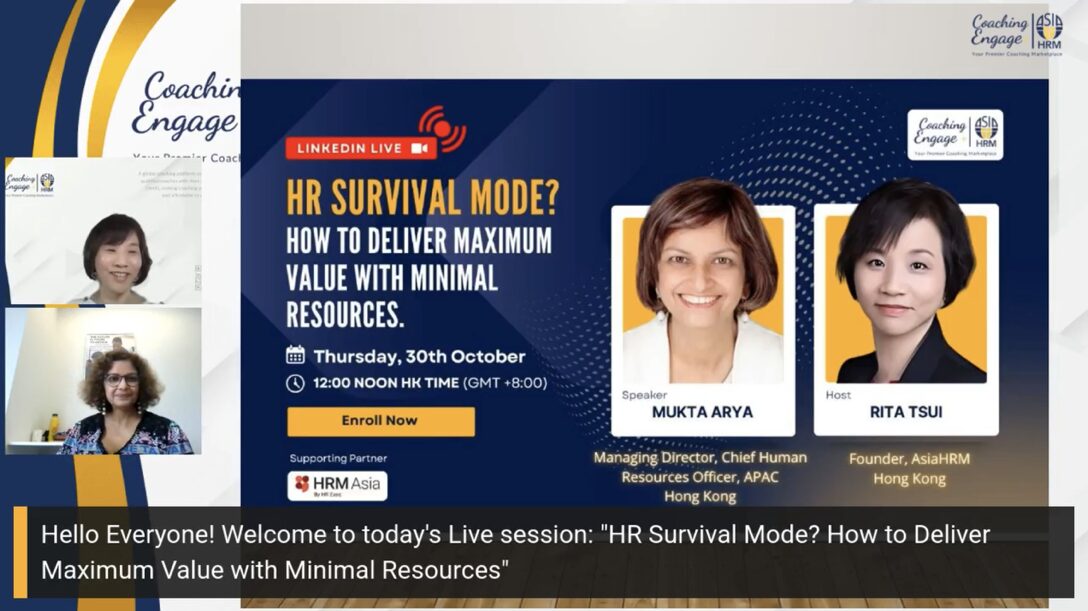
As global economic headwinds tighten budgets and stretch resources, HR leaders are increasingly challenged to deliver more with less. In a recent AsiaHRM webinar, HR Survival Mode: Delivering Maximum Value with Minimal Resources, Mukta Arya, Managing Director and CHRO, Asia-Pacific, at Société Générale, shared strategies for achieving high impact even amid constraints.
Drawing from her 27 years of experience across Asia-Pacific, Arya emphasised that true strategic value comes not from the size of the HR budget, but from how wisely resources are prioritised, allocated, and aligned with business goals.
“Efficient resource allocation is not about doing less, but doing what matters most,” said Arya. “HR can be a strategic driver even with limited resources if we lead with clarity, creativity, and collaboration.”
Arya began by challenging a common perception: HR as a “support” function. “We are not a support function—we are an enabler,” she asserted. “If we think like business owners, every investment of time, money, and manpower becomes intentional and value-driven.”
She stressed the importance of aligning HR initiatives with business objectives, ensuring every policy or programme directly contributes to organisational performance. Whether it is market expansion, cost optimisation, or workforce transformation, HR must understand the organisation’s strategic roadmap and allocate its limited resources accordingly.
Arya illustrated this with a practical approach: allocating HR team capacity based on business impact. “If one business unit contributes 80% of revenue, I will dedicate more HR resources to support that area, without compromising quality for others,” she explained.
Let data tell the story
In a resource-constrained environment, data-driven decision-making becomes a critical advantage. “Data tells a story,” Arya said. “It helps you know where to invest, what to optimise, and what to stop doing.”
From analysing medical benefits usage to evaluating training ROI, HR analytics can reveal patterns that guide smarter spending. Arya encouraged HR teams to use data not just for reporting, but as a strategic narrative to advise leadership on cost-saving and performance-enhancing opportunities.
Arya also shared that maximising manpower often requires creativity, flexibility, and empowerment. At Société Générale, she has successfully implemented cross-functional and dual-role arrangements—known as “double-hatting”—to increase agility while developing employees’ career breadth.
“For instance, my Head of HR for South-East Asia is also the Regional Head of Compensation,” she shared. “Cross-training employees enhances their employability while building organisational flexibility. It’s a win-win.”
She also advocates for selective outsourcing—delegating certain specialised or administrative functions to external providers—so internal teams can focus on strategic priorities.
And for Arya, technology is non-negotiable in modern HR. “Manual processes are living in the past,” she stated. “Automation and AI allow HR to focus on high-value work.”
From AI-assisted reporting to cloud-based HRIS systems that integrate learning, succession, and performance data, technology is key to scaling HR impact. But she also highlighted the need for HR professionals to stay tech-savvy and continuously upskill.
“Even if we’re not from the digital-native generation, we must learn. Being tech-capable is no longer optional for HR,” she said.
Engagement without a big budget
When asked by AsiaHRM Founder Rita Tsui how HR can keep employees engaged without substantial funding, Arya’s answer was simple: authentic connection.
“Engagement doesn’t always need money,” she said. “One-on-one conversations, personal notes of appreciation, visibility in front of senior management, and kindness during tough times—these cost nothing but mean everything.”
She also underscored the importance of maintaining team cohesion. “If there’s conflict or gossip, it destroys morale,” she said. “When I hear complaints, I bring everyone together immediately to resolve them. Our goal is progress, not politics.”
READ MORE: AsiaHRM and HRM Asia partner to elevate regional HR leadership dialogue
In closing, Arya left HR practitioners with a powerful reminder: treat the organisation as your own business. “If we don’t understand what the business is aiming for, we can’t provide value,” she said. “When HR understands the business, we give better advice, and that’s when leaders start looking to us as trusted partners.”
Looking ahead, the conversation on creating thriving workplaces continues. While the last session focused on doing more with less, the next AsiaHRM webinar shifts the spotlight to what truly drives engagement and motivation—psychological safety.
After all, building a high-performing, resilient workforce hinges on creating an environment where employees feel empowered to contribute, innovate, and be their authentic selves—factors that transcend efficiency and technology.
In the upcoming session, Steven Filby, former Head of Talent Management and Learning at the Hong Kong Jockey Club, will unpack how psychological safety can transform engagement, collaboration, and innovation across teams. Participants will learn how to identify barriers, design actionable steps, and make small yet powerful changes that build trust and boost morale.
Because in the end, the most resource-efficient organisations are not just those that manage costs well—they are the ones that invest in human connection, trust and belonging.