
Seeing leadership differently: Why darkness is the ultimate HR tool
- Josephine Tan
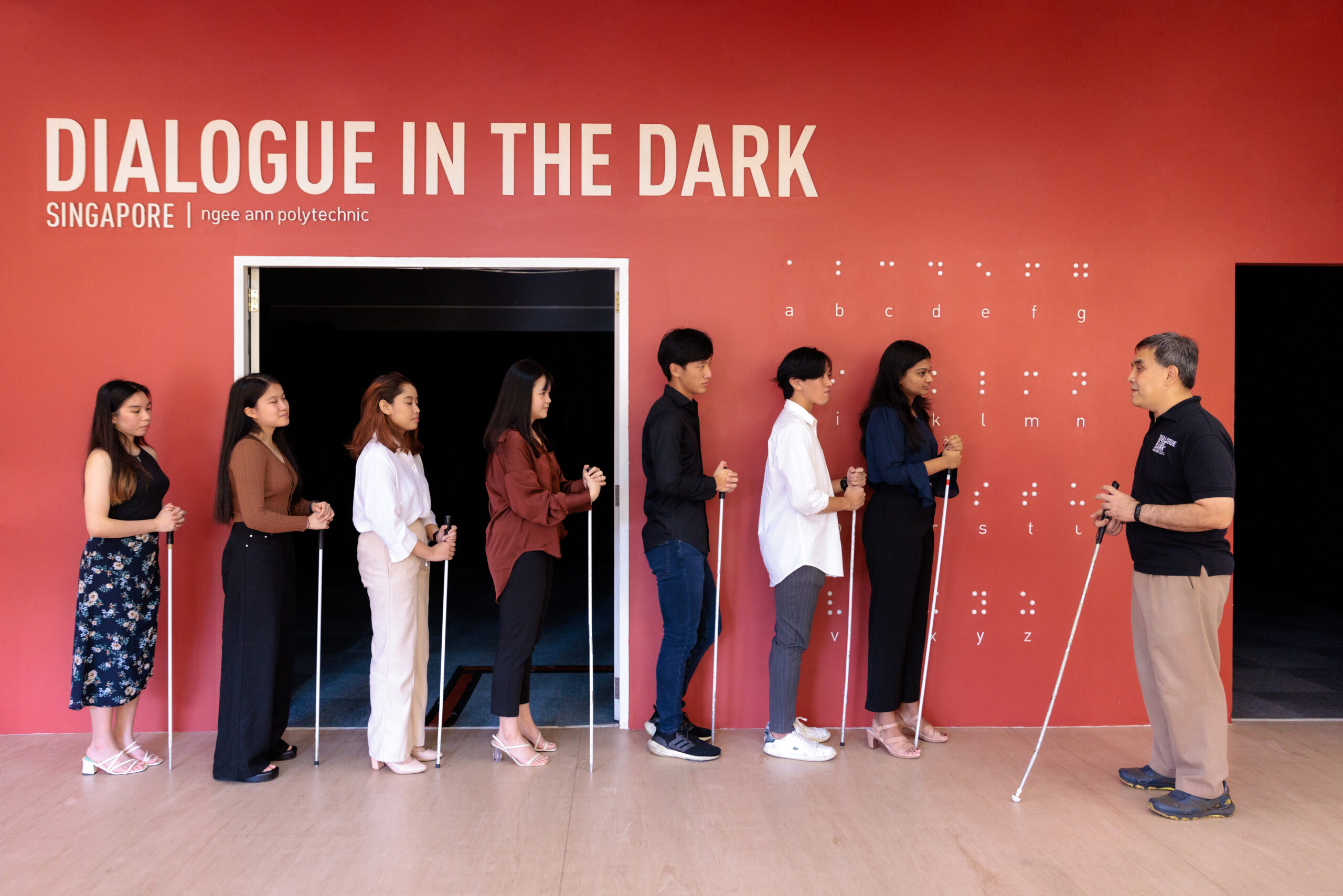
Imagine navigating a world without sight, relying solely on trust, communication, and intuition. At Dialogue in the Dark Singapore (DiDsg), this scenario is more than imagination—it is an immersive reality that transforms the way leaders perceive themselves, their teams, and the world around them.
Housed within Ngee Ann Polytechnic (NP), DiDsg offers a suite of sensory-driven experiences designed to challenge participants to step out of their comfort zones. The Signature Tour in the Dark places participants in complete darkness, guided by vision-impaired facilitators. Makan in the Dark and the Corporate Workshop in the Dark push the experience further, encouraging teams to collaborate without the usual visual cues.
“When sight is removed, participants must depend on their blind facilitators and one another, creating a level of vulnerability, trust, and presence that is difficult to achieve through screens or simulations,” Lin Xin, Director of NP’s CET Academy, tells HRM Asia. “Without visual cues—the familiar anchors people instinctively rely on to communicate, coordinate, and stay in control—they must slow down, listen more intentionally, and collaborate in ways that feel unfamiliar but deeply human.”
The absence of sight strips away the familiar anchors leaders rely on—hierarchy, body language, and visual cues. In this environment, facilitators with visual impairments naturally take the lead. “Our blind facilitators naturally take the lead, challenging long-held assumptions people might have about persons with disabilities and their capabilities,” Lin notes. “With visual cues removed, leaders begin to appreciate how much communication hinges on tone, clarity and patience. Many also recognise unconscious assumptions they bring into daily interactions, and gain a renewed respect for diverse perspectives after witnessing the expertise of our blind facilitators firsthand.”
This vulnerability becomes a catalyst for collaboration. Leaders learn that dependence on others is not a weakness, but a strength. Teams must navigate uncertainty together, developing trust, empathy, and mutual respect along the way. These lessons extend beyond the darkened room. Structured debriefs help participants translate their experiences into real-world behaviours, such as more deliberate listening, inclusive decision-making, and stronger interpersonal connections.
“Participants often describe the experience as transformational,” Lin says. “On a personal level, they speak of gaining stronger self-awareness and confidence in navigating uncertainty. At the team level, the shared experience strengthens communication, builds trust and forges closer bonds.”
DiDsg’s approach demonstrates a key limitation of digital learning. While e-learning and virtual reality excel at knowledge acquisition, they fall short in cultivating deep, emotional, and behavioural shifts. “Some forms of learning—especially those aimed at shifting attitudes, behaviours and mindsets—require genuine human connection,” Lin observes. “Experiences like DiDsg place leaders in a space where they must listen deeply, collaborate intentionally, and rely on people they may previously have underestimated. The learning becomes embodied rather than theoretical, which is why the mindset shifts tend to be lasting.”
READ MORE: Unlearning success: Why your past leadership wins could be your future liabilities
This method has implications for leadership development in the modern workplace. As organisations embrace AI, automation, and rapid technological change, technical expertise alone is insufficient. Leaders must also build trust, communicate with clarity, and connect with people across differences in culture, ability, and perspective. Experiences like DiDsg provide a safe yet challenging environment to hone these skills.
Lin envisions a future in which effective leadership integrates three elements: strong technical and digital capabilities; deep human-centred skills, strengthened through lived experience; and a commitment to inclusive, values-driven leadership. To make this more accessible, DiDsg will launch two new Darkness to Light SkillsFuture Singapore-funded courses from March 2026 onward, offering organisations and teams an avenue to access this experiential learning.
Since its founding in 2009, DiDsg has welcomed over 200,000 visitors and employs a team of approximately 15 blind facilitators who deliver uniquely human learning experiences. The centre’s programmes in the light, such as Spotlight on the Blind, complement these immersive sessions by providing broader insights into the world of persons with disabilities and scaling the impact to larger groups.
“DiDsg will continue contributing to this landscape by providing meaningful, reflective experiences that help leaders bring their full humanity into the way they guide teams and shape organisational culture,” Lin concludes.