
Where AI takes over, where humans stay – and where work simply changes
- Josephine Tan
The debate over AI’s impact on jobs has been conducted in generalities for too long, and it is time for commentaries to become more specific and detailed, said Ong Ye Kung, Singapore’s Minister for Health and Coordinating Minister for Social Policies.
Speaking at NCS AI Impact 2026, the technology firm’s annual forum held at Marina Bay Sands on 9 July, Ong argued that AI’s impact depends on the industry, how demand and market forces evolve, the behaviour of companies, consumer tastes, the exact nature of jobs, and the actions of individual employees.
He sketched three broad categories. In the first, jobs will grow regardless of AI, propelled by powerful driving forces: finance and banking, buoyed by Singapore’s role as an international financial hub; energy; semiconductor manufacturing; and health and social care, where demographic change is fuelling demand – and where the hope is that AI will help mitigate manpower shortages rather than displace employees. The second, and likely the largest, comprises industries where jobs will hold, but AI offers opportunities to do things better, from schools and construction to service and hospitality sectors that depend on human interaction, which can be aided, but not replaced, by AI. Here, Ong argued, consumer taste matters: he firmly believes that people will continue to value mastery and authentic human creation, which will limit the extent of AI’s diffusion.
The third category covers tasks that can be substituted: routine, process-intensive work such as data collection and report preparation is clearly under threat. The concerns of affected employees must be addressed, Ong said, with governments, unions, and employers helping them adjust – and he pointed to the Skills and Workforce Development Agency (SWDA), whose core mission must be to bring opportunities, training, skills, and people into close alignment. In safety-critical systems, he added, human oversight remains essential, noting that in Singapore’s healthcare system AI will not fully replace radiologists, and can substitute only one of two human readers for mammogram scans.
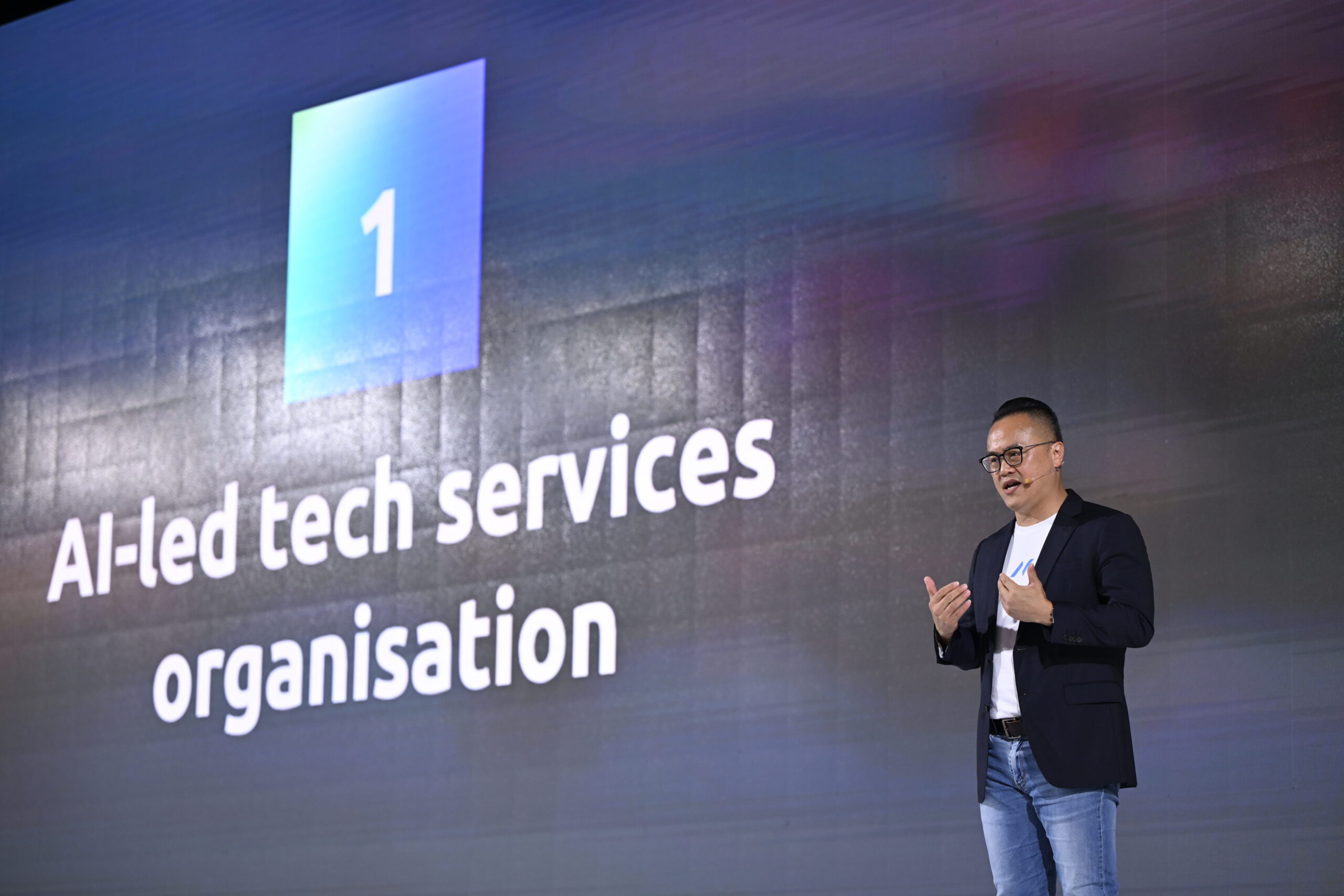
The host organisation, meanwhile, presented itself as a case study in workforce transformation. NCS CEO Sam Liew – marking his 100th day in the role in the organisation’s 45th anniversary year – told delegates the firm is rewiring itself into an AI-led tech services organisation, changing how it organises, builds, delivers, and operates rather than simply adding AI to existing work.
That transformation started internally. NCS has launched more than 100 AI agents to speed up its application development lifecycle, and every employee – including corporate services staff – is now paired with at least three role-based AI agents. Liew cited Jenny, a business support manager of 27 years with no technical training, whose team has used the company’s internal AI tools to turn manual project scope reviews into automated workflows, identify urgent unanswered emails, draft replies, and improve training materials.
“This is exactly what we mean by AI increasing our capability and capacity. Not just for engineers, not just for specialists, but for business support teams who understand their processes,” he said.
READ MORE: AI fluency and human judgment: The twin pillars of sustainable talent strategy
NCS has also onboarded more than 1,900 employees across three work-study programmes that allow employees to upgrade their qualifications while working full-time. The workforce that succeeds in this era, Liew argued, will be “bilingual”, fluent in both technical AI and domain language, bringing together younger employees’ AI-native thinking with experienced employees’ context, judgment, and leadership.
Edward Chen, NCS’ Chief AI Officer, drew a distinction between two kinds of gains. Layering AI on top of existing processes yields perhaps a 10% productivity improvement, he said, but rebuilding work around AI is what delivers a tenfold transformation. He likened large organisations to ships that cannot stop to rebuild: they must upgrade the ship while launching “speedboats” – small, AI-native teams with a mandate to build what did not exist before. NCS launched its first such unit four months ago, staffed by 10 AI-native builders shipping production-ready products in days and weeks.
The structural theme extends to NCS’ own organisation. The company has reorganised into 10 industry-specific Operating Groups, anchored by a newly created AI Central team, led by Chen, that drives strategy and ensures responsible AI adoption across the firm.
The people dimension also features prominently in the NCS AI Playbook, a practitioner’s guide launched at the event and distilled from more than 100 AI projects. Liew said 95% of AI pilots never make it to production, with root causes that include unchanged business processes, a lack of employee reskilling, and employees fearful of being displaced – alongside unclear costs, unready data, and ungoverned agent development.
Beyond its own walls, NCS announced talent partnerships spanning career stages: Applied AI masterclasses for senior executives developed with the Singapore University of Technology and Design, NUS School of Continuing and Lifelong Education, Shanghai Jiao Tong University, and AI Singapore, with role-specific courses such as AI Economics for finance leaders and AI Governance for risk leaders; and a partnership with Digital Industry Singapore under which NCS will hire more than 130 AI practitioners over three years.
Closing his address, Ong said the public and private sectors must navigate the path of AI evolution together, deciding deliberately where to embrace AI, where to rein it in, and where human judgment and effort must prevail. “We must be wiser and more humanistic and practical,” he said.