
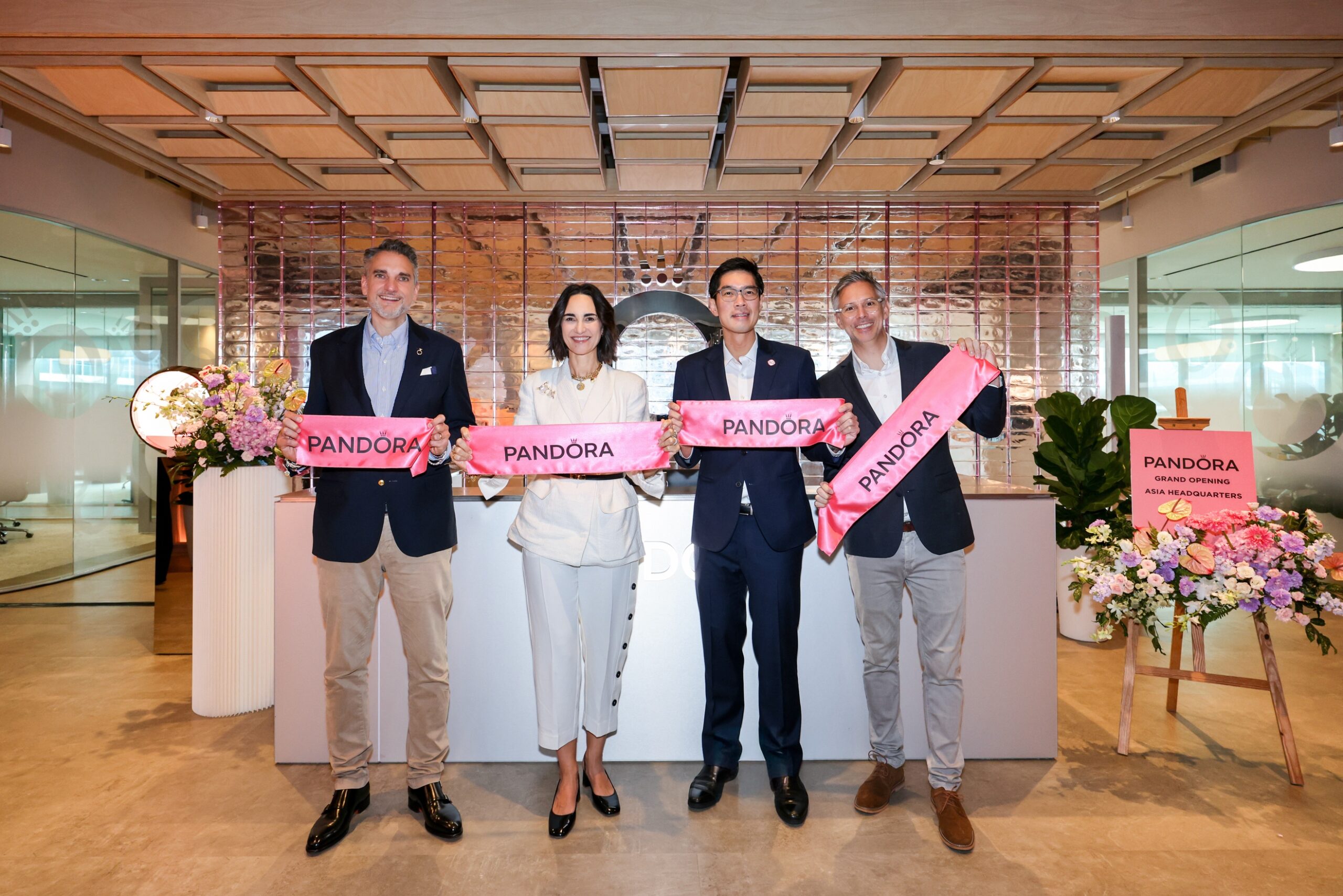
The official opening of Pandora’s Asia headquarters in Marina Bay on 2 October 2026. (Left to right: Byron Clayton, Chief People and Planet Officer, Pandora; Berta de Pablos-Barbier, President & CEO, Pandora; Jermaine Loy, Managing Director, EDB; and Thomas Knudsen, General Manager, Pandora Asia)
When Byron Clayton wants to explain Asia to his Danish colleagues, he sets a small trap for them. “The way I try to explain this to people in Denmark, especially when I am working with Danish people, is to say: you must think that Asia is just like Sweden and Denmark. They are the same, right?” The reaction was immediate. “Of course, Danish people will immediately get offended. No, no, no, Swedes are completely different from Danes. And I say, exactly.”
That instinct, that the differences within a region are its substance, not a footnote, runs beneath the decision Pandora made on 2 October 2026, when the jewellery company opened its Asia headquarters in Marina Bay, Singapore. The office oversees Pandora’s Asia Cluster, spanning both owned-and-operated stores and distributor markets, and brings around 50 people together across branding and marketing, market development and operations. Pandora employs more than 800 people across its offices and retail operations in the region, plus more than 12,000 artisans at its crafting facilities, and operates more than 200 owned-and-operated stores here.
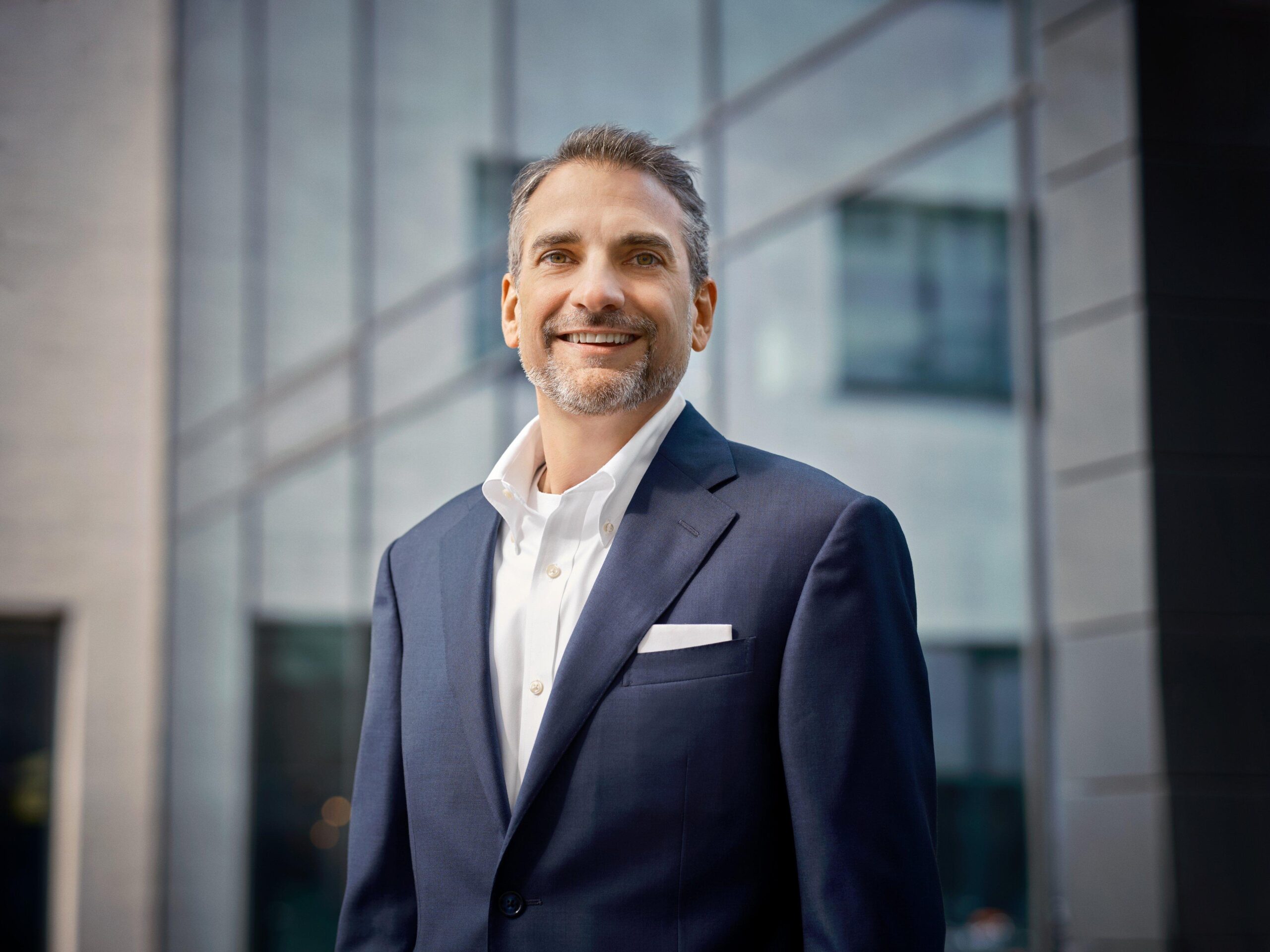
Clayton, the company’s Chief People and Planet Officer, is unusually well placed to have shaped the choice. He spent eight years living and working in Singapore earlier in his career, and two more in Thailand. Across Asia, he tells HRM Asia, the company was looking for more than a convenient address. It was a particular kind of experience that is difficult to assemble anywhere else.
“We did an extensive search before deciding on Singapore. We looked across all of Asia,” he says. “What is very important for us is access to talent and capability. What we find in Singapore, and not in North America or anywhere else, is Asia’s knowledge and experience. We need people who understand how to work across Asia, who understand the complexities, the intricacies, the differences.”
The alternative was to run the region from Copenhagen, and Clayton was blunt about why they rejected it. “Of course, we could try to hire and import people to Copenhagen, but we want people close to the market.” He describes a remit stretching from Japan and China through India and South-East Asia, with only Australia and New Zealand outside it, and argues that proximity cannot be simulated. “We want people based here visiting, seeing our customers, seeing the markets, and being able to have conversations with our partners, our landlords, whoever it might be. Doing that in person is not something you can replicate over the phone from Copenhagen.”
The Singapore Economic Development Board (EDB), which supported the move, framed the benefit in similar terms. “This will also create new opportunities for Singaporeans to take on regional roles and build their experience,” says Jermaine Loy, Managing Director of EDB.
Asked what living in the region taught him that a global headquarters cannot transmit, Clayton’s answer is less about market knowledge than about losing confidence in his own. “Thinking about myself before I came here, it is very easy to be naïve and assume that Asia is just one common thing,” he says. “Living here taught me how much I do not know. It taught me to appreciate the diversity of cultures, how people work differently, and the complexities of doing business here. It is very humbling.”
Where the value actually sits
For a company that serves customers across a global store network, Clayton’s view of what a people function is for starts with an unsentimental reading of where the money is made. “Our purpose as a people function is to help the business strategy come alive and drive the performance of the organisation. We are in retail. We live or die by creating growth. That is a fact.”
Pandora creates value in two places, he says: in its crafting facilities and when a customer walks into a store. This led the company to an unfashionable conclusion about retail attrition. Most employers approach the problem through the candidate. Pandora went at it through the store manager.
The reasoning was that managers reach full productivity only after about 18 months in the role, and that too much of their week was taken up with work that had nothing to do with leading a team. “The managers were spending a huge amount of time on people issues, because employee turnover is a big deal,” Clayton says. Within that non-selling time, recruitment was the single largest item.
The scale of the problem was evident in Pandora’s fourth quarter, the six-week window in which a disproportionate share of its annual business occurs. The company will hire 6,000 people globally during that period. It has already received more than 60,000 applications and is taking between 15,000 and 20,000 a week.
“That is physically impossible to go through,” he says. “That is why we said we need to change the game.”
What Pandora built is a two-stage filter that sits ahead of the manager. Applications are scanned automatically for relevant experience; candidates who pass that stage are sent an online assessment modelled on an analysis of the company’s own highest-performing store associates. Only the top scorers reach a manager, and the system schedules them for the manager’s available time.
Clayton is candid about the behaviour this is designed to protect managers from. “With all love and respect for our store managers, they are so busy and sometimes so desperate that they will just take the first CV they find,” he says. “And then they end up making a hasty decision.”
The point of the screening, on his account, is not to remove judgement from the manager but to raise the quality of what that judgement is applied to. “Even if a store manager is freaking out because they are so busy, they are far more likely to make a better choice now, because of all the screening and help that we have done.”
Careers, not career paths
What the model screens for says something about how Pandora positions itself as an employer. The company runs an assisted-selling model, and the demands it places on the shop floor shape who it looks to hire.
“We have around 1,500 products in our store. We are asking people to learn our products and to help tell stories to our customers,” Clayton says. “We refer to our store associates as storytellers.” The intent, he adds, is “to create an emotional connection with you as a customer, that a piece of jewellery is not just an artefact you wear, but something that has meaning connected to a moment in your life.”
So the company hires for attitude, behaviour and values fit over sector pedigree – which raises the question of what happens once it has finished developing someone whose skills are entirely portable.
Clayton does not dispute the risk. “Of course, you can take the skills and go somewhere else,” he says. His answer is that pay is not the only currency. “Can you go somewhere else and find more money? Of course you can. Can you go somewhere and find a better environment and a better culture? Maybe.” He describes associates weighing a job across the mall that pays more against one they find more demanding and more sociable. “What we really want is for people to thrive and to grow with us.”
The development promise behind that has been deliberately rewritten. Pandora has stopped describing career paths and started talking about careers – a distinction Clayton grounds in how progression actually works. “The old way of looking at career paths, a step-by-step ladder, is not realistic. That is not what happens for most people. Most people focus on broadening their skills and building development that gives them the most opportunities. In other words, employability.”
In practice, that shifts the weight onto the manager. “We want a manager to sit down with you and say, the next best role for you is this, this is how I see you getting there, and this is what you need to do to develop in your job. We are trying to make it real instead of theoretical and on paper.”
He is explicit that this lands differently in Asia, where development and progression carry particular weight. “We know that development is hyper important in Asia, and that people feel they are progressing,” he says. “They are thinking about their employability; they are concerned about their income, their livelihood. They want to grow.”
Pandora’s newest crafting facility in Vietnam has required the company to compress that timeline. The facility opened on 1 October 2026, a day before the Singapore headquarters. While Pandora’s Thai operations have had more than three decades to establish a settled progression structure, Vietnam is ramping up quickly in a market with intense competition for talent. The response has been to build development around demonstrated skills, with a time condition attached so speed does not hollow out the proof. “We have actually looked at how we shorten that cycle,” Clayton says. “They can see the progression happening very quickly.”
People and planet
Clayton’s title is an unusual one, covering people and culture, communications and sustainability in a single remit, and he says the wording was argued over.
“We used to be called human resources. But we said that actually we are a humanistic business. The most important asset we have in Pandora is our people.” Much of the workforce crafts products by hand or sells them face to face. “We wanted to reflect that people are not a resource. They are not disposable. They are an asset.”
The sustainability half was folded in on similar reasoning. “At the end of the day, the reason we do sustainability is that we care for the planet. We care for the environment we live in, and we care for what we do.” The team settled on people and planet partly because it would stick. “We want to give the world a hug, and we want to do the same for our people.”
He points to gender parity achieved three years ahead of the company’s own schedule, with women holding 48% of roles at every leadership level, and to a materials commitment that now covers 100% recycled gold and silver, with platinum to follow, alongside lab-grown diamonds and renewable energy across its factories. Pandora has also set out to halve greenhouse gas emissions across its value chain by 2030. Clayton knows the direction of travel has shifted elsewhere. “You see a lot of other companies today struggling with the environment, and some of them are even rolling back their environmental targets. We believe that this is the right thing to do.”
READ MORE: Sustainability as a talent tool? Make it genuine, these CHROs say
Having begun his career at Nokia and Microsoft, Clayton has watched one technology cycle give way to another, and that has shaped his view of AI. “No one in their right mind would come to you today and say, I miss the days of being in a typing pool, sitting in a room with 20 other people typing for eight hours a day, not being able to save my work,” he says. “In my view, AI is exactly the same. It is not something to be feared. It is something to be embraced.”
Pandora has rolled out AI tools to its office staff, trains employees to build their own agents, and tracks how they use them. For 2027, Clayton’s own organisation carries a target to find 15% operational savings from AI – which he is careful to separate from headcount. “That is not operational savings where we are slashing budgets. It goes back into how we reinvest. And it is looking for that typewriter work that needs to change.”
“There is no belief that we are going to leave anyone behind,” he concludes. “We are taking everyone with us.”