
Can making tea be a career? CHAGEE and ITE build the ladder
- Josephine Tan
- Topics: Home Page - News, Learning and Development, Mobility, News, Singapore
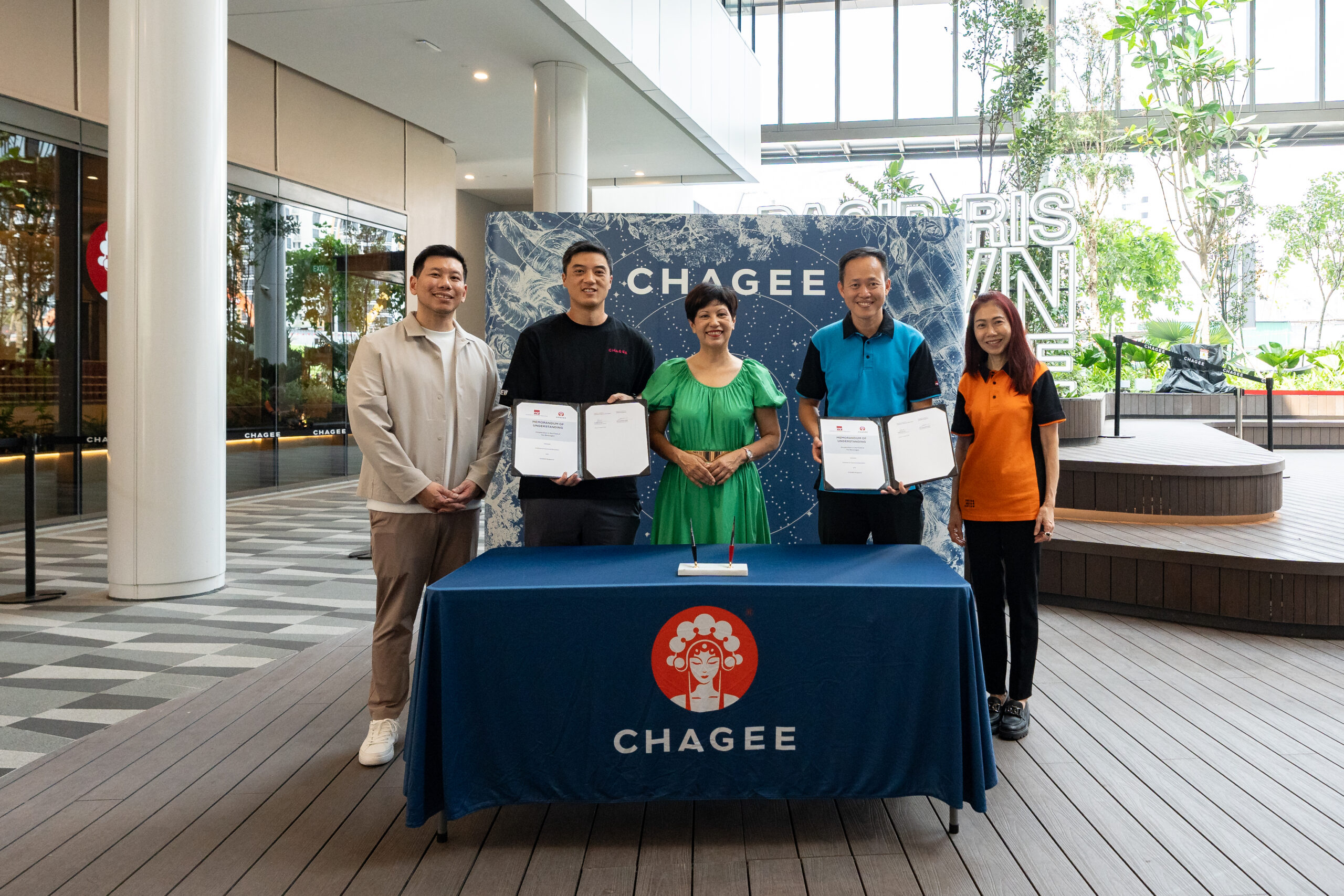
CHAGEE Singapore and ITE sign a memorandum of understanding to create a tea-beverage qualification and career pathway for baristas, witnessed by Guest-of-Honour Indranee Rajah, at the opening of CHAGEE Pasir Ris. (Photo credit: CHAGEE Singapore)
CHAGEE Singapore wants the job of making tea to be treated as a skilled profession – one with formal recognition and a clear path from behind the counter to running a store. The chain set out that ambition at the opening of CHAGEE Pasir Ris, its first store in Singapore’s residential heartlands, where it signed a memorandum of understanding (MoU) with the Institute of Technical Education (ITE), Singapore’s national technical and vocational training institution, to build a tea-beverage qualification and career pathway for its baristas.
Under the MoU, tea-beverage competencies will be embedded in ITE’s Higher Nitec in Hospitality Operations, a vocational qualification, starting with the Barista Service module taken by first-year students, and CHAGEE has committed to creating jobs and offering priority progression for them. The Chinese milk tea chain said the same eight core competencies – spanning tea-barista skills through to operations management – will shape development for its existing store staff, with part of the training delivered on the job.
For Lawrence Wen, CEO of CHAGEE Singapore, the starting point is recognition. The aim, he told HRM Asia, is to give store teams “confidence and also excitement in the work that they do every single day,” and to honour a job that is “very tough” and intensely hands-on. The certificate, in his telling, marks a barista’s craft as “a very privileged and also very honoured skill” that a worker keeps after they leave the organisation.
That recognition is tied to progression, though not an automatic one. Completing the qualification does not, by itself, trigger a promotion, Wen said; what it offers is “the clear pathway…from a tea barista all the way up to a store manager,” built on competencies ranging from making drinks to managing an entire store. He described internal mobility at CHAGEE as “limitless,” noting that many of its managers and founding members began behind the counter, and that management provides the routes and tools for staff to rise.
Pressed on whether certifying the role changes who applies and who stays in a trade known for churn, Wen leaned on professional pride and portable, industry-wide recognition. He was untroubled by the prospect that a portable credential might equip staff who then leave for a rival. CHAGEE, he said, sees itself as a steward “of the entire hospitality industry,” and skills that help the sector grow are “beneficial to all parties involved.”
‘A very important life skill’
ITE framed the qualification as an effort to give standing to work that is routinely undervalued. Denise Tan, Director of the School of Hospitality at ITE College West, said a tea barista’s role “doesn’t just focus on making good tea,” but also encompasses customer service, efficiency, product knowledge and confidence. The programme was built with “checkpoints to make sure that the competencies are all properly achieved,” she said, paired with bite-sized micro-learning that learners can complete on the move.
Tan cast the credentials as “your starting point” that “doesn’t denote your end point,” opening onto opportunities she called “limitless” and “not confined to retail.” Service, she added, is too often waved away, yet it is “a very important life skill” and a source of pride – a message she wanted incumbent food and beverage workers to hear as much as new entrants.
What ‘recognised’ means
CHAGEE has billed the tie-up as Singapore’s first recognised tea-beverage qualification. In practice, the two sides described it as a package of tea-beverage competencies delivered through an existing ITE course and reinforced by workplace training. Peter Lam, CEO of ITE, said in a statement that the arrangement would create “structured skills development pathways” for both students and CHAGEE employees, and that workplace training would “help raise professionalism in tea beverage preparation.”
It leaves a simple proposition on the table, the one both CHAGEE and ITE kept returning to: that making tea is a craft, and the person behind the counter a professional with somewhere to go.