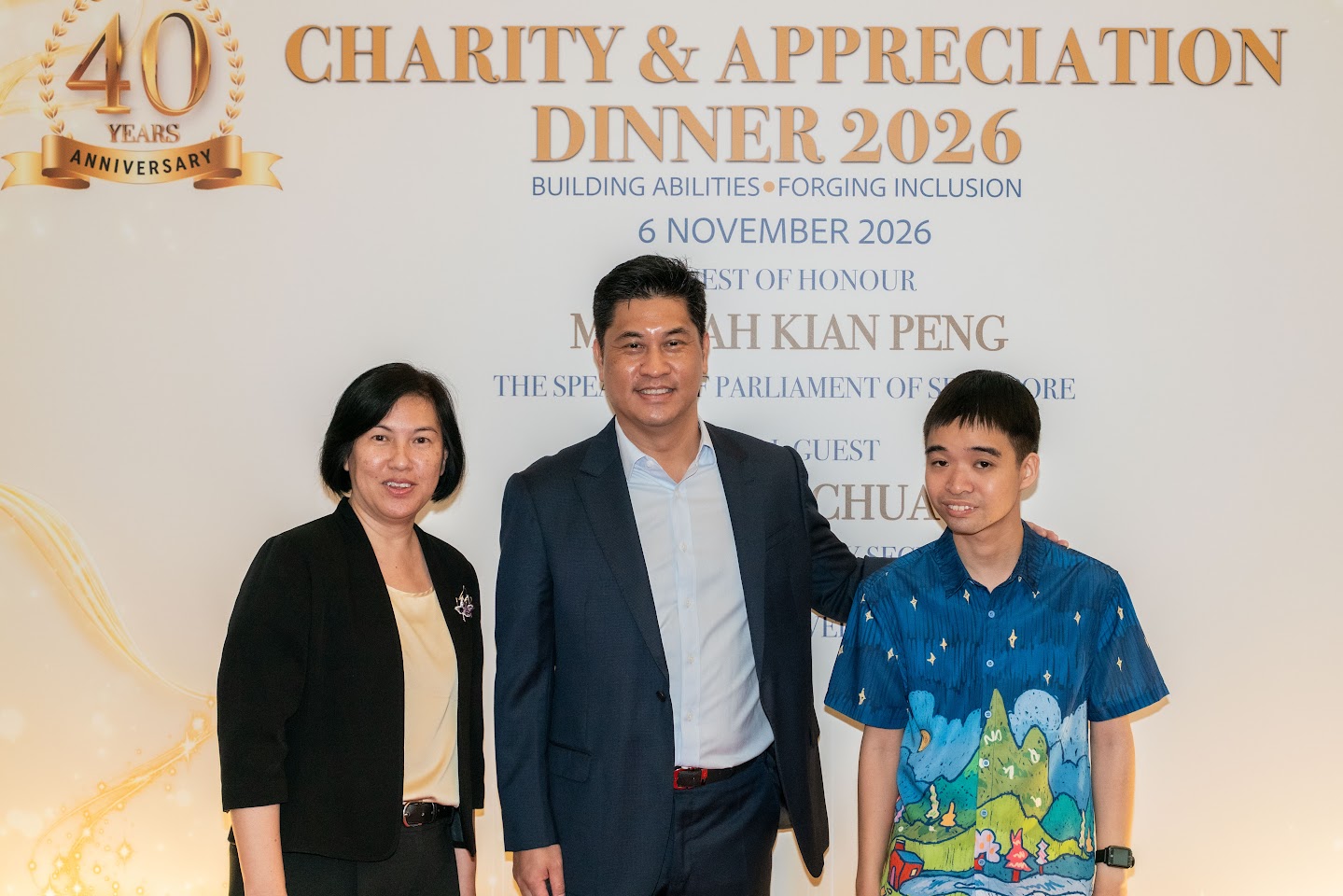

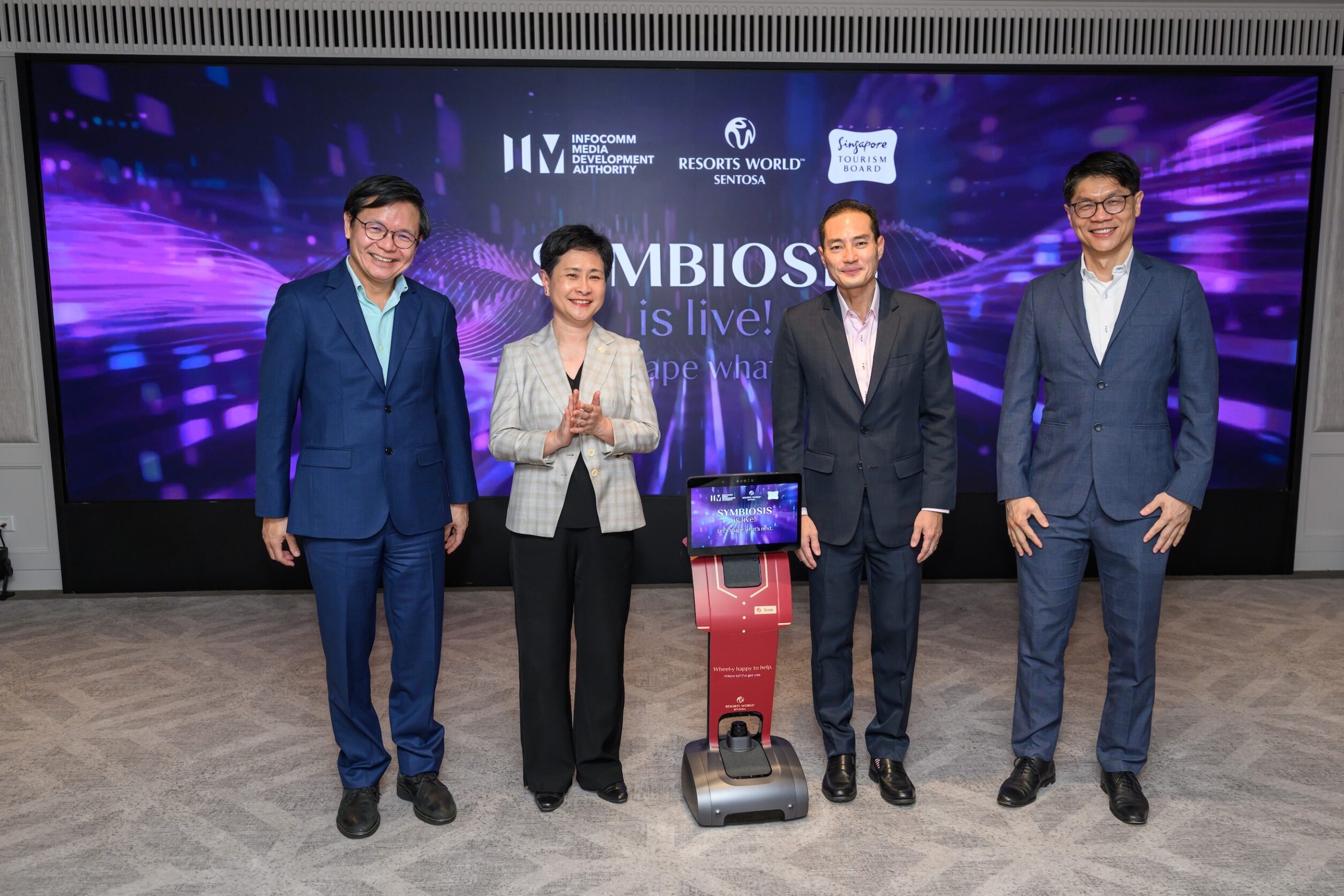
From left: Ng Cher Pong, Chief Executive of the Infocomm Media Development Authority (IMDA); Lee Shi Ruh, Chief Executive Officer of Resorts World Sentosa (RWS); Senior Minister of State for Digital Development and Information Tan Kiat How; and Jordan Tan, Chief Technology Officer of the Singapore Tourism Board (STB).
A guest at a theme park has lost their child. Another has lost a passport, and a third is upset over a missing water bottle. Frontline employees at Resorts World Sentosa (RWS) now practise all three conversations on a phone, talking to an AI guest who reacts to how well they handle it.
The training app is one small part of SYMBIOSIS, a two-year AI “living lab” launched at the integrated resort on 25 November. Supported by the Infocomm Media Development Authority (IMDA), the government agency that develops and regulates Singapore’s digital and media sectors, and the Singapore Tourism Board (STB), the initiative will trial robots, autonomous vehicles and AI tools across RWS’ hotels, attractions, restaurants and event venues.
Much of what goes on show is machinery. But the people side of the project is set out just as explicitly. One of its three workstreams is dedicated to the workforce, covering job and workflow redesign, AI skills assessments, reskilling and upskilling, and leadership development for the resort’s more than 8,000 team members.
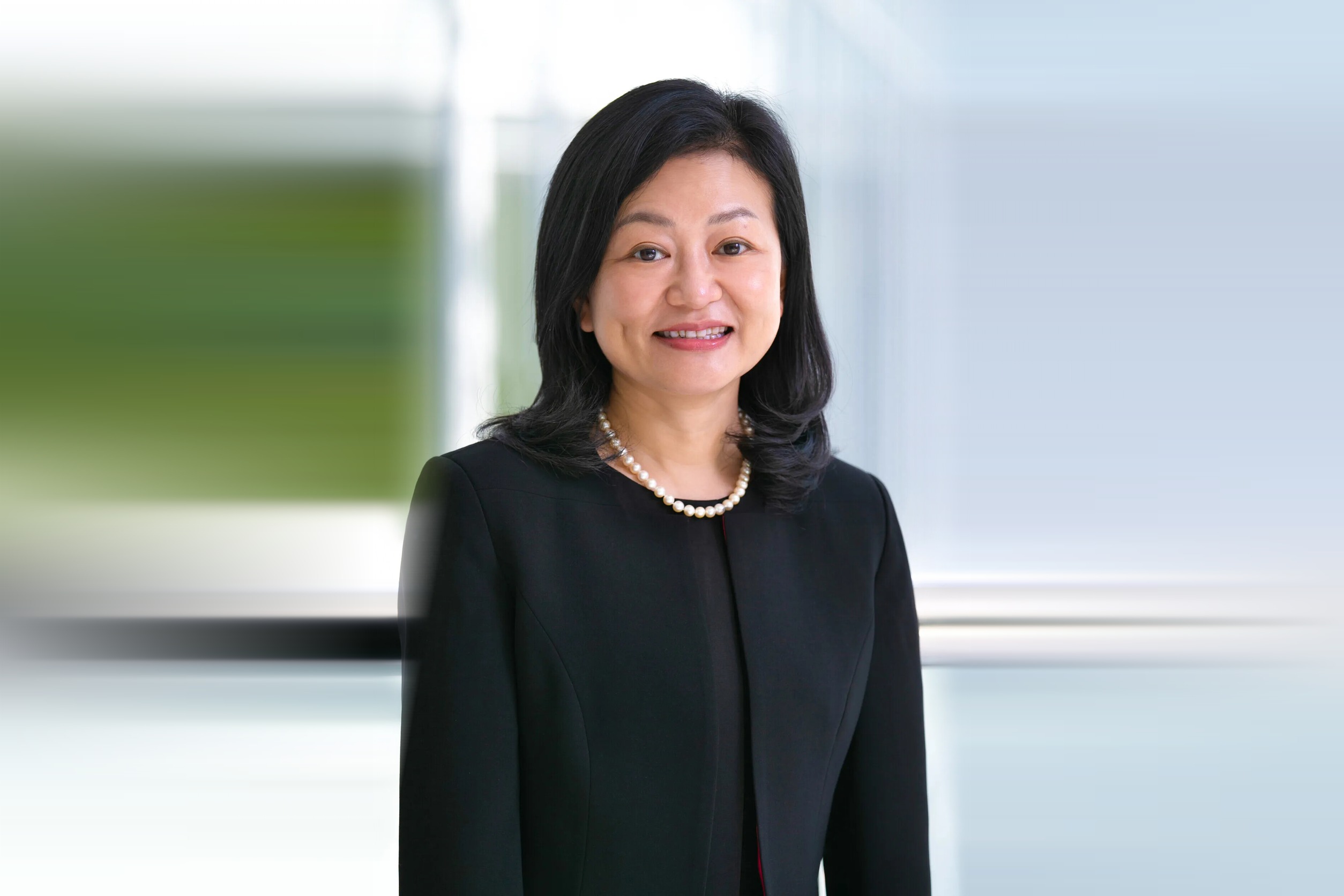
For RWS CEO Lee Shi Ruh, the workforce question is less about whether employees can use new tools and more about what they will need to be good at once those tools are in place.
“We often talk about reskilling and upskilling. The real question is: as technology does more, what skills do we need?” she said in her welcome address at the launch.
Technical skills are part of her answer, she said, since employees will need to “work alongside our digital colleagues”. The longer list, however, is human” interpersonal skills and service excellence, cognitive skills and judgement, emotional intelligence and cultural intelligence.
“These are not soft skills. They are essential skills for the future of work,” Lee said. “As technology changes the work, jobs change with it. And as jobs change, so must the skills we need.”
In hospitality, she argued, standards and consistency sit behind good service, but the best service goes beyond them. “It is reading the guest. Their words, their body language, the spoken and unspoken.”
That idea led to the training pilot now underway. Over coffee with a professor from the Singapore Institute of Technology (SIT), Lee recalled asking whether AI could help employees sense what a guest needs before the guest says it. “I called it mood sensing,” she said.” The pilot is still early. We have much to learn.”
Practising empathy on an AI guest
The result is Empathy One, a set of AI-enabled simulations built by the Centralised Skills Assessment and Validation Initiative (CSAVI) at SIT. Employees respond to AI guest avatars expressing different emotions across scenarios of increasing difficulty, and the avatar assesses how empathetic and effective their responses were. RWS has piloted it with 50 team members, plans to reach 300 by the end of 2026, and then intends to extend it to all relevant guest-facing employees. The organisation said it could later be used in assessment and recruitment too.
Alfred Lau, Senior Executive, Service Excellence and Training, Attractions Destination Experience at RWS, said the app was built to solve a reach problem. Service training at the resort has traditionally relied on role-play and one-to-one coaching, which limits how many people a trainer can work with at once.
“We want to have a platform that will allow team members to complete this training anytime,” he told HRM Asia. “It allows us to reach out to more team members as well.”
The one-to-one sessions are not going away. “We are not taking away that one-to-one training,” Lau said. “We are tapping on Empathy One’s capability as a supplement to that.” The idea is that employees can rehearse whenever they need to, so that when a difficult situation arises on the floor, they can draw on both their classroom training and their practice on the app.
He admitted the format took some getting used to. “To be honest, even for myself, when I first used Empathy One, I found it a little bit strange because I have never interacted with an AI persona before,” he said. What he found interesting was how the avatar reacted. “If you respond in a not-so-appropriate way to the AI, the AI will be able to give you a not-so-good response.”
The early feedback from employees has been encouraging, by his account. “I had a team member who actually came to me and said, ‘I’m actually more confident now after using the app.’”
For trainers, the tool also offers a second pair of eyes. Because Empathy One lists the improvements each user needs to make, Lau said it can catch things that slip past a trainer when a session gets busy. That does not change who is in charge of the learning, he said. “In adult learning, the human element cannot be removed. AI is a supplement to what we do.”
Asked how the trainer’s role might evolve, he was firm. “As a trainer, it will not replace the human element,” Lau said. “AI is a tool that we leverage on so that we can make an experience better for our learners or even for our guests.”
Dividing the work with robots
Elsewhere in the resort, the pilots look more like logistics than learning. A driverless refrigerated vehicle carries pastries from the central kitchen through an underground service network to the Pierre Hermé pâtisserie. An all-terrain robot delivers food to kisks across Adventure Cove Waterpark. Trials of a washroom-cleaning robot are being explored, which RWS said would leave employees to focus on detailed cleaning and guest care.
At Equarius Hotel, an indoor robot is ferrying guest amenities such as dental kits and shower caps from back-of-house storage to guest floors overnight. If scaled across RWS’ hotels, the organisation said, it could free up storage space and reduce physical strain on housekeeping teams.
READ MORE: Tourism offers jobs, not careers. Mandai Wildlife Group is trying to prove otherwise
On the ground, the picture is more tentative. Maria Tham, Assistant Housekeeper at Equarius Hotel, said it was still too early to put a number on the time saved. Her team continues to load and unload amenities while learning what the robot can and cannot do, and the work has settled into a division of labour: the robot takes the smaller amenities, and employees handle the larger items.
“As with any new technology, there is a familiarisation period, and the trial has been valuable in helping us better understand its capabilities and how it can complement our existing workflows,” she said.
Tham, who joined RWS in 2011 as a Linen and Guest Laundry Supervisor, sees the technology as connected to how housekeeping careers develop. “I believe technology and career growth go hand in hand,” she said. The final say on every room still rests with her team. “Technology helps us work more efficiently, but the attention to detail and personal touch that our team brings remain essential.”
Workforce planning is also on the agenda. RWS employs shift workers and engages casual staff, and the organisation said a smart rostering system and an intelligent casual workforce management solution could help it deploy people more effectively as demand shifts across the resort.
Lessons beyond the resort
What RWS learns is meant to travel. IMDA will help scope projects, bring in technology partners and document lessons so that proven solutions can be replicated in other enterprises and sectors. The work also feeds into Singapore’s National AI Impact Programme, which aims to help 10,000 enterprises deepen their AI adoption over three years and equip 100,000 employees to become “AI-bilingual”. STB will work with industry partners to take successful trials to the wider tourism sector.
“Equally important, we want the tourism workforce to build new skills and take on higher-value roles,” said Jordan Tan, Chief Technology Officer of STB.
RWS’ Lee described the exchange as running both ways. “AI is learning from our people,” she said. “And we are learning from AI.”