
How CHAGEE rebuilt a tea store to run on sight instead of sound
- Josephine Tan
- Topics: DE&I, Employee Experience, Features, Home Page - Features
Victor Teo almost turned down the job. “Initially, I was slightly hesitant to join, as I was unsure if the environment would be right for me,” he says. More than a year on, the barista at CHAGEE Singapore’s Signing Store at the National University of Singapore (NUS) frames that decision very differently. “Honestly, it has changed me a lot.”
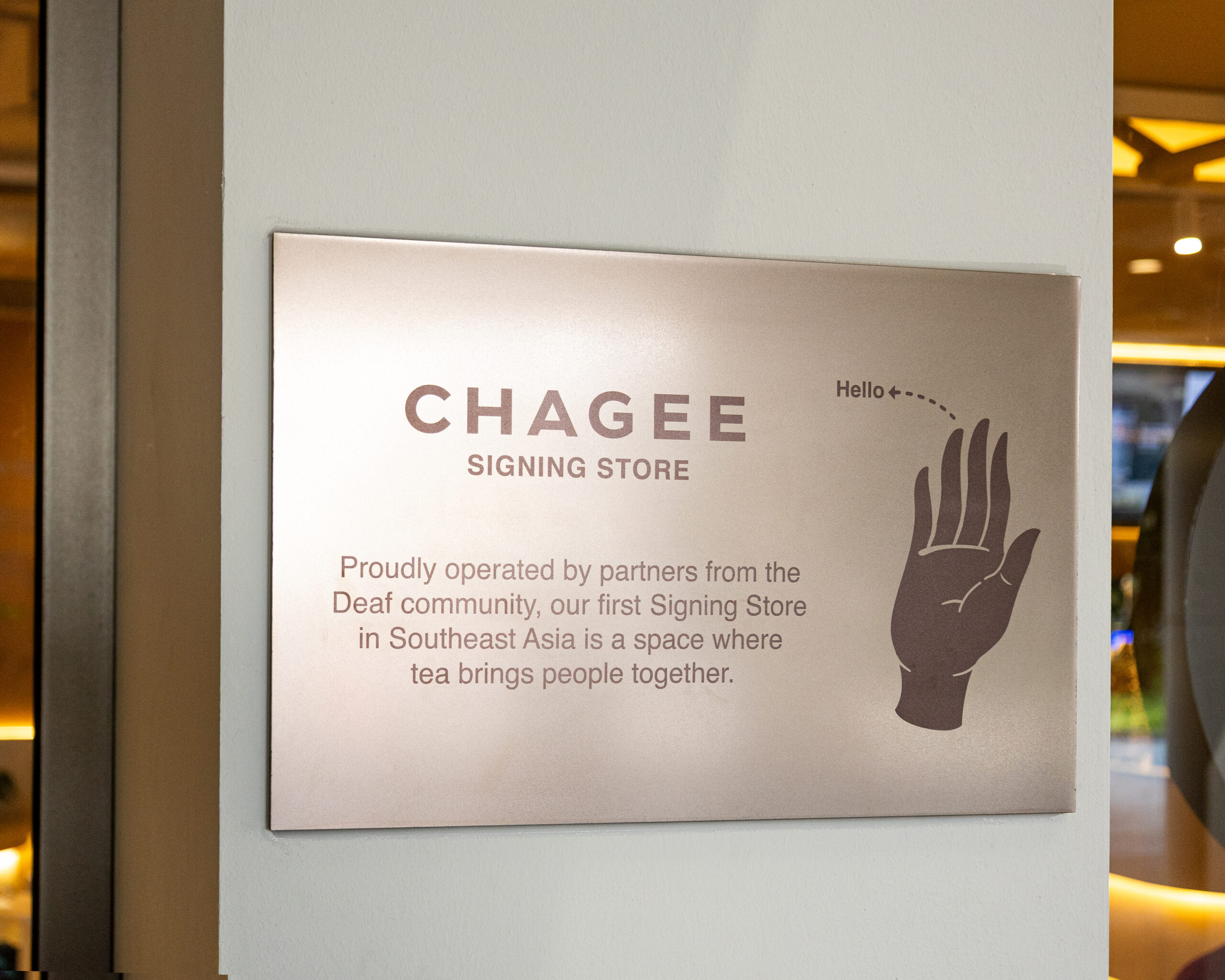
The store where Teo works opened in 2025 as CHAGEE’s first Signing Store in South-East Asia, and the first of its kind in Singapore – a high-traffic tea outlet on a university campus, staffed by deaf and hard-of-hearing baristas and developed with support from SG Enable, the national agency for people with disabilities, and the Singapore Association for the Deaf. For Teo, the year since has been a lesson in what he is capable of. He describes learning to communicate through sign language, growing comfortable with the equipment in a space that “can get noisy at times,” and handling the pressures any busy food-and-beverage employee would recognise. “I need to have a good sense of time management and multitasking skills, especially to deal with the rush of orders during the peak period,” he tells HRM Asia. “Being able to manage all these has also made me more assured of my own abilities.”
Ask him what the store means, and the answer comes back in three words: “communication, connection and community.” That everyday confidence is precisely what CHAGEE says it set out to create.
Designing the store around its employees
“For us, inclusive hiring is fundamentally about recognising talent and creating the conditions for people to perform at their best,” says Lawrence Wen, Chief Executive of CHAGEE Singapore. The organisation had already run Signing Stores in China, which he says gave it confidence that deaf and hard-of-hearing employees “can thrive in high-volume retail environments when workplace systems are designed inclusively.” Bringing the concept to Singapore, though, was not treated as a transplant. “We did not approach it simply as a social initiative,” Wen says. “That meant listening closely to our deaf and hard-of-hearing partners rather than assuming that an existing operating model would automatically work.” The word the team kept returning to, he adds, was “empowerment.”
In practice, that thinking reshaped the store itself. The space was softened for the senses – quieter acoustics, calmer layouts, and what Wen calls “an overall quieter and more welcoming experience,” designed for anyone who walks in and not only for the baristas behind the counter. The local team trained under a sign language master to learn practical ways to communicate on the floor. And the workflow was rebuilt around sight where it had once relied on sound. CHAGEE’s tea machines traditionally signal a finished brew with an audio tone; at the Signing Store, that became a visual red-light cue. Counter screens now route orders straight to the kitchen display, and, as Wen puts it, a low-stock alert “reaches the back of house without anyone needing to shout across the floor.”
None of it, he stresses, was a single fix at the point of opening. The adjustments kept coming through continual feedback with the baristas, as the team looked for barriers that only surfaced in daily use. “This endeavour underscored the importance of continuing to ask whether the systems in place still serve the people using them,” Wen says. “That mindset shapes how we think about every store now, not just this one.”
When inclusion becomes ordinary
For all the deliberate design, the outcome Wen returns to most is an unshowy one. “What has stood out to us most is how quickly the Signing Store has become, quite simply, another busy CHAGEE store,” he says. It is a high-volume location with heavy delivery demand and crowded peak periods. Many of the deaf and hard-of-hearing baristas had trained at other CHAGEE outlets before moving over, which smoothed the transition and, in Wen’s account, lifted their confidence at the same time. The team, he says, handled the demand “just as proficiently as any other store in our network.”
The store has also changed something in the way customers meet the brand. “Customers encounter inclusion not through a campaign or message, but through an ordinary interaction,” Wen says – ordering a drink, communicating with a barista, watching the place run like any other. “That is perhaps the outcome we value most. We want inclusion to feel normal rather than exceptional.”
Making that ordinariness work still asks for small adjustments on both sides of the counter, and Teo is clear about what helps. Patience, first of all. Speaking a little slower so he can follow, or reaching for the writing pad or a phone; sometimes, he and customers simply sign. “When we’re not facing them, we cannot hear them, so we are thankful when they wait for us to be able to see them before asking us questions,” he says. The same holds for employers, he adds, down to details that are easy to miss: “When we communicate with them, we are unable to call them and can only text each other. Their understanding when it comes to small details like this can really make the difference.”
READ MORE: Can making tea be a career? CHAGEE and ITE build the ladder
Those details are, in effect, the day-to-day version of the question Wen wants managers to keep asking. And for him, the NUS store is a first step rather than a finished statement. “This store was always meant to be a starting point in our long-term journey of promoting inclusive workspaces,” he says. Deafness, he notes, “is only one part of a much broader spectrum of disability,” and having a working model in other markets made this particular concept more straightforward to bring over – something he is careful not to treat as a ceiling.
What would move inclusive employment from stand-out projects to standard practice across the sector? For Wen, the shift is one of mindset. It “becomes mainstream when organisations stop viewing it as something separate from everyday workforce planning,” he says – weighed in the same breath as recruitment, training, workplace design, technology and career development.
Teo has his own version of that ambition, pitched closer to the floor. Having found his footing over the past year, he now wants to shorten the distance for whoever comes next. “My goal is to ensure that whenever a new partner joins, I can help make them feel more comfortable in our store, guide them on how to do tasks, and overall make their experience working here a meaningful one.”