
How the search for purpose is rewriting the social contract between employer and employee
- Josephine Tan
Talent attraction and retention have become increasingly complex in a business environment shaped by skills shortages, technological disruption, and shifting employee expectations. While organisations continue to invest heavily in compensation, benefits, and workplace technologies, many HR leaders are discovering that sustainable workforce strategies are rooted in something more fundamental: purpose, human connection, and continuous learning.
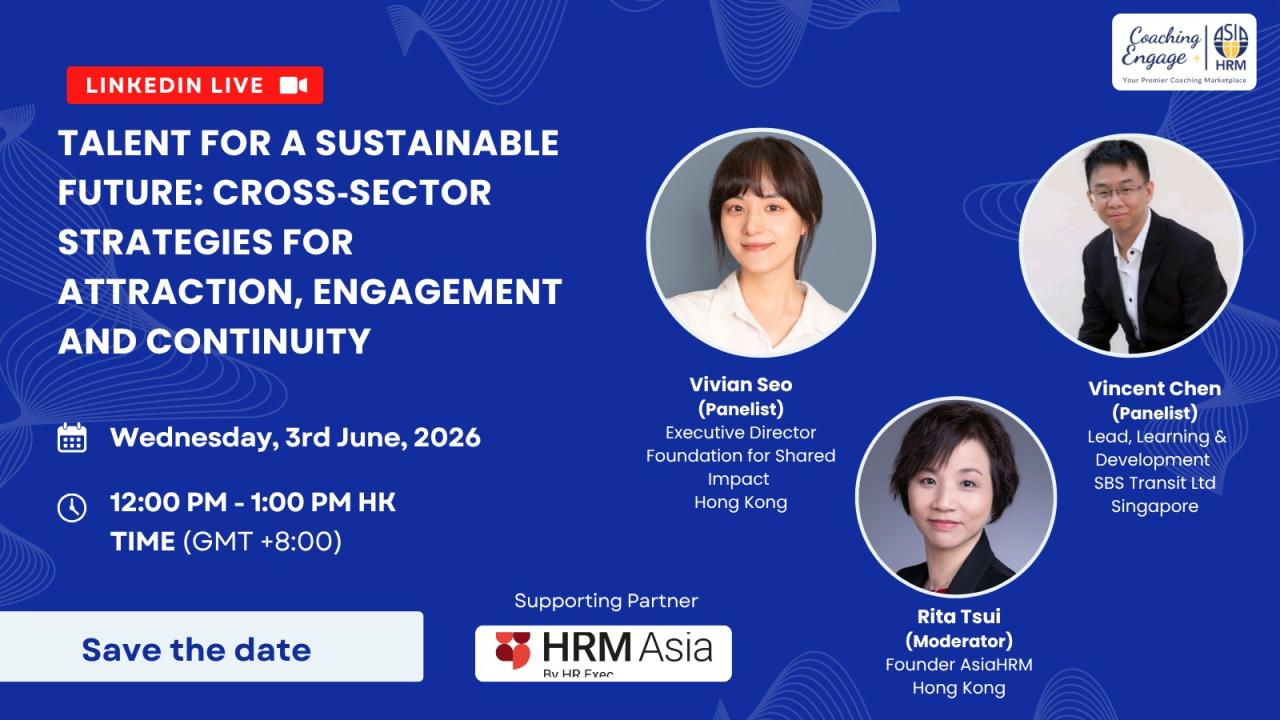
These themes were at the heart of the latest episode of AsiaHRM’s Sustainability in Business Series, titled Talent for a Sustainable Future: Cross-Sector Strategies for Attraction, Engagement and Continuity. Bringing together leaders from the corporate and nonprofit sectors, the discussion explored how organisations can build resilient workforces by creating meaningful employee experiences, developing future-ready skills, and fostering cultures where people feel valued and empowered to contribute.
Vivian Seo, Executive Director of the Foundation for Shared Impact (FSI) in Hong Kong, and Vincent Chen, Lead, Learning and Development at SBS Transit in Singapore, shared insights from their respective sectors, highlighting how businesses and nonprofits can learn from one another to create sustainable talent strategies that benefit both organisations and society.
Purpose is becoming a competitive advantage
In an increasingly competitive labour market, purpose has become a powerful differentiator. According to Seo, while younger generations are often associated with a stronger desire for meaningful work, the search for purpose extends across all career stages. Employees want to understand how their work contributes to something larger than themselves and how their efforts create value beyond immediate business outcomes.
“The mindset where we’re no longer thinking about talent as somebody who delivers tasks, but through work, someone who can find their personal meanings through work as well,” she said.
Importantly, she stressed the purpose is not exclusive to the nonprofit sector. Organisations can generate meaningful impact while remaining commercially successful, provided they clearly articulate their mission and create opportunities for employees to connect with it.
Purpose becomes even more powerful when employees are empowered to take ownership of initiatives aligned with organisational values. Rather than relying solely on mission statements or employer branding campaigns, organisations should encourage employees to lead activities that reinforce the organisation’s broader purpose.
Chen echoed this sentiment, sharing how SBS Transit’s CARES values—Caring, Agility, Reliable, Eco-Friendly, and Safe—help shape employee experiences and customer interactions. Through community engagement programmes, innovative initiatives, and daily leadership practices, employees are encouraged to see how their work contributes to a larger purpose.
“Leaders set the purpose and employees feel it,” he said.
Engagement requires more than financial incentives
While fair compensation remains essential, both speakers agreed that employee engagement cannot be sustained through financial rewards alone.
Seo challenged the long-held perception that nonprofit employees should simply accept lower pay because they are motivated by social impact. “Fair wage and fair pay have to be there, regardless of you being in the nonprofit sector,” she said.
Once employees feel fairly rewarded, however, other factors become increasingly important. Purpose, autonomy, and ownership often play a greater role in sustaining long-term engagement than additional financial initiatives.
Drawing on her experience in the nonprofit sector, Seo highlighted the value of giving employees the freedom to shape projects and make meaningful decisions. Such autonomy fosters a stronger sense of accountability, ownership, and commitment. “Having enough sense of autonomy and sense of purpose of doing their own tasks, I think that would be the way to incentivise people on top of the monetary return,” she said.
Chen pointed to another powerful engagement driver: listening. At SBS Transit, regular team briefings and feedback sessions provide employees with opportunities to share concerns, ideas, and experiences. These conversations are particularly important for frontline employees who may have limited interaction with senior leaders. “If the employees are not being heard, it’s very hard to generate engagement and get purpose,” he said.
The organisation also supports employee wellbeing through mental wellness initiatives and other programmes that reinforce its commitment to caring for employees beyond their job responsibilities.
For both speakers, engagement ultimately comes down to helping employees feel seen, valued, and supported.
Preparing talent for an AI-shaped future
As AI continues to transform industries and redefine job roles, organisations face growing pressure to build adaptable and future-ready workforces.
For Chen, preparing for change begins with anticipating future skills requirements rather than reacting to them. SBS Transit works closely with educational institutions, industry bodies, and external partners to identify emerging competencies and equip employees accordingly.
The organisation has introduced training programmes related to electric vehicles, high-voltage systems, AI-enabled diagnostics, and virtual reality simulations. It also collaborates with community organisations that support individuals with dementia, autism, and visual impairments, helping employees develop the skills needed to serve an increasingly diverse commuter population.
“We have built capabilities ahead of the curve,” Chen said. One lesson that has stood out is that adaptability is not limited to younger employees. Some of the organisation’s most enthusiastic learners are experienced employees who have embraced new technologies and become champions of change.
While technical capabilities are critical, Seo argued that organisations must also invest in skills that AI cannot replicate. “The more AI-driven the world becomes, the more important it is to build non-AI skills,” she said. These include communication, relationship building, empathy, creativity, critical thinking, and the ability to conceptualise and solve complex problems. As AI increasingly handles administrative and repetitive work, these human capabilities will become even more valuable.
Leadership remains the ultimate differentiator
Throughout the discussion, one message surfaced repeatedly: leadership behaviours play a decisive role in creating cultures where people want to stay.
Chen shared examples of leaders who actively break down hierarchical barriers by encouraging employees to engage with them openly and informally. “Don’t see me as a leader. See me as one of yourselves,” he said, describing an approach adopted by some leaders within the organisation. Such behaviours help foster trust and create a stronger sense of belonging. They also encourage employees to speak openly about challenges, ideas, and opportunities for improvement.
Beyond accessibility, Chen emphasised the importance of consistent and genuine check-ins. Drawing on his experience at previous organisations, he noted that leaders who regularly ask employees how they are feeling and what support they need often build stronger, more committed teams.
Seo agreed, stressing that leadership credibility is built through action rather than messaging. “Leaders really need to walk the talk,” she said. Whether promoting volunteerism, social impact initiatives, or employee development programmes, leaders must actively participate for employees to embrace these priorities.
Collaboration is key to long-term talent sustainability
Building sustainable talent strategies is not something organisations can achieve alone. Seo encouraged organisations to develop long-term partnerships with nonprofits, educational institutions, and community groups to strengthen talent pipelines and gain deeper insight into workforce needs. Such partnerships create opportunities for mentorship, skills development, and meaningful employee engagement while helping organisations better understand the expectations of future talent.
“It’s really not about just the private sector or the social sector,” she said. “It’s about who the partners are that we can work together with in the long term.”
Chen highlighted the importance of linking talent development efforts to broader environmental, social, and governance (ESG) objectives. By recognising employee contributions, sharing success stories, and demonstrating social impact, organisations can create stronger alignment between workforce engagement and business performance.
For organisations seeking to futureproof their workforce, collaboration offers an opportunity to expand capabilities, strengthen community connections, and create long-term value beyond organisational boundaries.
Sustainable talent strategies are no longer defined solely by recruitment metrics or retention rates. They are increasingly measured by an organisation’s ability to create purpose, foster belonging, develop adaptable skills, and build meaningful partnerships. As businesses and nonprofits alike navigate an increasingly uncertain future, the organisations that succeed will be those that recognise a simple truth: sustainable organisations are built by sustainably engaged people.