
One size does not fit all: Decoding the cultural blind spots of psychological safety
- Josephine Tan
Psychological safety has become one of HR’s most frequently cited priorities—but in Asia’s multicultural workplaces, it is also one of the most misunderstood.
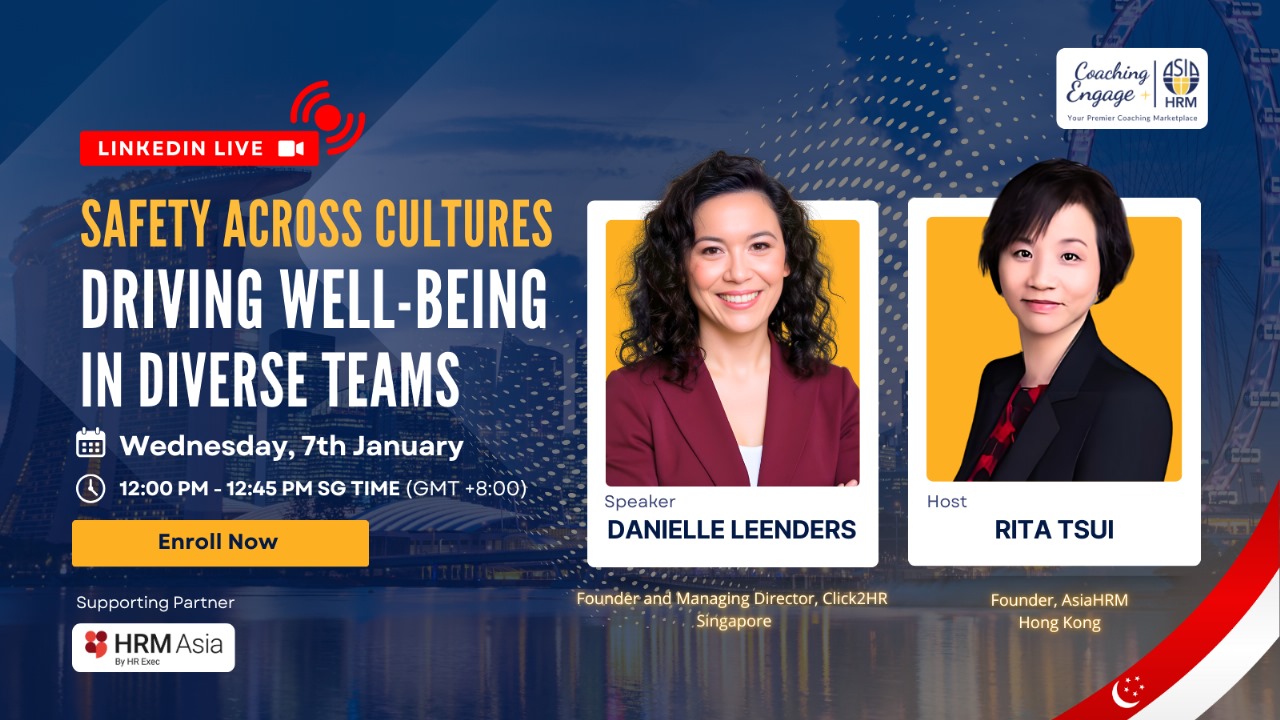
That was the central message from Safety Across Cultures – Driving Wellbeing in Diverse Teams, a recent Asia HR Leaders Live session hosted by Rita Tsui, Founder of AsiaHRM, and featuring Danielle Leenders, Founder and Managing Director of Click2HR. Supported by HRM Asia, the session explored how cultural background, power dynamics, and representation profoundly shape whether employees truly feel safe at work.
“Psychological safety is often measured by whether people speak up or challenge their managers,” said Leenders. “But these behaviours are not culturally neutral.”
When “speaking up” isn’t universal
In Western-influenced leadership models, psychological safety is often equated with directness, visible participation, and vocal disagreement. Yet in Asian contexts—particularly in multicultural hubs like Singapore—these behaviours can clash with deeply ingrained norms around hierarchy, restraint, and harmony.
Leenders, who was born in Hong Kong to a Chinese-Dutch family and now works in Singapore, shared how her own experiences of being “in between” cultures shaped her sensitivity to inclusion and belonging. That perspective has carried through her 17-year HR career across Europe and Asia.
“Teams can look polite, efficient, and high-performing on the surface,” she explained. “But underneath, there can be a lot of self-censorship.”
In a typical Singapore-based multinational, Leenders described a workforce comprising local Singaporeans, Western expatriates, and professionals from across Asia. While all are capable and qualified, the personal cost of making a mistake—or challenging authority—varies differently.
“For many foreign professionals, job security is directly tied to their right to stay in the country,” she noted. “The question ‘what happens if this goes wrong?’ carries very different weight.”
Whose version of “good” gets rewarded?
One of the most resonant moments of the session came through a familiar workplace scenario.
Leenders described two peers: Mei, a locally experienced Chinese team leader who is thoughtful, analytical, and precise; and Dan, her Australian counterpart, who is confident, outspoken, and socially visible—but with less technical depth. In meetings, Dan was seen as more influential. When promotion time came, he advanced.
“No one says anything when this happens,” Leenders said. “But everyone notices.”
The lesson, she argued, is not about individual merit but about the systems organisations use to define leadership potential. When promotion criteria privilege visibility, assertiveness, and verbal dominance, they systemically favour some cultural styles over others.
“If it’s always the same group that needs to ‘develop’ towards a particular standard,” she asked, “is that really development—or is it assimilation?”
Safety is structural, not performative
Psychological safety, Leenders emphasised, cannot rely solely on individual bravery. When leadership norms are homogenous—whether in nationality, communication style, or cultural training—safety depends on how willing employees are to adapt, code-switch, or suppress parts of themselves.
True safety, she argued, becomes structural only when organisations widen their definition of what “good” looks like.
This includes recognising different forms of contribution beyond speaking up in meetings, valuing substance alongside presence, and ensuring representation at senior levels so employees can see paths forward that do not require abandoning their identity.
“Representation reduces the emotional cost of participation,” she said. “It shows people there is more than one way to succeed.”
The signals employees never forget
Leenders also highlighted how seemingly small organisational decisions send powerful signals about whose needs matter.
She cited examples such as restructuring timelines that protect Christmas but disrupt Lunar New Year, or organisations that observe public holidays without understanding—or acknowledging—the traditions behind them. Over time, employees learn which parts of themselves are welcome and which are better kept invisible.
READ MORE: Stop fixing systems, start unlearning: An HR leader’s guide to futureproofing talent
The same applies to everyday leadership behaviours. Employees constantly observe what happens when someone makes a mistake, challenges a decision, or offers dissent. They remember interruptions, dismissive reactions, and moments where leaders fail to repair trust.
“Psychological safety often breaks down vertically,” Leenders said. “And people have a very long memory.”
HR’s role: Designing for fairness
While HR may not control leadership behaviour, Leenders stressed that HR holds significant influence through system design.
Promotion criteria, performance calibration, leadership development frameworks, and even the use of performance improvement plans (PIPs) all shape whether safety is reinforced—or undermined.
“When ‘not proactive’ or ‘doesn’t speak up’ shows up on a PIP, we need to ask deeper questions,” she said. “How does this person perform in their core role? How do peers and stakeholders experience them? And were there multiple channels for contribution?”
In psychologically unsafe environments, she warned, PIPs do not fix performance—they legitimise fear.
HR can also support leaders through coaching, observation, and feedback, particularly around how leaders receive input, not just how they give it. Even small acts of repair—acknowledging missteps, revisiting decisions, or apologising publicly—can have an outsized impact on restoring trust.
Start with noticing
When asked about the most challenging part of shaping culture, Leenders was clear: honesty.
“Culture isn’t what we aspire to—it’s the sum of what people actually experience,” she said. “If we want to change it, we need to confront where we really are, not just where we want to be.”
Her closing reflection captured the heart of the session: psychological safety is not a generic ideal, but a question of perspective.
“When we talk about safety and wellbeing,” she said, “we need to ask: whose safety are we really talking about?”