
The apprentice and the veteran: How expertise survives automation
- Josephine Tan
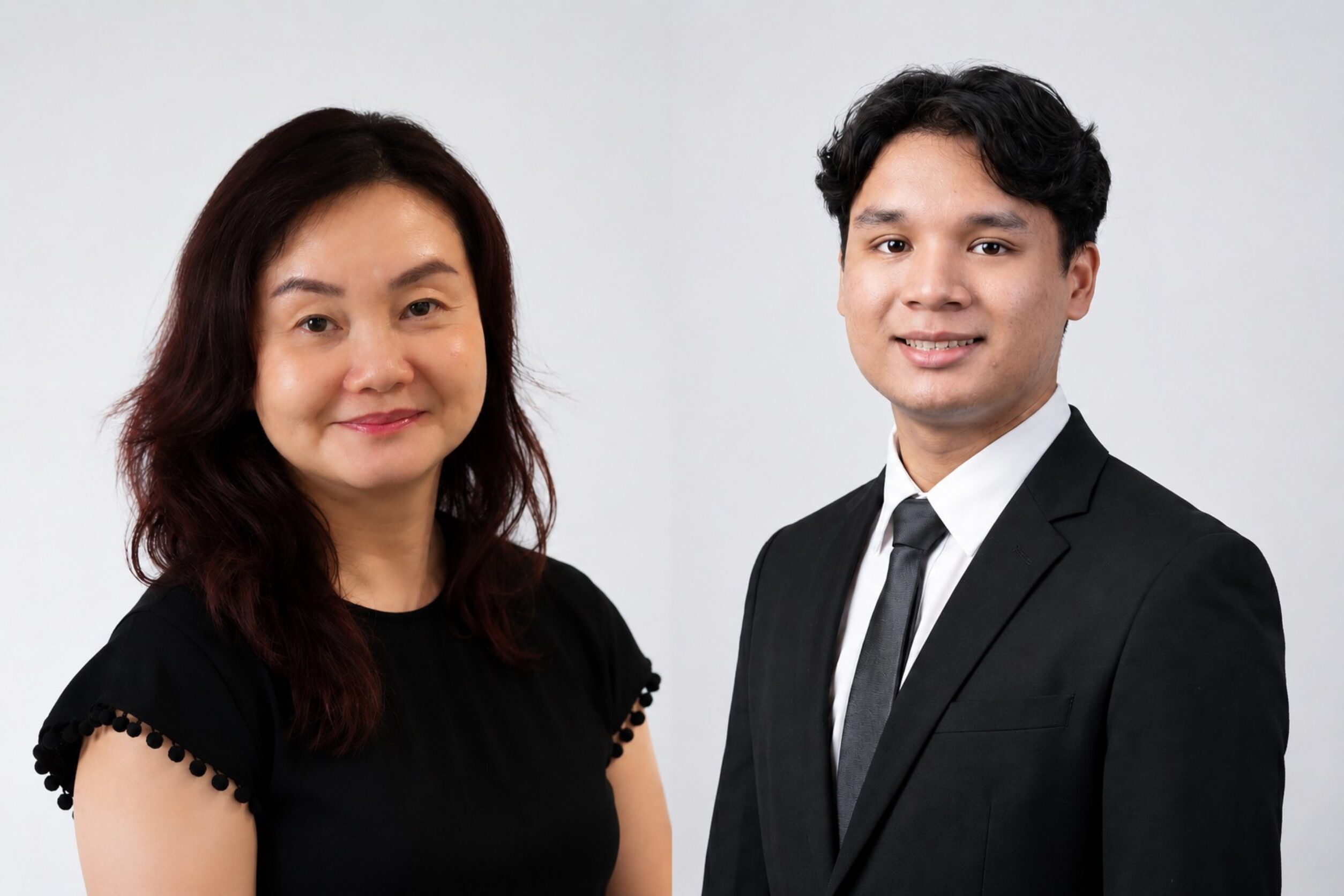
Jancy Seah, Business Support Senior Manager (left), and Amirul Ali, AI Platform Engineer, represent opposite ends of the career span at NCS – and have arrived at similar views on AI.
For most of her 27 years at NCS, Jancy Seah’s team did its most important work by reading. Every signed contract that came through had to be reviewed manually – checked against the organisation’s Sales Registration Policy, assessed for the right project structure, and assigned the correct service product type before a project could even be created. It meant working carefully through award documents, cross-referencing policies, and applying judgement to interpret contractual scope. With more than 5,00 awards reviewed annually, each taking 20 to 40 minutes, the volume was relentless, and keeping different reviewers consistent was a challenge of its own.
That work looks different now. Seah, a Business Support Senior Manager whose team’s transformation was highlighted by CEO Sam Liew in his keynote at NCS AI Impact 2026, has seen review times fall by 35 to 50% since her team embedded its review criteria and decision-making framework into an AI-assisted workflow. The hours saved have not been reinvested in more of the same; they have shifted towards complex cases, exceptions, and advisory work. “AI helps us improve speed, consistency, and productivity, but our people remain responsible for quality assurance, compliance, and the final decision,” she tells HRM Asia.
Seah had no technical training. What she has instead, she argues, is something organisations consistently undervalue when rolling out AI: an understanding of what good work looks like. “One of the biggest misconceptions is that building trust in AI is mainly about teaching people how technology works,” she says. “Trust is ultimately built when people can see how AI helps them perform their work more effectively.” What made the difference for her team was starting with a genuine business challenge – not the technology – and building a standardised workflow around it that people could watch paying off.
Her message to professionals of similar tenure who feel the moment has passed them by is direct. “It is never too late. You do not need to become a technical expert or learn how to build AI systems,” she says. Start within your own area of expertise, she advises, find the high-volume tasks that eat time, and pick one practical use case. “Years of experience are a strength. Experienced professionals understand business context, recognise what good outcomes look like, and know how to apply sound judgement to AI-generated outputs. The goal is not to compete with AI, but to learn how to work alongside it.”
The engineer automating his old job
At the other end of the career span sits Amirul Ali, who joined NCS through its Fusion Work-Study Programme and started out in traditional IT operations – infrastructure health checks, monitoring alerts, firewall and network issues, incident management when things broke. Unglamorous work, but he credits it with something his current role depends on: a first-hand understanding of how operations teams actually function.
His move into AI began with an observation about that work. Troubleshooting an incident meant moving across multiple systems, reviewing historical cases, analysing monitoring data, and leaning on the judgement of experienced engineers – a process that was highly repetitive yet heavily dependent on human knowledge. So instead of building what he calls “a simple chatbot,” Ali began developing agentic AI solutions in which different agents handle specific parts of an investigation: analysing previous incidents, identifying similar issues on the same configuration item, correlating recent changes, running infrastructure and database checks, and updating tickets with findings.
READ MORE: Where AI takes over, where humans stay – and where work simply changes
Now an AI Platform Engineer, Ali is candid that the systems he builds automate the very tasks he once performed. He does not read that as a warning. “There is an important distinction between automating a task and replacing the person responsible for the outcome,” he says. Decisions involving risk, business impact, governance, and accountability still sit with people; what AI takes on is the repetitive investigation and information-gathering that precedes them.
Much of what he builds, in fact, is an exercise in preserving expertise rather than displacing it. “AI alone is not enough,” he says. “You can have a highly capable model, but without an understanding of the underlying operational processes, it wouldn’t know which information matters, what questions to ask, or what actions are appropriate.” His workflows are shaped through conversations with veteran engineers, capturing the mental frameworks they have developed over years of practice – the hard-earned lessons, as he puts it, that are often impossible to find in documentation.
Where opposite ends meet
That experience has given him a view of the workforce that mirrors Seah’s from the opposite direction. Experienced colleagues bring domain knowledge and practical judgement; younger professionals bring comfort with experimentation and new ways to scale that expertise. “Experience helps define what good outcomes look like, while AI provides the way to scale and apply that knowledge more broadly,” he says.
As for where it takes him, Ali hopes to move beyond individual agents towards designing larger-scale AI platforms – and perhaps, one day, a product of his own. His ambition, though, is framed in terms of what they could have used: to take a real business problem, understand both the technology and the people behind it, and build something that genuinely improves how organisations work.
Two careers, nearly three decades apart, arriving at the same conclusion from opposite ends: the value of AI depends on the expertise it serves.