
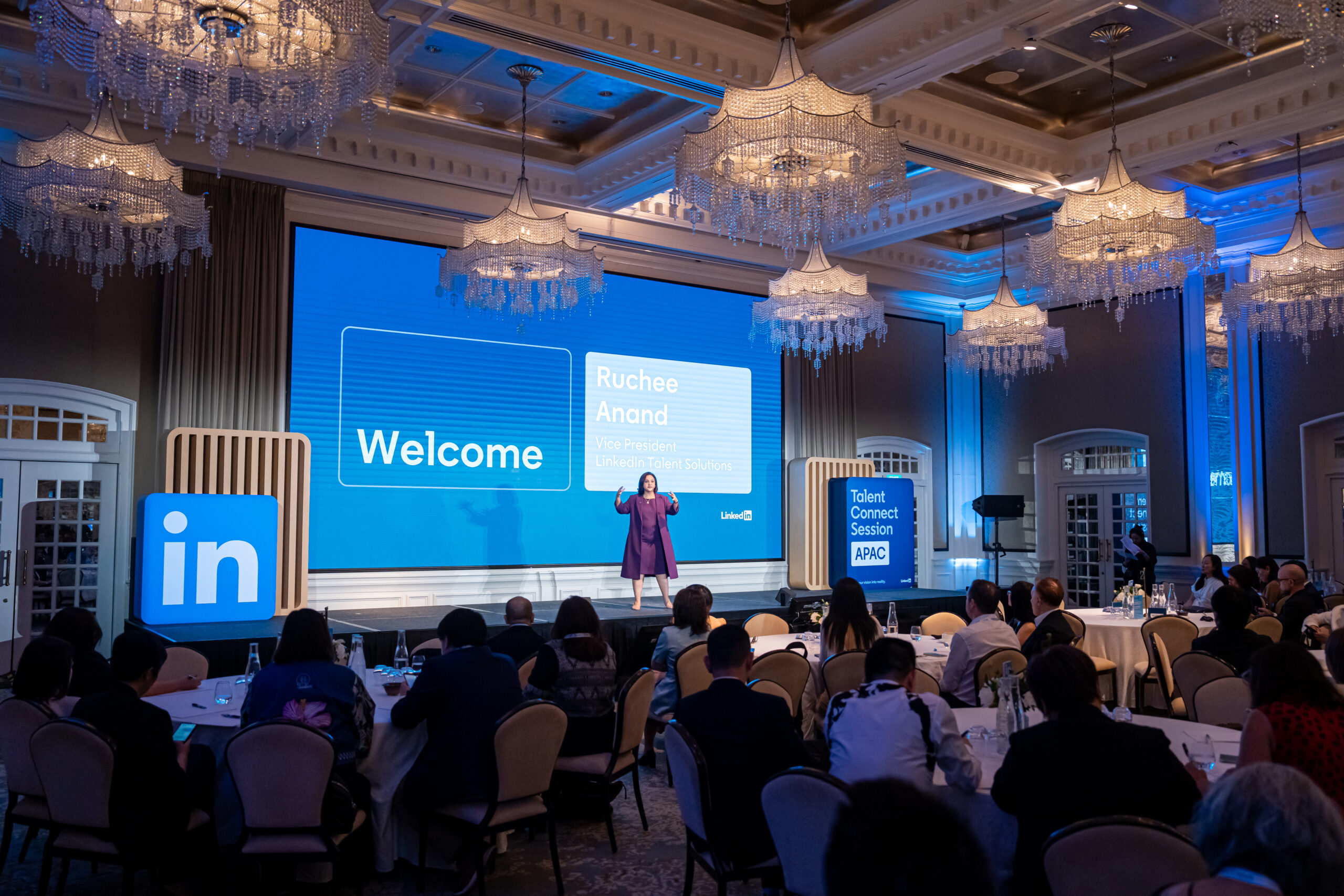
LinkedIn Talent Connect Asia-Pacific 2026 made one thing clear in its first instalment: AI is no longer a future conversation. It is a present imperative.
But beyond platform capabilities, the deeper conversation playing out across the region is more existential: What does leadership look like when the rules of experience, hiring, and even career progression are being rewritten?
In this second instalment, Ruchee Anand, Vice-President, LinkedIn Talent Solutions, Asia-Pacific, offers a view of what she calls leadership in the “messy middle”—the uncomfortable space between yesterday’s operating model and tomorrow’s emerging reality.
Kal: When yesterday and tomorrow are the same word
Anand opened her address with a simple but thought-provoking linguistic lesson. “There is this one very important word in Hindi—Kal,” she told the audience. “Kal means yesterday. Kal also means tomorrow. The exact same word.”
In Indian philosophy, time is circular rather than linear. Yesterday shapes tomorrow, and tomorrow eventually becomes yesterday. For Anand, the metaphor mirrors the current state of work and technology.
“Every wave of innovation has felt like an ending,” she said. “When computers arrived, we worried about jobs. When the internet arrived, we worried about relevance. When search engines arrived, we worried about knowledge. Today, it’s AI. Tomorrow it will be something else.”
The pattern is familiar. The context is not.
Right now, leaders are not firmly in the past nor fully in the future. “We are standing in between,” Anand said. “Between yesterday and tomorrow is where we are right now—what I like to call the messy middle.”
It is a phase where old playbooks no longer work seamlessly, and new ones are still being written. For HR leaders, that ambiguity is not a weakness. It is the test.
“That’s where real leadership shows up,” she added. “Not when answers are obvious or when the playbook is complete, but when you’re ready to act, even when the future is still forming.”
The labour market isn’t retreating—it’s rotating
While headlines often frame AI as a job-disruptor, Anand offered a more nuanced view.
Globally, hiring volumes remain nearly 20% below pre-pandemic levels, driven more by productivity pressures and macro volatility than by AI alone. At the same time, LinkedIn data shows that 1.3 million AI-related jobs have been created in just the past two years—roles that did not exist five years ago.
“We’re not seeing fewer jobs,” she explained in an interview with HRM Asia. “We’re seeing newer jobs.”
Alongside the growth in core AI roles, AI-adjacent skills—from prompting to AI literacy—are accelerating, with 70% year-on-year growth in AI learning on the platform. The implications for HR are significant. Even within the same job title, the work itself is evolving.
“About 70% of the skills required in jobs today will shift by 2030,” Anand said. “The way we research, the way we analyse, the way we use AI as a performance enabler—that’s changing the skills we need.”
In that context, the traditional proxy for competence—years of experience—is losing its primacy.
For decades, seniority equated to value. Time served was a shorthand for credibility and capability. However, that assumption no longer holds.
“It’s more about skills rather than just tenure,” Anand said. “Are you relevant? Are you constantly learning? Are you able to add value? How adaptable are you?”
AI has compressed capability gaps. A junior employee armed with the right tools can now deliver outputs once associated with far more experienced professionals. But Anand is careful not to dismiss experience entirely.
“What years of experience bring is the human element of life experience,” she noted. “That cannot be taken away.”
The shift, then, is not about discarding experience but reframing maturity. Professional maturity in an AI-enabled workplace is increasingly defined by adaptability, curiosity, and continuous learning. For HR leaders, this calls for more robust skills taxonomies, dynamic workforce planning, and reward systems that recognise capability over chronology.
The AI arms race: Deadlock or breakthrough?
As AI adoption accelerates, both sides of the hiring equation are becoming more technologically sophisticated.
Nearly 94% of jobseekers are using AI in some form during their job search—from discovering roles and optimising profiles to preparing for interviews. At the same time, recruiters are deploying AI to screen, source, and shortlist candidates.
Does this create an algorithmic stalemate? Anand does not believe so.

“On both sides, the human element trumps everything else,” she said. While AI can drive speed and efficiency, she argues that its most transformative potential lies elsewhere—in expanding access. “More than eliminating candidates, AI is helping discover hidden gems,” she explained. “It helps expand talent pools. It understands context much better—what organisation needs, what skills candidates actually have.”
This is particularly critical in markets like Singapore, where three in four recruiters report difficulty finding qualified candidates, even as many professionals indicate they are actively exploring new opportunities in 2026.
“The disconnect is clear,” Anand said. “Talent is chasing opportunity, while organisations are chasing skills. Legacy hiring methods are slowing the match.”
Used responsibly, AI can help bridge that gap by moving hiring away from linear title-based searches and towards skills-based discovery. Equally important, it can restore a human dimension often lost in high-volume recruitment cycles.
“Candidates say they don’t hear back from recruiters,” Anand acknowledged. “It’s not that recruiters don’t want to. But when AI saves time on administrative tasks, that creates more space for meaningful human interaction.”
Leadership in the age of AI literacy
If hiring is being reshaped by AI, leadership is being redefined by it.
When asked what single leadership trait will matter most in an AI-enabled workforce, Anand resists reducing the answer to one word. Yet she returns repeatedly to one theme: learnability.
“Leaders must invest in AI literacy—for themselves and their teams,” she said. “Learnability as a skill is going to be critical. And it starts with the leader.”
This is not merely about understanding tools. It is about modelling curiosity and humility.
“Can we have the humility to know what we don’t know?” she asked. “Can we stay curious? Play around with tools? Change management is tough, but when leaders embrace learning themselves, they make their organisations more ready.”
In a world where technology can increasingly provide answers, the leader’s role may indeed shift towards asking better questions. But Anand insists that human judgment remains irreplaceable.
“Good talent will only be recognised by human interaction and intuition,” she said. “Technology sharpens our pathways, but it’s there to create more time for the human aspect of getting to know people.”
And as AI becomes embedded in talent strategies, Anand argues that speed cannot be the only metric of success. Five years from now, she believes organisations should not simply be asking whether hiring has become more efficient, but whether it has become more equitable.
READ MORE: The superworker organisation: Why HR must redesign work, not just adopt AI
“We have to move from credential-based to skills-based hiring,” she said. “AI can be a great leveller.”
By focusing on demonstrated capabilities rather than pedigree, AI-driven systems have the potential to widen access to opportunity. But fairness also depends on internal investment. “How do we build our internal talent? How do we showcase upcoming skills and give people direction on how to prepare?” Anand asked.
For her, creating economic opportunity—LinkedIn’s core mission—requires not just matching talent to roles, but helping individuals understand where the market is moving and how to remain relevant. “The gap is not about lack of ambition,” she observed. “The gap is in execution and skill.”
What hasn’t changed in 20 years
Having spent more than two decades in the talent ecosystem—including almost 13 years at LinkedIn—Anand witnessed multiple waves of transformation. She recalls helping customers set up email IDs to receive digital applications at a time when CVs arrived via print advertisements and post.
From e-recruitment to cloud adoption to AI agents, the technology has evolved at breathtaking speed. Yet something fundamental remains constant.
“The requirement for good talent will never change,” she said. “And good talent is recognised through human intention and intuition.”
Organisations still build and scale on the strength of their people. The tools may evolve, but the human spirit—resilience, adaptability, ambition—remains the engine.
As for what comes after AI?
“I wish I had a crystal ball,” Anand admitted. “Tomorrow will be disruptive. How? I can’t say.”
Her advice, including to her own teenage son, is simple: prioritise learnability over fixed pathways. “Be humble enough to know what you don’t know. Be okay with discomfort. Keep learning.”
Ultimately, Anand’s message to HR leaders is neither alarmist nor complacent. It is pragmatic.
“Yesterday taught us resilience. Tomorrow demands imagination,” she said. “But leadership doesn’t live in yesterday or tomorrow. Leadership lives in what we choose to do today—right here in the messy middle.”
For CHROs and talent leaders across Asia-Pacific, that means redefining value beyond tenure, embedding AI literacy at every level, and ensuring that technological acceleration translates not only into productivity gains, but into broader economic opportunity.
The future of work is still forming. But in the messy middle, the decisions HR leaders make today will determine whether tomorrow becomes merely faster—or fundamentally fairer.