
Stop fixing systems, start unlearning: An HR leader’s guide to futureproofing talent
- Josephine Tan
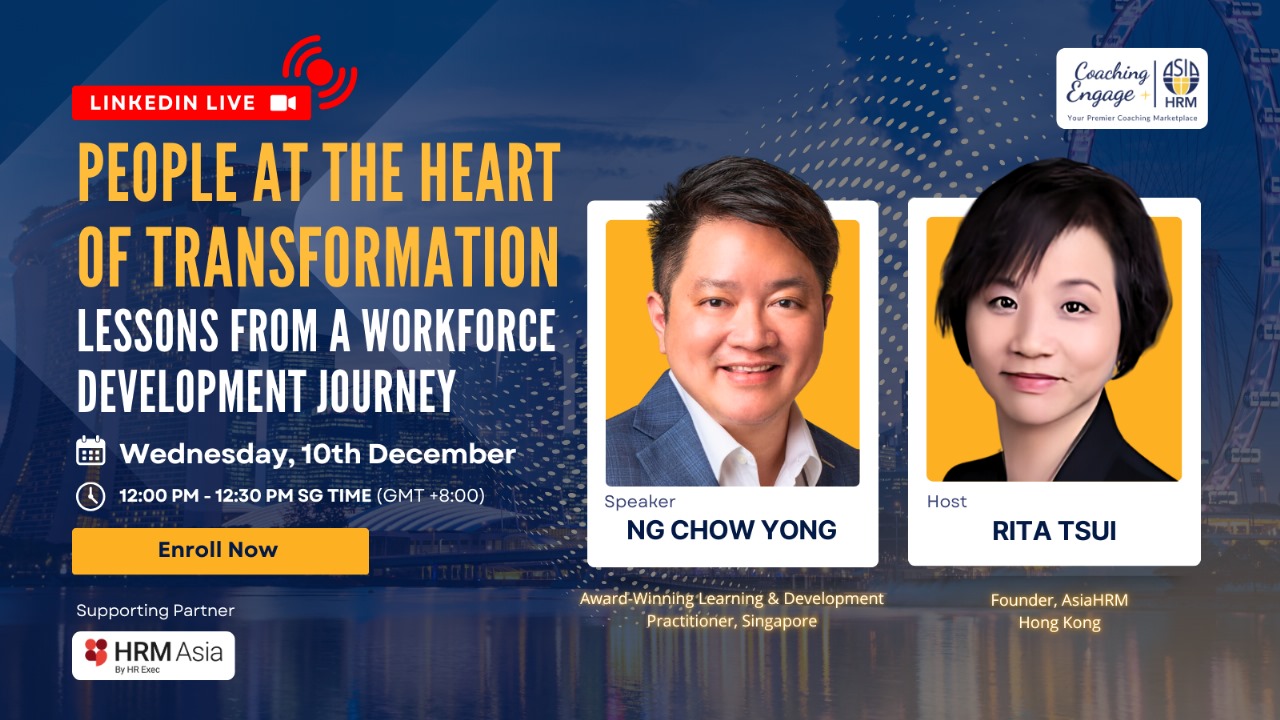
When organisations talk about transformation, most conversations quickly turn to technology, systems, or processes. But during a recent Asia HR Leaders Live Series—organised by AsiaHRM and supported by HRM Asia—learning and development (L&D) expert Ng Chow Yong reminded HR leaders of a simple truth: real transformation begins with people, not tools.
Speaking with Rita Tsui, Founder of AsiaHRM, Ng reflected on more than two decades of shaping workforce and capability development across diverse sectors. His approach distils into three pillars: Strengthening the Core, Grow People, and Build Capabilities—a framework he believes organisations and individuals alike can use to navigate change with clarity and confidence.
Pillar 1: Strengthening the Core – Start from the fundamentals
To Ng, any transformation begins with understanding “the core”—the organisation’s identity, purpose, and foundational strengths, and those of its people.
One of his most memorable examples comes from his time in the postal logistics sector. Contrary to public perception, frontline employees were not just serving customers at the counter—they were engaging in upselling, advising on seasonal products, and building long-standing relationships with members of the community. When organisational transformation required new service models, new sales approaches, and new customer experiences, these long-held habits had to evolve.
But change did not start with a new process. It began with unlearning.
“We had to help long-serving employees unlearn what had worked in the past and embrace new ways of working,” Ng shared. “Strengthening core means being honest about what needs to change for the business to remain relevant.”
The lesson? Transformation is not simply about introducing new systems or technology—it is about helping people re-anchor themselves to what matters and giving them clarity on why adapting is necessary.
Pillar 2: Growing People – Fostering ownership and motivation in a new learning landscape
Many HR leaders today share a common frustration: employees often do not prioritise learning.
Ng believes this challenge cannot be solved by pushing more content. Instead, organisations must understand how people learn today, and how different generations prefer to engage.
His anecdote about a friend who learnt car maintenance entirely through YouTube illustrates a broader shift: learners want immediacy, relevance, and autonomy.
This means modern L&D strategies must include:
- Bite-sized learning that fits the habits of digital-native employees
- Multiple modalities, from self-paced online modules to in-person sessions for hands-on learners
- Learning linked to real, practical outcomes so that employees feel immediate value
- Clear ROI so learning investments translate into performance, not participation rates
Ng emphasised that the purpose of L&D is not just skill acquisition; it is about building the capability that employees can apply right away.
“People need to feel that their time spent learning was worth it,” he said. “And organisations need to ensure that learning drives real outcomes.”
Pillar 3: Building Capabilities – Modern skills assessment for a fast-evolving world
The skills assessment landscape has shifted dramatically over the last decade. Previously limited to technical proficiency—such as coding languages—today’s assessments include power skills, or what many would recognise as soft skills.
Modern tools now offer adaptive assessments that adjust question difficulty based on employee responses, enabling a more accurate and holistic view of workforce capabil
This evolution allows HR teams to:
- Identify hidden talent
- Understand skill gaps across teams
- Make informed decisions during reorganisations
- Better design learning pathways
- Support internal mobility and succession planning
As AI accelerates and the pace of change quickens, Ng believes skills assessments will become even more critical. “Unlearning and relearning isn’t optional anymore. It’s part of how we futureproof the workforce,” he said.
Spotting emerging leaders: Values first, titles second
When asked how organisations should identify emerging leaders, Ng emphasised a consistent truth: values must come before competencies. In a multigenerational workplace where authority-based leadership models hold less influence, tomorrow’s leaders must be accessible, open, and able to create psychological safety, and capable of role-modelling organisational values. They lead through influence rather than hierarchy.
While many performance systems already capture value-based behaviours, Ng believes organisations must go further by embedding values into leadership development, succession planning, and culture-building initiatives. He illustrated this with his experience in the education sector, where he helped a young university build its identity by co-designing a culture ambassador programme. These ambassadors—employees who naturally embodied the institution’s purpose and spirit—became connectors across faculty, administrators, and professional staff. It was a reminder that leadership does not always begin in the boardroom; often, it emerges from the ground up.
READ MORE: The M.E.E.T. Framework: A strategic approach to employee loyalty
In his closing message, Ng emphasised that these three pillars are not just organisational principles—they apply equally to every individual. Strengthening your core begins with knowing what you are good at and intentionally building on it. Growing your people and yourself means staying curious, embracing uncertainty, and committing to continuous learning. Building capabilities requires unlearning outdated habits, relearning new skills, and making growth a lifelong practice.
“We must futureproof not only our organisations, but also ourselves,” he reminded the audience.
As the Asia HR Leaders Live Series continues, conversations like these reinforce a critical truth: transformation is ultimately about people. Technologies change, markets shift, and job roles evolve—but it is human adaptability, purpose, and capability that determine whether organisations thrive.
And at the heart of that journey is HR.