
The M.E.E.T. Framework: A strategic approach to employee loyalty
- Josephine Tan
In the current landscape of HR, the narrative has shifted fundamentally. While competitive remuneration remains the baseline, it is no longer the sole driver of employee loyalty. As organisations navigate a complex, post-pandemic business environment, the challenge has moved from acquisition to retention.
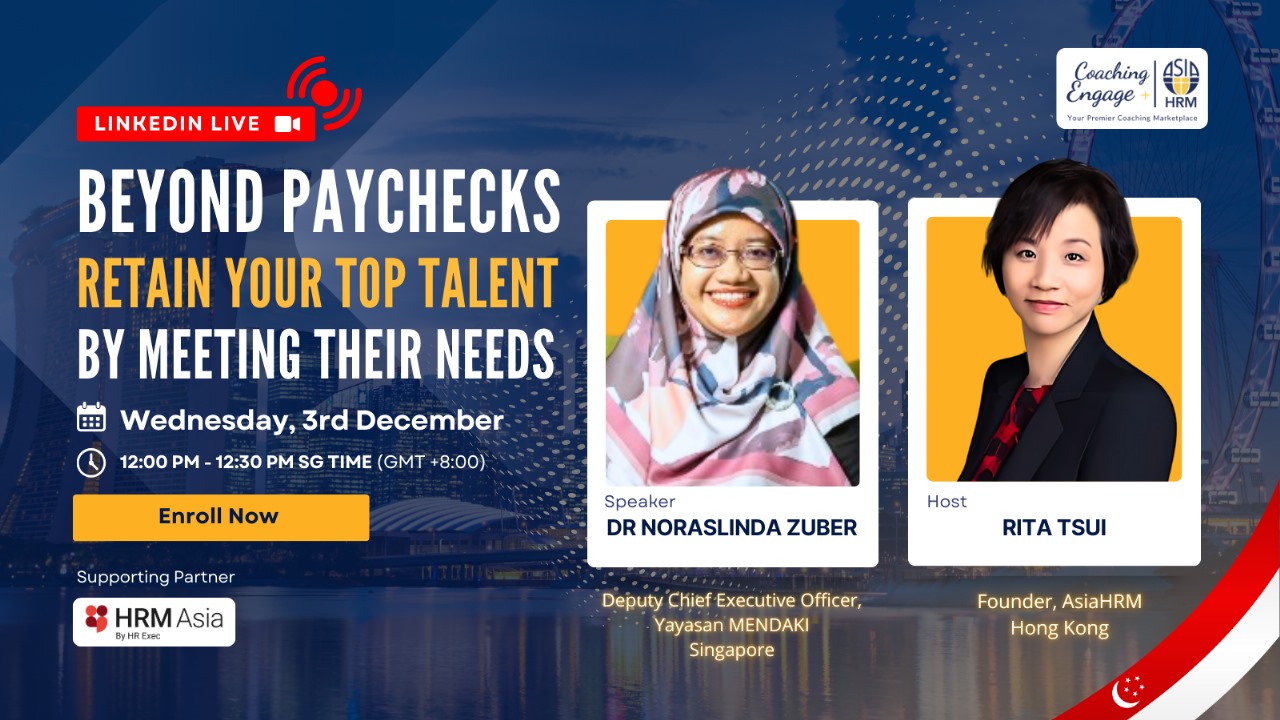
“It is actually quite easy to recruit people…you will get the best among the cohort,” said Dr Noraslinda Zuber, Deputy CEO of Yayasan MENDAKI and a veteran HR leader. “But once you recruit, the challenge is: can you keep them? Being able to keep your talent is your competitive advantage.”
In a recent session of the Asia HR Leaders Live Series, hosted by AsiaHRM Founder Rita Tsui, Dr Zuber unveiled a strategic approach to the retention puzzle: the M.E.E.T. Framework. This model shifts the focus from transactional relationships to deep, human-centred engagement.
The pulse of the employee
Before implementing solutions, leaders must diagnose the true state of their workforce. While standard tools like pulse surveys, annual engagement questionnaires, and HR data (turnover rates, absence patterns) are necessary, Dr Zuber argued they are insufficient on their own.
Data provides the “what,” but conversations provide the “why.”
“What I find most insightful is the human-centred conversation,” Dr Zuber noted. She advocates for dedicated one-on-one sessions that move beyond performance appraisals to discuss what inspires the employee and what makes them thrive. This qualitative approach, combined with quantitative data and employee segmentation (understanding the differing needs of Gen Z vs. mid-career caregivers), forms the foundation of effective retention.
The M.E.E.T. Framework
To operationalise these insights, Dr Zuber developed the M.E.E.T. Framework—an acronym designed to help organisations “meet” the evolving needs of their workforce.
M: Motivate
Motivation is often mistaken for monetary incentive. In this framework, the focus is on creating conditions that inspire commitment.
- Purpose and Meaning: Employees need to see the “red thread” connecting their daily tasks to the organisational mission. In the social sector, for example, even administrative tasks must be linked to community impact.
- Recognition: Leaders should not wait for major milestones. “A small win, a pat on the back, will really motivate,” said Dr Zuber.
- Wellbeing: Motivation collapses under burnout. Access to mental health support is now a non-negotiable aspect of the motivation pillar.
E: Engage
The first ‘E’ focuses on emotional connection and psychological safety. This pillar is heavily dependent on the quality of managers. An engaged workplace is one where employees feel safe to voice opinions without fear of judgment. It requires leaders who possess strong coaching and communication skills to foster an environment where employees feel they belong.
E: Expand
The second ‘E’ addresses the hunger for growth.
- Future-Readiness: Organisations must support upskilling, particularly in AI and digital fluency.
- The Career Lattice: Dr Zuber highlighted that growth is no longer just vertical. “It is not just about upward movement…it is also about lateral growth.” Employees, especially younger generations, value the opportunity to move sideways to learn new domains before moving up or returning to a previous role with expanded capabilities.
READ MORE: The multi-stage career: Redefining longevity, purpose, and flexibility in the modern workforce
T: Time
The final pillar is respecting the employee’s most finite resource.
- Optimisation: Leaders must set clear priorities and deadlines. Ambiguity leads to wasted time and extended hours.
- Flexibility: Respecting time means acknowledging the employee’s life outside of work. Flexible work arrangements (FWAs) allow employees to sustain high performance without sacrificing personal responsibilities.
The leadership anchor
Underpinning the entire M.E.E.T. framework is the quality of leadership. “Employees thrive when the leaders listen with full intention,” Dr Zuber emphasised.
She recounts a formative experience from her early career in the public service: seeing a senior leader at the highest echelon greet a junior clerical officer by the name at the lift lobby. That humility and genuine interest in the individual, regardless of rank, left a lasting impression.
Leadership requires the courage to have difficult conversations. When an employee’s needs exceed what the organisation can provide, the leader must be transparent. “I’m prepared to meet you halfway,” is a powerful stance. It balances organisational limitations with empathy, often retaining the employee’s respect even if every specific request cannot be granted.
A two-way street
Finally, retention is not solely the responsibility of the employer. Dr Zuber, who is also an executive coach, reminded employees that they must take ownership of their career trajectory.
“It takes two hands to clap,” she said. Employees must remain adaptable, seek opportunities aligned with their strengths, and drive their own development. When a proactive employee meets a supportive organisation using M.E.E.T. framework, the result is a resilient, high-performing partnership.
The next session of the Asia HR Leaders Live Series will turn the spotlight to workforce development—a critical foundation for building resilient, future-ready organisations. On December 10, award-winning learning and development (L&D) practitioner Ng Chow Yong will share a structured, multi-pronged approach to developing today’s workforce through three core pillars: Strengthen Core, Grow People, and Build Capabilities.
In this 30-minute LinkedIn Live session, he will unpack strategies for scaling foundational and digital skills, nurturing emerging leaders, and building capability pathways that equip teams for tomorrow’s demands. To register, click here.