
Technology is the enabler, not the solution: Reimagining training in the age of AI
- Josephine Tan
As organisations across Asia accelerate the adoption of AI, automation, and digital platforms, many are confronting a hard reality: technology alone does not close skills gaps. Despite rising investments in learning systems and tools, capability shortfalls continue to surface—particularly in operational and frontline roles where judgment, experience, and human interaction remain irreplaceable.
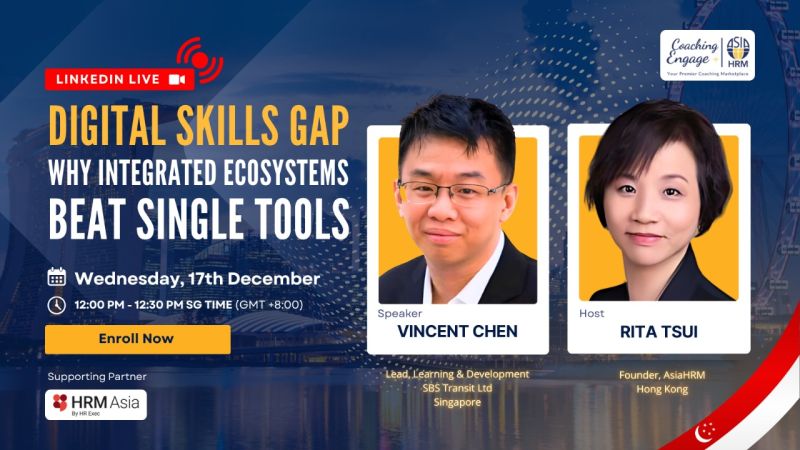
This challenge was the focus of Digital Skills Gap: Why Integrated Ecosystems Beat Single Tools, a recent session in the Asia HR Leaders Live Series, organised by AsiaHRM and supported by HRM Asia. The session featured a conversation between Rita Tsui, Founder of AsiaHRM, and Vincent Chen, Lead, Learning and Development at SBS Transit, who shared how one of Singapore’s largest public transport operators is addressing skills gaps at scale through an integrated, human-centred approach.
A workforce challenge that leaves no room for error
For SBS Transit, workforce capability is not an abstract HR concern—it is a business imperative. The organisation supports millions of passenger journeys each year and trains close to 4,000 bus captains, alongside technicians, safety officers, controllers, and trainers. Together, these employees operate in an environment where service reliability, safety, and customer trust are non-negotiable.
“Scale is always our challenge,” Chen said. “It’s not just about training more people. It’s about ensuring they are trained well, consistently, and in line with where the business is heading.”
As technologies such as autonomous vehicles, AI-enabled safety systems, and data analytics begin to reshape the transport sector, SBS Transit recognised early that isolation training programmes or standalone tools would be insufficient. Closing skills gaps would require a broader ecosystem—one that connects systems, people, and business strategy.
While digital systems play a critical role in SBS Transit’s learning strategy, Chen was clear that technology is an enabler, not the solution. The organisation uses integrated learning management systems and data analytics to identify skills gaps and blind spots, but places equal emphasis on mentorship, coaching, and peer learning.
“AI can assist us, but people are still the most valuable resource in closing skills gaps,” he noted. “A mentor or coach provides context, experience, and guidance that no system can replicate.”
This philosophy underpins SBS Transit’s approach to workforce development, where learning is designed as an ecosystem rather than a collection of disconnected interventions.
The dojo model: Embedding learning into work
At the centre of this ecosystem is SBS Transit’s internal “dojo” model for on-the-job training (OJT). Rather than removing employees from the workplace for learning, the dojo embeds skill development directly into daily operations.
The organisation works with more than 120 trained internal mentors, many of whom are seasoned bus captains and technicians with deep operational knowledge. These mentors are developed as trainers themselves, through structured programmes, sandbox training, and overseas exposure with industry partners such as vehicle manufacturers.
Learning outcomes are closely tracked and tied to business performance. SBS Transit has reported improvements in areas such as service reliability, customer experience, and its compliment-to-complaint ratio.
“This is not training for training’s sake,” Chen said. “If learning does not translate into better performance and better service for commuters, then we have missed the point.”
Beyond structured OJT, SBS Transit places strong emphasis on individual development plans (IDPs), which are reviewed quarterly. Rather than functioning as a compliance exercise, IDPs are treated as a diagnostic tool—similar to a health report—that tracks an employee’s development needs, progress, and application of learning over time.
What makes the process effective is the quality of dialogue between managers and employees. Chen highlighted the impact of simple, non-threatening questions, such as “Where are you at now?”
“These are coaching conversations,” he explained. “When someone says they are at 70%, the real value comes from understanding what the remaining 30% looks like and how we can support that journey.”
READ MORE: Stop fixing systems, start unlearning: An HR leader’s guide to futureproofing talent
Mentoring relationships, peer learning, and regular one-to-one check-ins further reinforce this culture. According to Chen, these human-centred practices have also contributed to stronger engagement and retention, particularly among long-tenured employees.
To ensure learning initiatives deliver tangible value, SBS Transit applies established evaluation frameworks such as the Kirkpatrick Model, assessing reaction, learning, behaviour change, and results. Assessments methods include scenario-based evaluations, video reviews of on-road performance, and analysis of real-time operational data.
Importantly, validation does not sit with HR alone. Operational managers, technical experts, and external partners—including institutes of higher learning—play a role in signing off competencies and outcomes.
“HR is a facilitator and advisor,” Chen said. “True ownership of skills development must sit with the business.”
And as digitalisation reshapes work, SBS Transit is also identifying new and evolving roles. Chen pointed to the emergence of diagnostic experts—roles that combine technical expertise with data analytics, reporting, and storytelling skills.
Helping employees understand the relevance of these new competencies is a critical part of the transition. “Change can be unsettling,” he acknowledged. “You need to explain why roles are evolving and reassure people that the organisation is on this journey with them.”
A human-centred path forward
The key takeaway from the session was clear: closing the digital skills gap requires more than adopting the latest tools. It demands an integrated ecosystem that aligns learning with business strategy, empowers employees through mentoring and coaching, and measures outcomes that matter.
As Tsui observed during the discussion, the success of SBS Transit’s approach lies in its strong human touch—leaders who ask thoughtful questions, mentors who guide with empathy, and systems that support rather than replace people.