
The multi-stage career: Redefining longevity, purpose, and flexibility in the modern workforce
- Josephine Tan
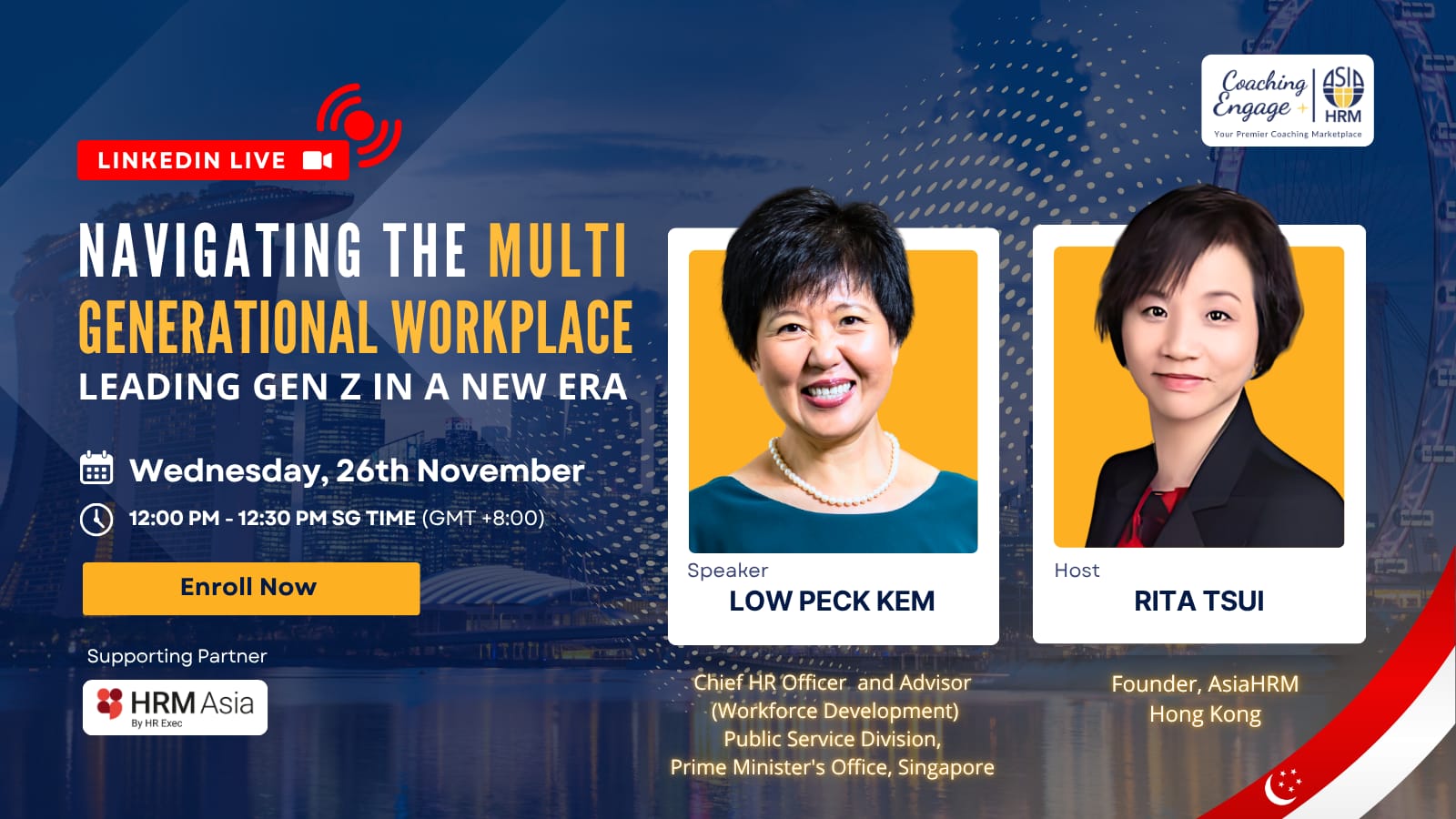
In a world where career spans are lengthening, employee expectations are shifting, and workplaces are becoming more multigenerational than ever, HR leaders across Asia are facing profound questions about how to prepare for the future of work. These questions shaped the latest session of AsiaHRM’s webinar series on top HR challenges, where Founder Rita Tsui hosted Low Peck Kem, Chief HR Officer and Advisor (Workforce Development) at Singapore’s Public Division, and President of both SHRI and the World Federation of People Management Associations.
Over a candid and wide-ranging conversation, Low explored the realities of leading Gen Z, the need to rethink traditional career models, and the role of trust in designing flexibility that works. Her reflections were not abstract theories but lived experiences—shaped by decades in HR, a career across global technology organisations, and her own identity as a leader, mother of Gen Z children, and advocate for wellbeing across the life course.
The discussion opened with a fundamental question: How should leaders approach career planning in an era where people may live—and work—far longer than past generations? According to Low, the three-stage life model that once defined work-life trajectories is rapidly becoming obsolete. For decades, employees spent their first 20 years in education, followed by roughly 40 years of employment, and ended with 20 years of retirement. But with improved healthcare and longer lifespans, many of today’s employees can expect to live past 100. The idea of retiring at 60 and living another 40 years without work is neither economically viable nor personally fulfilling.
Low argued that instead of seeing life as a linear sprint, individuals and organisations must embrace a “multi-stage” mindset. Careers will span 50 years or more, and the healthiest path through that journey is not an unbroken marathon but a series of mini-marathons. The implication is clear: people need planned pauses. Whether to rest, or pursue personal passions such as community work, these breaks are critical investments, not indulgences.
Drawing on her own experience, Low shared how she took a four-month career break in her late 40s, calling it one of her best decisions. Pausing between roles created space to reflect, rejuvenate, and enter the next chapter with clarity. She challenged attendees to be intentional about weaving these periods of renewal into long careers rather than waiting until retirement—when physical health, family availability, or personal interests may no longer align. “If you want to climb mountains, do it when you still can,” she said, underscoring the need to balance financial preparedness with mental, physical, and social wellbeing.
The conversation soon shifted to Gen Z, the workforce that often dominates HR debates. Low resisted caricatures, noting that many traits attributed to Gen Z—such as prioritising purpose, autonomy, and work-life balance—are increasingly shared by employees of all ages. Still, she acknowledged that younger employees are growing up in an age of instant gratification, where technology accelerates expectations and patience is scarce. The result is a generation that expects faster progression and more frequent career moves, often viewing two to three years as the norm before switching roles.
Low cautioned that this mindset, if unchecked, can turn a multi-decade career into an exhausting sprint. Moving every few years in search of promotions and salary jumps may provide short-term wins but leaves little time to build for long-term success. More importantly, it deprives individuals of the opportunity to “smell the roses,” she noted—a reminder that the journey matters as much as the destination.
The misconception that Gen Z is uniquely difficult to engage, she added, stems from focusing too heavily on surface behaviours rather than underlying motivations. When stripped down, the fundamentals are unchanged: employees of every generation want meaningful work, growth opportunities, and environments where they feel valued. Low encouraged leaders to guide younger talent towards roles where purpose aligns with organisational impact. Reflecting on her experience in the tech sector, she recalled how motivating it was to see the products she helped develop used in everyday life—from LED traffic lights that increased energy efficiency to measurement tools that enabled innovation.
Such alignment between personal purpose and organisational mission is far harder to achieve in industries whose outputs clash with individual values. Low noted, half-jokingly, that she would struggle to find meaning as an HR leader in industries like tobacco, because the products themselves contradict her personal beliefs about wellbeing. Leaders, she emphasised, must help employees think beyond the allure of a new job title or incremental salary increase, and towards a deeper question: What do you want your work to contribute to the world?
READ MORE: Microsoft’s HR playbook: Building capability, confidence and culture in an AI-driven workplace
As the discussion progressed, Tsui raised the topic of flexibility, closely associated with Gen Z. Low was quick to point out that flexible work arrangements (FWAs) appeal to far more than just younger employees. For many, especially women, the ability to work remotely is a game-changer—not only for reducing commute times but for enabling better management of personal responsibilities. Yet the true value of flexibility, she argued, goes far deeper. It signals trust.
For Low, this psychological contract is the most powerful currency an organisation can offer. When employers trust employees to manage their own schedules, employees tend to repay that trust through commitment and performance. Low even admitted she often works harder from home, finding herself more focused and less distracted than in the office. The issue, therefore, is not whether flexibility decreases productivity, but whether managers have developed the capacity to lead through empowerment rather than control.
This transition, she acknowledged, is often more difficult for managers than for employees. It requires a mindset shift, supported by clear guidelines and expectations, to create a framework that balances autonomy and team cohesion. Some roles—such as frontline or enforcement jobs—naturally require physical presence, and employees understand these constraints. The key is transparency, consistency, and trust, underpinned by intentional design rather than ad-hoc decisions.
As the session drew to a close, Low returned to a theme that anchored the entire conversation: sustainability—not environmental, but human sustainability. In a world reshaped by technological change, longevity, and evolving employee expectations, she urged HR leaders to champion a more holistic view of career and talent development. The future belongs not to those who sprint the fastest, but to those who pace themselves wisely, understand their purpose, and continually invest in their wellbeing, relationships, and growth.
The conversation with Low Peck Kem sets the stage for the next instalment of the Asia HR Leaders Live Series, happening on 3 December 2025, featuring Dr Noraslinda Zuber, Deputy Chief Executive Officer of Yayasan MENDAKI. As organisations continue to grapple with shifting workforce expectations, Dr Zuber will shift the focus from generational dynamics to the deeper question of what truly motivates employees beyond compensation. In a competitive talent market where salary alone no longer guarantees loyalty, leaders must learn to uncover and respond to the diverse needs that shape why people stay—or leave.
In this upcoming 30-minute LinkedIn Live session titled Beyond Paycheck: Retain Your Top Talent By Meeting Their Needs, Dr Zuber will introduce the M.E.E.T. Framework, an actionable model designed to help HR leaders strengthen retention by understanding and meeting employee needs holistically. Participants can expect insights on identifying evolving expectations, designing meaningful employee experiences, and building environments that foster long-term commitment and high performance. It is an essential session for leaders seeking sustainable ways to reduce turnover and secure their teams’ future success.