
Day 1 of HR Tech Asia 2026: Workforce transformation takes centre stage in Singapore
- Josephine Tan
Thousands of HR professionals, business leaders, and technology innovators descended on Singapore yesterday for the opening of HR Tech Asia 2026, organised by HRM Asia and held at the Suntec Singapore Convention and Exhibition Centre. Under the theme Inspiring You to Inspire Success, the two-day conference and expo brought together senior leaders from across Asia-Pacific and beyond to grapple with the most pressing question facing the profession: how to lead people and organisations through an era of accelerating AI-driven change.
Singapore signals its commitment to workforce transformation
The conference opened with an Opening Remarks by Guest of Honour Shawn Huang, Senior Parliamentary Secretary, Minister of Manpower and Ministry of Finance, who set a clear tone for the gathering: Singapore sees the AI revolution not as a threat, but as an opportunity to unlock human potential.
“The future of work isn’t coming – it’s here,” Huang told the audience. “Where others see disruption, Singapore recognises opportunity.”
He outlined three pillars guiding Singapore’s approach: synergising human capital with technology, strengthening HR capabilities, and safeguarding progress through ethical AI. On the first point, he pointed to Certis’ AeroRL system at Changi Airport as an example of technology and people working in tandem. The AI-powered rostering system – which handles the complexity of Changi’s decentralised gate clearance – has freed operations planners from hours of manual scheduling, allowing them to focus on coaching staff and driving improvements instead.
Huang also called on HR professionals to become “bilingual” – fluent in both data analytics and culture-building – as the function evolves from a support role to a strategic force. He announced that Singapore is finalising recommendations to uplift the HR profession through AI-driven transformation, including a refreshed HR Jobs Transformation Map to guide how AI reshapes roles and responsibilities.
On ethical AI, Huang was direct: “Ethical AI extends beyond compliance – it’s about culture.” He called on organisations to ensure AI-driven decisions are explainable, that employees have mechanisms to challenge systems affecting their careers, and that algorithms reflect organisational values rather than efficiency targets alone.
He closed with an acknowledgement of the HR community’s central role in national competitiveness. “Every career you develop strengthens Singapore’s competitiveness. Every culture you build powers our economy,” he said.
Jason Averbook: Stop automating dysfunction
The Opening Keynote was delivered by Jason Averbook, Co-Founder of Now to Next, who brought high energy and a provocative message: the AI revolution will not save organisations that layer new technology on top of broken processes.
“Don’t take AI and put it on top of junk,” Averbook said. “It creates what I call work slop – bad data, bad processes, bad creativity.”
Averbook challenged HR professionals to reckon with a core truth: from mainframe to cloud, the function has essentially continued doing the same things in new wrappers. The AI revolution, he argued, demands something different – a genuine reimagining of work itself.
He introduced a framework for thinking about jobs as composed of three types of tasks: hands work (execution), heads work (strategy and thinking), and hearts work (amplifying people and building connections). Most studies suggest HR spends roughly 70% of its time on hands-on work – precisely the category most susceptible to automation. Rather than cause for alarm, Averbook framed this as liberation. “When 70% of your job goes away, it gives you more time to focus on the human side.”
He also pushed back on the fixation on AI adoption metrics. “Adoption can’t be the goal. Embodiment has to be the goal.” He described a world already arriving in which employees interact with HR systems through conversational interfaces – citing McDonald’s use of WhatsApp as a front-end for Workday – and urged attendees to think beyond tools toward a full cultural shift in how work is designed and experienced.
CHRO panel: Architects of adaptation
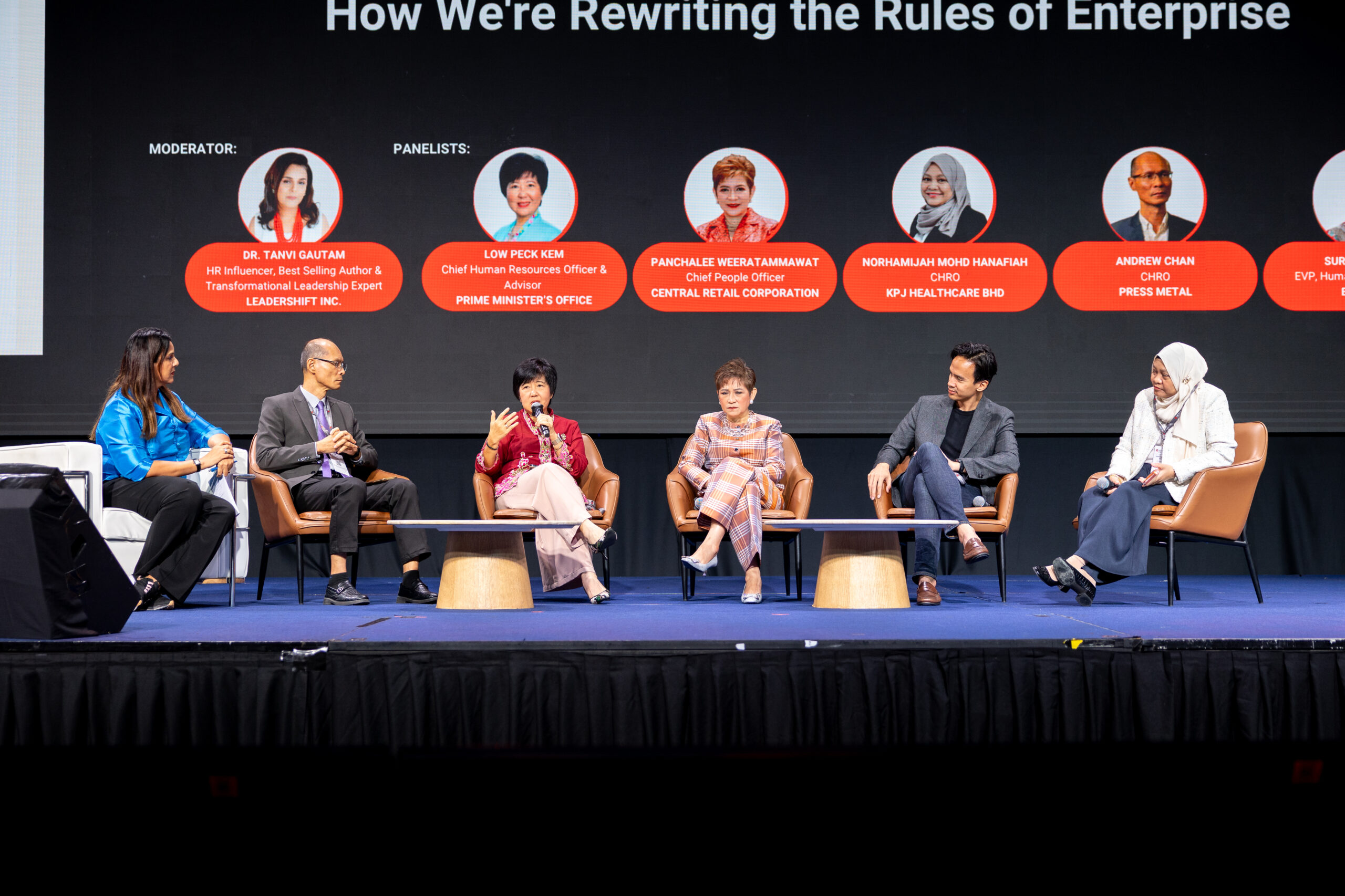
The morning featured one of the conference’s most anticipated sessions – a CHRO panel moderated by Dr Tanvi Gautam, HR Influencer and Transformational Leadership Expert, Leadershift Inc, bringing together senior HR leaders from across Asia.
Panellists included Low Peck Kem, CHRO and Advisor (Workforce Development), Public Service Division, Prime Minister’s Office; Panchalee Weeratammawat, Chief People Officer of Central Retail Corporation; Norhamijah Mohd Hanafiah, CHRO of KPJ Healthcare; Andrew Chan, CHRO for Press Metal; and Suryo Sasono, Executive Vice-President of Human Capital Strategy and Talent Management, Bank BRI.
The conversation ranged across talent mobility, succession planning, and the question of where to draw the line between AI-driven decisions and human accountability. Sasono offered a telling example from Bank BRI, where the bank chose not to fully automate credit decisions despite having the data to do so. “When you start outsourcing decision-making purely to AI, it becomes no one’s responsibility,” he said. “There needs to be one person accountable.”
On succession planning, Chan described a multi-year journey at Press Metal to move from familiarity- and tenure-based promotions to a transparent, data-driven talent dashboard – work that earned the organisation a United Nations Global Compact Award. Low stressed that talent flow requires deliberate architecture, noting that in Singapore’s public service, HR directors are expected to rotate sectors every five years. “If you yourself don’t want to move, it’s very difficult to convince your business to allow their people to move,” she said.
A rapid-fire round on which leadership quality is hardest to cultivate – curiosity, empathy, or systems thinking – produced a split verdict. Weeratammawat argued empathy is the most neglected: “Most people focus on delivering commercial targets rather than understanding that human is human.” Sasono chose curiosity, describing how Bank BRI, as one of Indonesia’s largest and most profitable banks, faces the particular danger of complacency – a mindset, he noted, that has historically felled giants like Kodak and Nokia.
Dr Gautam closed the panel with a note of her own: “A right person with the wrong technology could work. But the wrong person, even with the right technology, is not going to work.”
Workforce Singapore: Equipping the workforce for what’s next
Rebecca Chua, Senior Manager at Workforce Singapore (WSG), presented a practical overview of the government’s workforce transformation programmes, including the 19 Jobs Transformation Maps developed to guide organisations through role redesign, and the newly launched Career Health SG Initiative – a joint effort between the Ministry of Manpower (MOM), WSG, and SkillsFuture Singapore.
The initiative centres on a skills-first approach to hiring and career development, with tools including a free Career Conversations Guidebook to help managers have meaningful developmental conversations with employees. Chua also outlined the Enterprise Workforce Transformation Package, which offers organisations up to S$150,000 in funding support for workforce consultancy, capability building, and the adoption of AI-infused HR technology.
HR Tech Asia 2026 continues today at Suntec Singapore. The full programme, including the Conference Tracks and Power Talk Stage, runs through 6 May. For more information, visit https://www.hrtechfestivalasia.com.